


By Matt Meduri
Thirty-six states and three territories will hold gubernatorial contests in 2026 – along with the District of Columbia’s mayoral race.
Of those thirty-six states, fifteen feature term-limited incumbents. The states are evenly split – eighteen are governed by Republicans, eighteen by Democrats. The GOP is defending two states that voted for Kamala Harris (D-CA) in 2024, Vermont and New Hampshire. On the other hand, Democrats are defending five governorships in states won by Donald Trump (R-FL) – Arizona, Kansas, Michigan, Pennsylvania, and Wisconsin.
The key to looking at gubernatorial races is that no state is truly “off the table” for either party. While environment, state political leanings, and history all make for elements typical of any statewide campaign, gubernatorial races are the last frontier of split-ticket voting and results that are opposite from its typical partisan preferences.
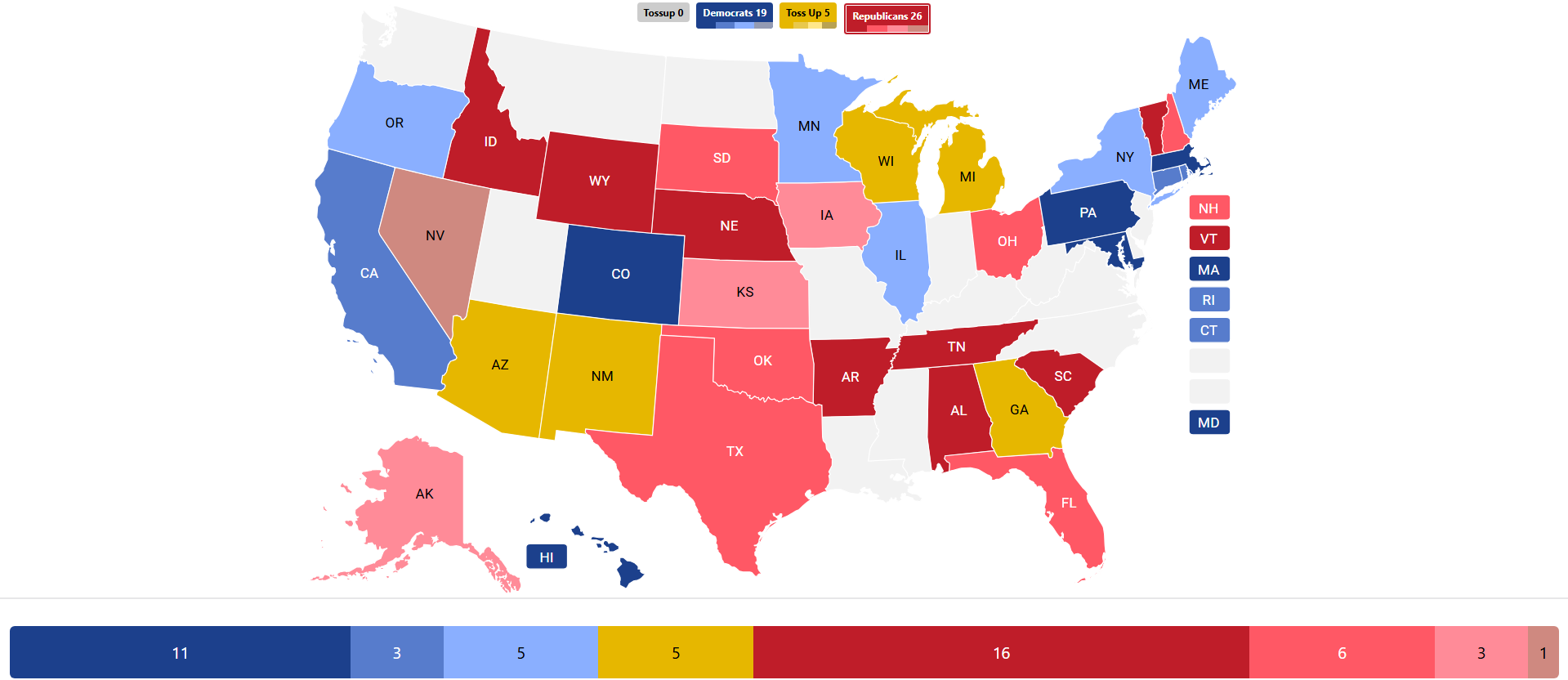
The Messenger identifies five states as Toss Ups, with another eighteen rated at varying levels of competition. Only the staunchest conservative or liberal states we rate as Safe for either party, as well as a few states featuring key incumbents who appear poised to cruise to victory as of press time.
For this forecast, we’re looking at the seats we think are the likeliest to flip this year.
Arizona – Toss Up
Katie Hobbs (D-AZ) won a razor-thin race to flip this open seat blue in 2022, defeating firebrand conservative Kari Lake (R-AZ) by just 17,000 votes out of almost 2.5 million ballots cast. Maricopa County (Phoenix), once a traditionally Republican anchor of a traditionally Republican state, has made Arizona race to the center of the competitive table at every level.
Hobbs became the first Democrat to be elected governor of Arizona since 2006, and while the Copper State remains healthily competitive, the key here will be to see how the state parties get along.
In 2022, Republicans blew winnable races in Arizona due to a fractured base after Trump’s 2020 loss. However, as of late, the state Democrats have been internally feuding. While Hobbs doesn’t appear to have serious primary opposition, rifts within the rank-and-file electorate could swing a race that went down to the wire four years ago.
Trump’s margin in Arizona, 5.5%, not only surpassed margins expected by pundits and pollsters, but was the greatest margin of his of the seven swing states in 2024.
Presidential results are not necessarily transferable to gubernatorial results, however. Hobbs has maintained net-positive approval ratings. Governors with those ratings are usually very difficult to defeat for re-election, even if they’re just treading water.
But Hobbs also has a deck of more credible Republican opponents, including Phoenix-area Congressman Andy Biggs (R, AZ-05) and David Schewikert (R, AZ-01). Their abilities to overperform in their suburban districts might give them the upper-hand in a close contest.
Georgia – Toss Up
The Peach State has an open seat this year. Governor Brian Kemp (R), hailed by many in his state as more of a moderate Republican, is term-limited. The massive growth in the Atlanta metro area is proving to be a problem for Republicans statewide, and that problem might continue into the 2030s if the trends continue.
That leaves the current state of the race an open question. Kemp was re-elected in 2022 by a close yet decisive 7.5-point margin, while Trump flipped the state by just about two points.
Three statewide Republicans are vying for the nomination: Attorney General Chris Carr, Lieutenant Governor Burt Jones, and Secretary of State Brad Raffensperger. Raffensperger made headlines in 2020 for defying Trump’s requests to look into the vote count in that year’s presidential race.
Democrats have Geoff Duncan, the former Lieutenant Governor who became a Democrat in 2025, and Mike Thurmond, former DeKalb County CEO, as their top recruits. DeKalb County is one of the most populous counties in the state, and its suburban Atlanta situation should make for a high floor for Thurmond.
Kansas – Leans R (Flip)
Since the late 1950s, Kansas has been alternating between both parties, typically in a “two on, two off” fashion, wherein voters elect two terms of one party for governor, followed by two terms of the other party. Many states operate on this basis, making for Democrats’ win in the Sunflower State in 2018 not a terrible shock.
Owing to the aforementioned “treading water” approval ratings, Governor Laura Kelly (D-KS) narrowly clinched a second term in 2022. Now, the seat is open, and Kansas, owing not only to its clockwork-like voting record, but also its intrinsic Republican lean, is the GOP’s best bet for a pickup this year. Such a flip would also secure a GOP trifecta in Topeka.
Democrats have a couple of state senators running, but if Congresswoman Sharice Davids (D, KS-03) decides to run for governor, she could give the GOP a real run for their money. However, it seems she’s posturing to run for U.S. Senate, depending on if the GOP-led state legislature gerrymanders her Kansas City-based district.
Former Governor Jeff Colyer (R-KS), who lost the GOP primary in 2018, is eying a comeback. Kansas Senate President Ty Masterson (R) is also running, as well as Secretary of State Scott Schwab.
Michigan – Toss Up
Like Kansas, Michigan has been a “two on, two off” state since the 1970s. The seat is open and Governor Gretchen Whitmer (D-MI), who flipped the seat blue in 2018, leaves office with a significant national profile that could likely culminate in a presidential run in 2028. Whitmer was spared a competitive race due to GOP infighting in 2022, but Detroit-area Congressman John James (R, MI-10) is one of the GOP’s top candidates.
Democrats have Secretary of State Jocelyn Benson (D) as the likely frontrunner, but the real curveball is former Detroit Mayor Mike Duggan, who is running as an Independent. Duggan was a Democrat until 2024 and was the mayor of the state’s largest city from 2014 to 2026. Given his prior registration and appeal in Democrats’ largest basket of votes in the Wolverine State, Duggan proves a serious liability to Democrats looking to hold this seat.
Nevada – Tilts R
Joe Lombardo (R-NV) ousted a Democratic governor in 2022, making for the only GOP flip of that cycle. The former Clark County (Las Vegas) Sheriff brings significant name recognition in Nevada’s largest city. The sharp shift of Latino voters to the GOP in the Southwest makes for a conceivably higher floor, while Democrats continue to bear responsibility of beleaguering the state’s recovery after COVID-19 – not a welcome platform for Nevada’s dependence on the service industry.
Lombardo is generating a serious primary challenge, and Democrats have Attorney General Aaron Ford and Washoe County (Reno) Commissioner Chair Alexis Hill as top candidates. Former Governor Steve Sisolak (D), whom Lombardo defeated in 2022, is eyeing a comeback.
New Mexico – Toss Up
Governor Michelle Lujan Grisham (D-NM) flipped this state blue in 2018 by a landslide. In 2022, her margin was about halved in a race more competitive than initially believed. Now, she is term-limited, and New Mexico has been a “two on, two off” state since the 1980s.
Lujan Grisham has middling approval ratings and has faced scrutiny for high crime in the Land of Enchantment’s urban areas and the security of the Southern border. Time will tell if the GOP can play in this state, as Latino voters might be souring on Trump in key battlegrounds.
Former Interior Secretary [under Joe Biden] Deb Haaland (D) appears the top Democratic candidate, while incumbent Rio Rancho Mayor Gregg Hull (R) and State Senator Steve Lanier seem to be the most equipped GOP candidates.
Wisconsin – Toss Up
Another “two on, two off” state since the 1980s, Wisconsin will probably be one of the most competitive gubernatorial races this cycle.
Governor Tony Evers (D-WI) is opting not to run for a third term. Elected in 2018, he ousted then-Governor Scott Walker (R-WI), who in 2012 famously became the first American governor to survive a recall election.
Evers was elected by close margins in both 2018 and 2022, and Wisconsin has been decided by less than a percentage point in the last three presidential elections. The GOP continues to have a stronghold on the state legislature, while liberals are the majority on the State Supreme Court. Wisconsin is also one of just three states to have a split U.S. Senate delegation – one Senator of one party, and the other Senator of another.
Wisconsin’s thirst for balance will be center-stage in this year’s race, former Lieutenant Governor Mandela Barnes (D) and incumbent Lieutenant Governor Sara Rodriguez (D) are arguably the most equipped Democrats running. The GOP has Congressman Tom Tiffany (R, WI-07) as their top recruit, although former Governor Tommy Thompson (R) is eying a comeback. Thompson served as governor from 1987 to 2001. He is the longest-served governor in state history and is the only governor to have been elected four times.