

This week, we’re discussing a landmark piece of legislation that has been the basis for landmark Supreme Court cases, the Voting Rights Act (VRA) of 1965. We find it pertinent to our column as the Supreme Court is likely to issue a ruling that could significantly impact redistricting, as the nationwide “arms race” continues.
History and Origin
At a glance, the VRA is a federal statute that prohibits racial discrimination in voting. Signed into law by President Lyndon B. Johnson (D-TX) on August 6, 1965, Congress has since passed five amendments to expand its protections.
The Constitution gives states their own powers to administer their own elections, including voter qualifications. After the end of the Civil War, three amendments – known as the Reconstruction Amendments – were added to the Constitution: the Thirteenth, Fourteenth, and Fifteenth Amendments. The amendments in question for the VRA’s purposes are the Fourteenth, which grants citizenship to anyone “born or naturalized in the United States” and guarantees all citizens due process and equal protection rights, and the Fifteenth, which prohibits the denial of suffrage based on race, color, or previous condition of servitude.
The Enforcement Acts to bolster these protections were passed in the 1870s. These acts criminalized the obstruction of voting rights, and imposed federal supervision over the electoral process. After the end of Reconstruction, however, enforcement became difficult in the Jim Crow South, leading to their eventual repeal. During that period, Southern Democrats began to impose strict electoral regulations on voting, including poll taxes, literacy tests, property-ownership requirements, and moral characters tests, among other initiatives.
For the judiciary to remedy violations, the meticulous work of reviewing thousands upon thousands of documents, test results, and ballots in an age without modern technology was already an undertaking, combined with fierce resistance from Southern local officials. Litigation was as frequent as it was severe, meaning the Justice Department was effectively playing a game of whack-a-mole in applying legal remedies.
The primary response was the Civil Rights Act of 1964, although further unrest and protest promulgated the Voting Rights Act of 1965.
Senate Majority Leader Mike Mansfield (D-MT) and Senate Minority Leader Everett Dirksen (R-IL) together crafted the bill. Despite a Democrat-controlled Senate in the supermajority, President Johnson feared extensive filibuster from Southern Democrats who had held up the approval of the Civil Rights Act. Mansfield proposed motions to get the bill out of the Senate Judiciary Committee on a deadline with a full vote so as to not have the bill die in committee at the hands of Senator James Eastland (D-MS), a vehement segregationist.
Ultimately, the VRA was passed 77-19, with two Republicans and seventeen Democrats voting against it. In the House, it passed 333-85, with twenty-three Republicans and sixty-two Democrats opposed.
Section 2
Section 2 of the VRA is what’s being considered by the Supreme Court, particularly as it pertains to congressional districts drawn to its provisions. Section 2 prohibits any jurisdiction – state or local – from imposing a “voting qualification or prerequisite to voting, or standard, practice, of procedure…in a manner which results in a denial or abridgement of the right…to vote on account of race…”
Section 2 stipulates that if the provision is intentionally violated, then it is also a violation of the Fifteenth Amendment.
Perhaps the most significant provision of Section 2 is its redistricting sections. The VRA prohibits redistricting that discriminates based on race, color, or membership of a language minority group. The VRA has been used to overturn maps that dilute a minority population’s power of electing a representative who they believe to be an accurate one of their community. This section has also been used to mandate the drawing of majority-minority districts – those where the majority of the population is constituted by a minority group.
Section 3
Section 3 gives federal courts the power to assign federal examiners to jurisdictions where voter disenfranchisement is alleged to have occurred. Moreover, it also contains the “bail-in” provision, which allows courts to bail a jurisdiction into preclearance after finding it has violated the Fourteenth or Fifteenth Amendments. Through this, Section 3 allows courts to tailor preclearance requirements to specific changes and for specified periods.
Section 4
Section 4 established the “coverage formula” to identify jurisdictions with histories of voting discrimination. A jurisdiction would be covered if it used a “test” or “device” to prevent voting and if said jurisdiction had lower voter registration and turnout compared to the 1964 presidential election.
Section 5
Section 5, pursuant to the formula in Section 4, required covered jurisdictions to get preclearance from the DOJ or a federal court before making any changes to its voting laws and/or procedures.
However, in 2013 the Supreme Court declared the coverage formula of Section 4(b) unconstitutional, as it was based on decades-old data and no longer a valid yardstick with which to gauge present-day voter disenfranchisement. This means that jurisdictions no longer have to seek federal preclearance before changing their laws.
Notable Amendments
Many amendments to the VRA were merely extensions of special provisions that were tied to the coverage formula in Section 4(b). Those provisions were extended in 1970, 1975, 1982, and 2006.
In 1970, standard residency requirements for presidential elections and extended the ban on literacy tests for access to the ballot box.
In 1975, Congress expanded the language of “tests” or “devices” to include any jurisdiction that disseminated election information in English only if said jurisdiction had a single-language minority group that made up more than 5% of its voting-age citizens. In 1982, Congress expanded procedures to allow jurisdictions out of the coverage formula if they sustained the voting rights of protected classes.
In 2006, Congress reauthorized the preclearance provisions until 2031. It was signed into law by President George W. Bush (R-TX).
The VRA Today
The VRA is making media rounds as the Supreme Court is set to hear a challenge to the redistricting provision of Section 2. The law is currently being challenged in the case Louisiana V. Callais. Plaintiffs argue that Section 2’s requirements are relied upon too heavily in creating majority-minority districts to the point that race has been a deliberate factor in drawing maps. While Section 2 stipulates that race cannot be a factor in drawing districts so as to not dilute a protected class’s voting power, it doesn’t state that a district should be made for the purpose of creating lopsided maps based solely on race. The pathological political cartography, if you will, is what’s being litigated.
Louisiana V. Callais was mounted following the 2020 Census, with plaintiffs arguing that Section 2 itself violates the Fourteenth and Fifteenth Amendments.
The results of the 2020 Census in Louisiana found that one-third of the state’s population is black, but only one black-majority congressional district had been drawn, with five Republican districts alongside it. That district is LA-02, which is 50.4% black and 33.6% white. It takes in New Orleans proper and the exurbs of Baton Rouge.
Litigation over Louisiana’s map passed in 2021 argued that a second black-majority district must be drawn to better represent the state’s demography. Plaintiffs argued that the 5R-1D map violated Section 2 of the VRA, resulting in a new map approved before the 2024 elections in which LA-06 went from a district carefully carved around the city of Baton Rouge – a solidly-red district – to one that stretches from Baton Rouge all the way to the northwestern corner of the state to take in Shreveport. The current LA-06 is 54.4% black and 36.0% white. LA-06 is solidly Democratic.
What followed was a decision in Allen V. Milligan, in which Alabama’s map – a 6R-1D map – also violated Section 2 of the VRA. Before the 2024 elections, a new map was placed to redraw the Montgomery-based AL-02 from a solidly-red district to a blue-leaning district that contains Montgomery, Mobile, and the Wiregrass Region.
After the new maps were passed, a group calling themselves “non-African-American voters” sued Louisiana, claiming that the districts were racially gerrymandered and violated the Fourteenth and Fifteenth Amendments. The federal district judges from the Western District of Louisiana ruled in a 2-1 decision that the map was racially gerrymandered and blocked its usage before the 2024 elections. The Supreme Court ordered the map remain in place.
The first oral hearing was in March, while the second hearing was held on October 15. Court observers say that the Supreme Court could be leaning to limit the use of Section 2 of the VRA for redistricting, in a manner similar to the decision that ended affirmative action in Students for Fair Admissions V. Harvard. Observers also believe that while the Court might not deem Section 2 unconstitutional, its scope could be limited.
What Would the Maps Look Like?
If the Supreme Court limited Section 2’s power in redistricting, Republicans could net up to a dozen seats in the Deep South. Particularly, Democratic seats in Louisiana, Mississippi, Alabama, Tennessee, Florida, North Carolina, South Carolina, and Georgia could be endangered. If those seats were to be undone due to such a Court ruling, the GOP would have a much larger upper-hand in retaining control of the House next year, mid-decade redistricting by both parties thus far notwithstanding.
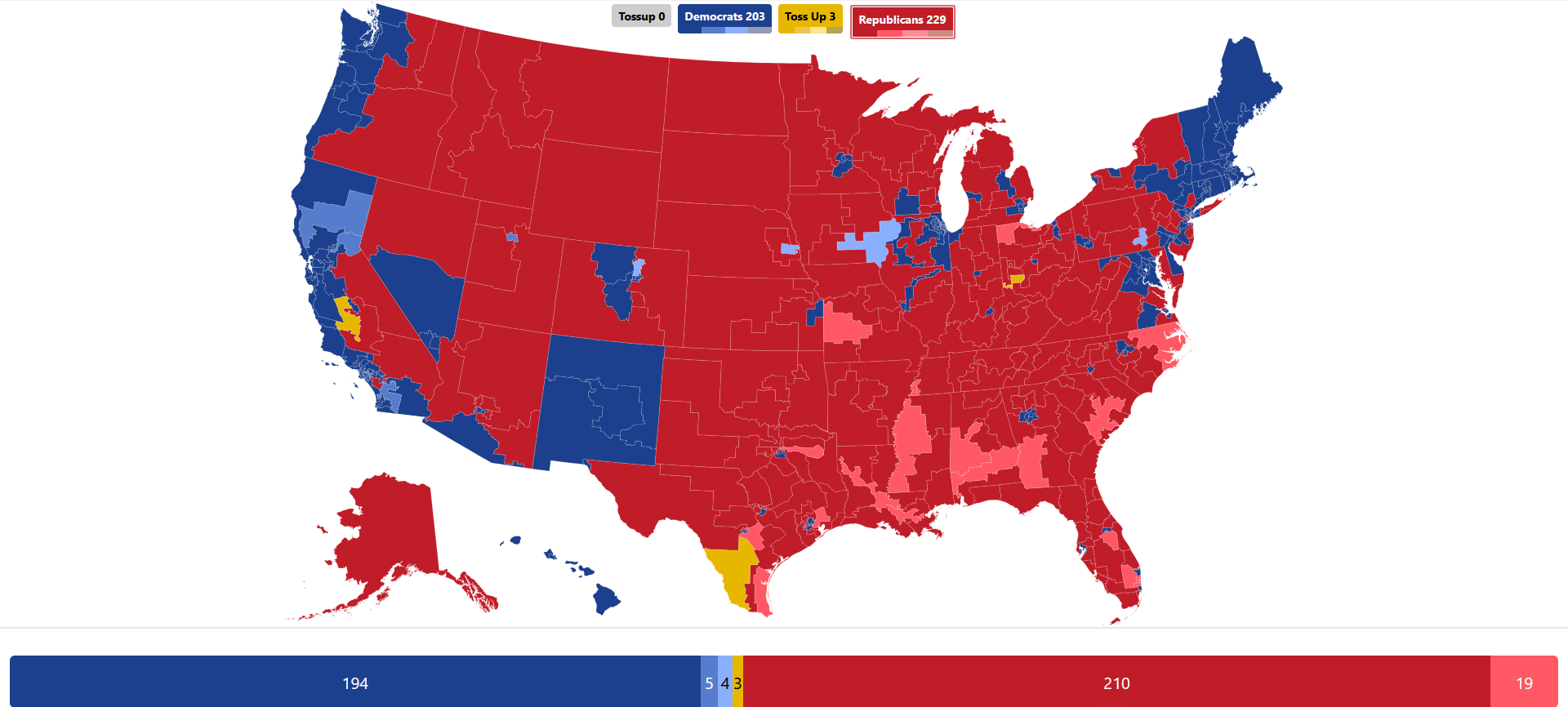
The map shows what those dozen seats could do for a GOP majority. The dark red/blue seats are holds for the respective party based on incumbency. Some of these could flip next year, but for the sake of the argument, we’ll say that the party holds these seats. The medium red/blue seats are flips for the respective party based on mid-decade redistricting, while the light-blue seats are those we think the Democratic Party is likely to pick up next year without a mid-decade redraw.
Under this circumstance, the GOP makes a net gain of ten seats for a total of 228 seats, with three Toss Ups that could go either way – a much rosier picture than their current razor-thin majority of 220 seats.