


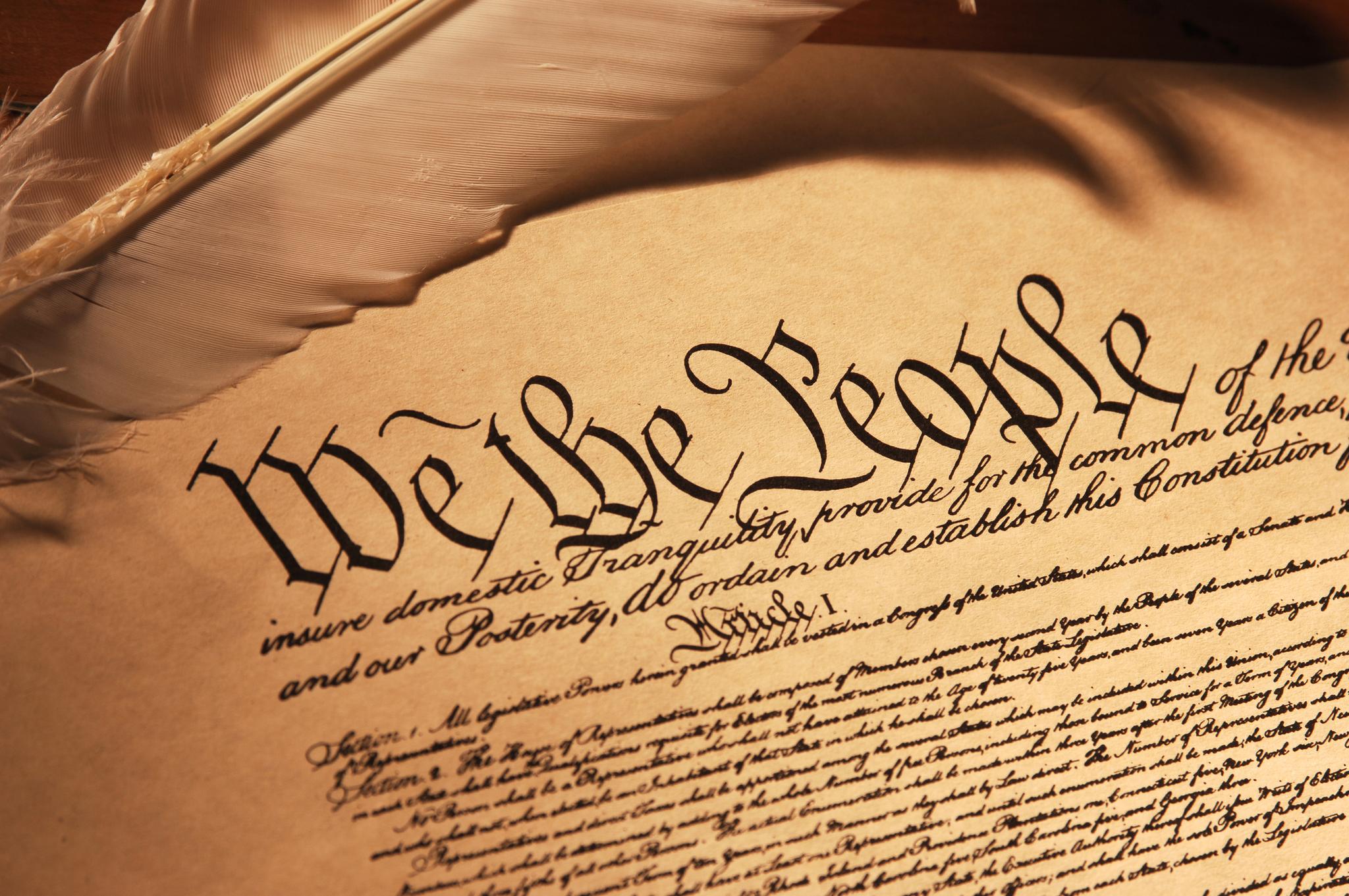
Since New York State just had a measure on the ballot to ratify the State Constitution, we figured this would be a good opportunity to discuss how a state constitution, or even the U.S. Constitution, is amended and ratified.
Amendment Vs. Ratification
The first is the distinction between these two terms, neither of which really exist without the other.
An amendment is a proposed change or set of changes to a document or law, while ratification is the process of approving said changes.
What Can an Amendment Consist Of?
Practically anything, so long as it does not interfere with previously-established rights – namely suffrage. The Constitution has only a few exceptions for what’s not on the table.
All fifty states have the same number of Senators – 2 – regardless of population. Originally intended to be the state government’s lobbying arm in Washington, the Senate delegations are meant to ensure states are represented equally in the federalist republic, a direct contrast to the U.S. House’s representation by proportion.
Therefore, no amendment can deprive a state of equal representation in the Senate, without that state’s consent.
While not a codified rule, the single-subject rule is often upheld in amendments to the U.S. Constitution; some states require them for amendments to their individual constitutions. This requires that an amendment only deal with a single issue so as to maximize clarity, purpose, and transparency.
No amendment to the U.S. Constitution has ever been deemed unconstitutional.
We’ve reviewed all twenty-seven amendments to the Constitution in this column. Amendments are and have been concerned with individual liberties, civil rights, suffrage, minimum voting age, the direct election of U.S. Senators, presidential term limits, congressional compensation rules, a federal income tax levy, to name a few.
Only one amendment exists to have nullified a previous one. The Twenty-First Amendment overturns the provisions of the Eighteenth Amendment, which instituted Prohibition.
Amendment Origins and Passage
In the federal government, a proposal for an amendment can start like any other bill, but with the purpose of amending the Constitution. These can be sponsored by members of the House, Senate, or jointly. Both chambers engage in debate over the parameters, possible effects, and overall scope of the proposition.
One notable origin is that of the Twenty-Seventh Amendment. This one was one of the first amendments submitted to the First Congress in 1789 but did not receive enough support from the states. It was forgotten until 1982, when Gregory Watson, a 19-year-old student at the University of Texas at Austin wrote a paper for a government class in which he argued that the amendment could still be ratified. He launched a national campaign for its ratification, which succeeded in 1992.
In order to pass the halls of Congress, an amendment must be approved by the House and Senate by separate two-thirds majority votes. Failure to achieve that threshold in either chamber means the end of that amendment’s progress – at least for the time being.
If an amendment should receive the necessary two-thirds support in both chambers, the amendment is then sent to the legislatures of all fifty states for the second part of the process: approval from three-fourths of the states.
State legislatures then convene for debate. When 38 states – three-quarters of 50 – vote to ratify, the amendment becomes law – all devoid of presidential approval or veto opportunity.
The alternative to the aforementioned chain of events is a constitutional convention, in which two-thirds of the state legislature (34 of 50 states) call for a convention to be held by Congress in which the states deliberate. This method has never been used before.
Amendment Difficulty: A Flaw or a Feature?
This is an area of frequent debate, as some scholars have noted that the U.S. Constitution is extraordinarily difficult to amend, which they argue is a case for “democratic backsliding.” Some argue that the two-thirds majorities required in Congress and the three-fourths majority required by the states is far too high a threshold to be met without a significant campaign or deliberation. Moreover, they argue that when an amendment might be “most necessary”, polarization and/or thinly-divided federal and/or state governments preclude the changes desired.
However, others argue that the difficulty is a solid feature.
Proponents of the current process say that a document as wide-reaching and as sacrosanct as the U.S. Constitution should be difficult to change, especially in times of polarization. As various factions might form within the country and/or states along ideological lines, the current thresholds required are a failsafe against runaway legislation pushed by the dominant party at the time. They also argue that the amendments previously passed have had significant changes to the American landscape over the last 250 years and that extreme caution should be utilized when altering such an influential document.
State Constitutions
State constitutions operate more or less the same as the federal constitution, but its power is only limited to the state in question. This is one of the classic provisions that make the United States a constitutional republic; each state has its own sovereignty of any powers not afforded to the federal government – vis-à-vis the Tenth Amendment. States are free to regulate a host of issues, such as firearm ownership, elections, abortion, income taxes, sales taxes, and term limits, to name a handful.
Some states also have provisions in place to mirror the deliberate difficulty of the federal Constitution’s amendability. Florida, for example, has a 60% threshold required in order to pass amendments as ballot measures. If less than 60% of the population votes in favor of the amendment, the initiative fails. This was seen very recently in 2024, as two separate amendments to codify abortion rights and the legalization of recreational marijuana failed with just under 60% of the vote.
However, state constitutions might deal with more regionalized issues, which, if they are to be amended, requires the entire state to be on board.
This is what was on the ballot last week in New York. Adirondack Forest Preserve lands protected by the State Constitution were being endangered by development at the Mount Van Hoevenberg Olympic Sports Complex in Lake Placid. The agreement, as stipulated by the amendment, allowed development rights to a set number of acres, while 2,500 additional acres of forest would be added to the preserve. Since the New York State Constitution has jurisdiction over those lands, it was a ballot measure in all sixty-two counties of the state.
How is the New York State Constitution Amended?
New York has an interesting method of passing amendments, something we’re seeing unfold with the state’s current redistricting fight.
In order for a constitutional amendment to pass the State Legislature, it must be approved by both the Assembly and the Senate in two consecutive legislative sessions before it can be delivered to the public. It essentially boils down to this flow chart:
- An issue arises – whether it be a sweeping statewide initiative or a more localized problem.
- Legislators in both chambers sponsor the resolution to address said issue in Legislative Session 1.
- The resolution passes in Legislative Session 1.
- Legislators in both chambers sponsor the resolution in Legislative Session 2.
- The resolution passes in Legislative Session 2.
- The resolution is then delivered to the voters in the form of a ballot measure, for them to reject or approve in a simple “yes” or “no” vote. Only a majority vote is required by the voters. If achieved, the resolution amends the State Constitution.
Another method in New York is the constitutional convention, in which voters, during a general election, can decide whether or not hold a convention to consider constitutional amendments. The State Constitution currently requires that the question of holding a convention be put to a statewide vote every twenty years. If a majority of voters approve it, delegates are elected in the next general election, after which they convene to propose, deliberate, and vote on amendments to the state constitution.
Voters elect three delegates from each of New York’s sixty-three Senate districts and fifteen at-large delegates from across the state – a grand total of 204 delegates.
If called, a constitutional convention is slated to begin on the first Tuesday of April in the year following the delegate election.
The last constitutional convention in New York was held in 1967. The proposed changes were given to voters in the 1967 general election, but were rejected. The convention ran from April 4 to September 26. New York voters have rejected the last three opportunities for a convention in 1977, 1997, and 2017. The next opportunity will be in 2037. The last time a constitutional convention resulted in approved amendments by the voters was in 1938. Changes approved in 1938 included a State-enacted Social Security program, NYC being excluded from its debt limits to finance a public transport system, and permission for the State Legislature to fund transportation to parochial schools.