

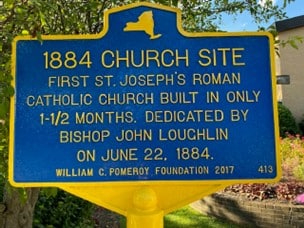
On November 26, 2017, the landmark of the site of the first St. Joseph’s Roman Catholic Church built in 1884 was proclaimed. Research and primary source documents were obtained with the generous assistance of the staff and congregation of the Parish. However, the original church was no longer there.
Lake Ronkonkoma had a Protestant and Episcopalian population for most of the early years. As the area progressed, a large majority of the employees at the pavilions and nearby businesses were here from New York City, and a Roman Catholic Church was needed. The worshippers were burdened by travel to Hauppauge or Smithtown by horse and buggy or would walk to attend worship on Sundays. The same obstacles were present for them to attend Mass on holy days, and all wondered what could be done to alleviate the trips.
Daniel Joseph O’Conor (1845-1918) was the owner of what today is known as Raynor Park/Raynor Beach. His family vacationed here for over thirty years. His property was also the site of the first fire department, keeping the equipment and horse in a designated barn on the property.
O’Conor was Roman Catholic, and he took a strong interest in bringing a church to Lake Ronkonkoma for his friends and hired help. He was the one to lead the community in their quest to build a Roman Catholic Church nearby.
In 1883, he purchased the land where the original church was built, on Church Street. On March 3, 1884, Mr. D. J. O’Connor and a few other influential citizens of Lake Ronkonkoma started a subscription paper for the purpose of securing funds; and they were so successful in obtaining money, that on May 3, work was begun upon the church. The plans and specifications were donated by Joseph M. Dunn, Architect of Broadway. Josiah Woodhull, of Sayville, was the builder, and his workmanship plainly shows that he was an artistic and skillful mechanic. The painting was done by Nugent & Cowles, of Patchogue, whose work gave general satisfaction. The church, including the furniture, cost about $3,500 and was all paid for in full.
Among those who contributed liberally toward the church were C. N. Browne, D. J. O’Connor, V. Zolnowski, Herbert Seymour, J. S. Cattanach, all of Ronkonkoma, Hon. John Kelly, J. A. Laughlin, John D. Crimmins, Oliver Brown, Senator J. J. Trainer, R. V. Hartnett, all of New York City; Frank Otis, of Bellport; Madam Keller, Madam Lake, of Philadelphia; Eugene Kelly, Judge Gildersleeve, Trayors Brothers, of New York City; Alderman Kirk, Mrs. Maitland, Kate Doherty, N. Frapfwell, Annie Kealy, Father Pendergrast, Rev. Theodore Thiry, J. Rubie Wood, M. D., Mrs. William Lake, and Madam O’Connor.
The altar was donated by J. Rubie Wood, M.D., of New York City; the statue of St. Joseph, Rev. Theodore Thiry, of New York City; Mrs. William Lake set of vestments and altar linen; Mme. O’Connor, chalice ciborium; pictures and other donations, by Rev. Theo Thiry.
On May 10, 1884, Mr. Josiah Woodhull, skilled builder of Sayville, who had been contracted and was now at work on the erection of a Roman Catholic Church in this place. The edifice was a gift from the leading members of that faith in this vicinity. Not just one week later, May 17, 1884, the lumber had arrived for the new R. C. Church. In only one week’s time, May 24, 1884, the new Roman Catholic church at the lake was rapidly nearing completion and would be ready for occupation by June 20. In just 44 days, the long-anticipated Church was in its final steps of completion.
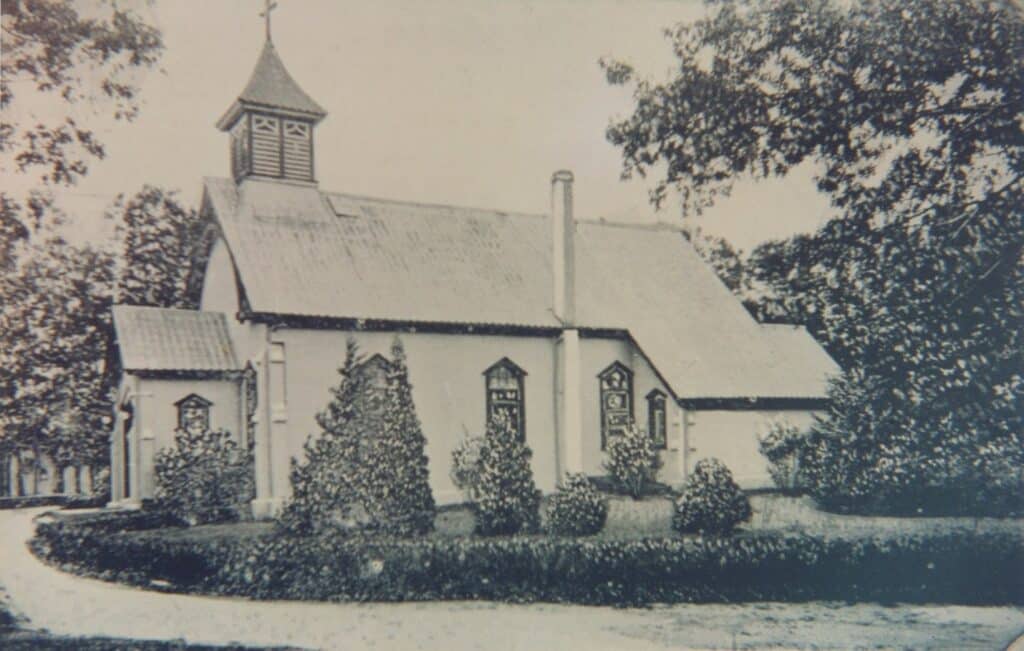
The church was a neat little structure, with a seating capacity of about 300 people. The new church was small but had a picturesque frame structure, chiefly notable for the excellent character of the interior arrangement and decoration. It was finished throughout in hardwood, and the altar was a marvel of the wood carver’s art. It was located upon a level spot of ground, situated to the south of Lake Ronkonkoma, within a seven-minute walk to the lake. It was only about four months until the first step was taken toward erecting this edifice.
On Sunday June 22, 1884, the dedication of the new St. Joseph’s Roman Catholic Church took place with bright sunshine and a perfect day that brought pleasure to the congregation. Many still refer to it as one of the greatest days in Ronkonkoma. Notwithstanding the intense heat of “Old Sol” and the unusually dry and dusty roads, people began to arrive from Port Jefferson, Stony Brook, St. James, Smithtown, and Patchogue, until the new edifice was filled to its utmost capacity long after the opening exercises were begun; and when the services commenced, at 11:00 a.m., a large number of people were unable to gain admittance. While the dedicatory services were in progress, it was so crowded, that many were only able to hear the Mass as they stood outside.
The Right Rev. John Longhlin, Bishop of Brooklyn, had journeyed out on an early Long Island train to dedicate the edifice. The parish, although comparatively young, was flourishing, and under the pastorate of the Rev. Father M. J. Dowd had a most promising future.
The venerable Bishop, in golden miter and gorgeous vestments, made a very imposing figure as he conducted the services. He was assisted by the Rev. Fathers Dowd, Kenney, Killehey, Gnerin, McLaughlin, of Chicago, and other visiting clergymen. After the dedication, Bishop Loughlin administered the rite of confirmation to more than a score of young ladies, whose snowy veils made a creamy wave that lightened up the interior of the church. The singing by a visiting choir from Brooklyn was exquisite, and the new organ, presented to the parish by a friend of Father Dowd, was heard to great advantage.
When the services were over, the Bishop and visiting clergy were escorted to the residence of Mr. O’Conor, where, under a big tent, a caterer revealed wonders in the gastronomical line. At 2:00, a reception was given to the invited guests in the large tent erected upon the premises, where a grand banquet had been prepared and served up by A. W. Dieter, the great caterer of Fulton Street, Brooklyn. About 40 participated at the feast, and a joyful and social hour was whiled away in eating, drinking, and speech-making, several toasts being tendered Father Dowd in honor of the occasion. The visitors were then escorted over to the beautiful estate of Mr. Brown, a wealthy gentleman, who, although of another faith, had materially assisted Father Dowd in building the new church.
A visit was also paid to the house of Mr. William P. Kirk, President of the New York Board of Aldermen, and to Senator Michael C. Murphy, who was spending the summer at Lake Ronkonkoma.
At 5:30p.m. that evening, vespers were sung in the church, and Father Killehey preached an eloquent sermon, which concluded the exercises of the day.
The fact that the new Roman Catholic Church was built on the wrong ground gave rise to a report that it would have to be removed. Building on the wrong parcel is a mistake sometimes made. Luck had it that the incorrect soil was owned by C.W. Hawkins, also from town, and it became understood that he would be willing to sell the ground on which it now stands, for a small amount. This error would benefit the Parish as it doubled the size of the existing property and has been used up to the present for many different outreach projects and the school which came to be primary in the area.
A mentionable gift for the Parish was announced July 27, 1902, by The Rev. Father M.P. Heffernan when they received a new 600-pound bell for the church and it was hoped it could be placed in position for use at the service that day. The bell was made of brass and was a gift of Dr. James Cattanach, a well-known physician of Manhattan, whose summer home was at Ronkonkoma. The bell was given to the church in memory of the doctor’s daughter, Elsie, who prior to her death had been a member of the St. Joseph’s choir.
The Parish has always been known for its outreach, ministries, organization, and prayer intentions, among other areas. The history of St. Joseph’s Roman Catholic Church is substantial. Further study can be made with the Journal of Rosemary Cleary, a long-time parishioner and local businesswoman, who wrote her recollections.