



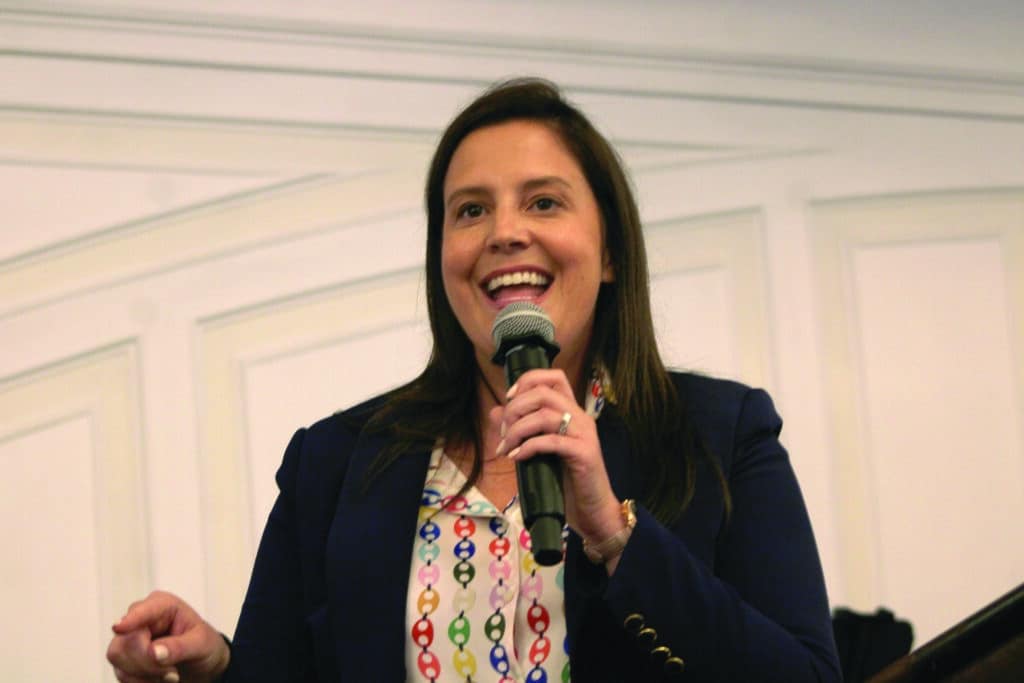
The 2026 gubernatorial race in New York seems increasingly headed towards a matchup between Governor Kathy Hochul (D) and Congresswoman Elise Stefanik (R, NY-21) (pictured below). Hochul is aiming to defend her four years in Albany and Stefanik is aiming to become the first Republican elected governor of New York since George Pataki (R) won a third and final term in 2002.
Hochul succeeded Andrew Cuomo (D) as governor upon his resignation in 2021 and won a full term in 2022 over then-Congressman Lee Zeldin (R-Shirley), but winning by a shockingly close six-point margin. The 2024 election saw Kamala Harris (D-CA) win the state by 12.6%, a solid margin, but substantially decreased from Joe Biden’s (D-DE) 23% margin four years prior. Moreover, the 2024 presidential race in the Empire State was the closest since Michael Dukakis’ (D-MA) marginal four-point win in 1988.
The 2022 gubernatorial race and the sharp rightward swing observed in New York in the presidential race – the Empire Swing swung over ten points to the right last year – are gathering notice of party leaders and prognosticators alike. Inside Elections rate it as a “Battleground”, while all forecasters rate the seat as “Likely Democratic”, one rating off from the strongest rating, and typical position for New York’s statewide races, “Safe Democratic.” A poll conducted in the spring by the firm co/efficient showed Hochul with just a one-point lead over Stefanik in a hypothetical matchup.
Hochul Vs. Stefanik
On the other hand, other polls have shown a different race. In June, the Siena College found Hochul (pictured below) +23 over Stefanik, a significantly larger margin than the ones that elected Hochul in 2022 and backed Harris in 2024. Her margin in that poll was 47%-24% – a strong lead, but one that indicates many voters are undecided.
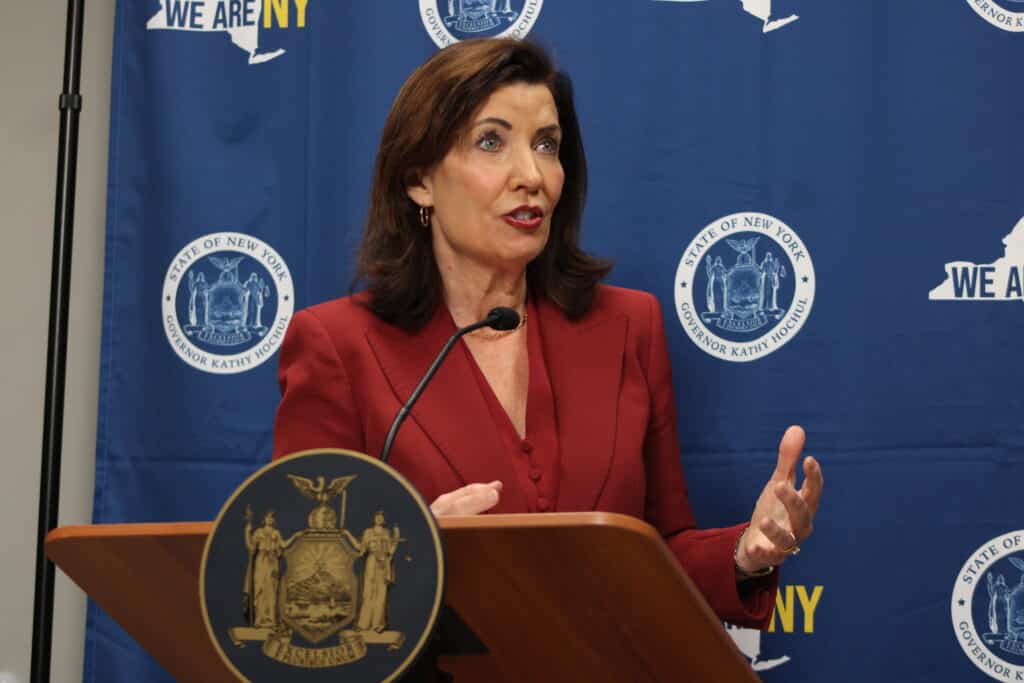
The College found in a poll conducted August 4-7 that Hochul is not as favored as she was earlier this summer and that some voters might be making up their minds.
Hochul’s margin has slipped from +23 to +14, with the percentages resting at 45%-31%. Not only did Stefanik gain a net seven points in voters’ preferences, but Hochul lost a net two points.
The race is still within a comfortable margin for Hochul, more than double her 2022 score, but the sharp decline in the race indicates some elasticity among the electorate, especially since Hochul is receding farther from the 50% mark often desired in pre-election polling.
Even though voters, as of now, would choose Hochul over Stefanik by a decisive margin, only 29% say she has the right experience to be governor and by a 49%-37% margin, say that if Stefanik were elected governor, it would be “bad for New York.”
The College also found her favorability rating improved slightly to 42%-44%, up slightly from -5 rating in June. Her job approval is also 53%-42%, up from 50%-45%.
More seriously for Hochul, downstate suburban voters went from favoring her by eleven points earlier this summer to now narrowly favoring Stefanik. Upstate voters were previously keen on Hochul by a twelve-point margin, but are now “virtually evenly divided.”
“More than two-thirds of Democrats are with Hochul and three-quarters of Republicans are with Stefanik. Independents are closely divided, leaning toward Stefanik, after favoring Hochul in June,” said Siena College pollster Steven Greenberg, adding that roughly half of the polled electorate is not familiar with her.
The College also polled New Yorkers on several other matters.
President Trump
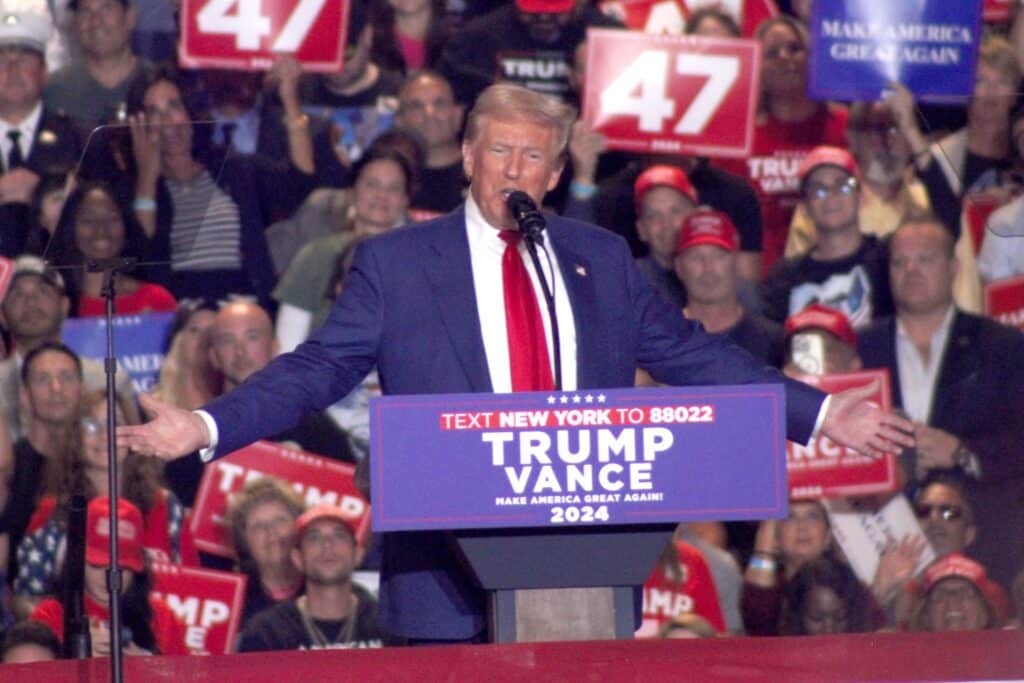
President Donald Trump’s (R-FL) (pictured above) approval rating sits at 41%-58%, slightly improved from his June figures of 37%-56%, although half of Independents do not think he is succeeding on key pieces of his agenda.
In terms of the pocketbook model of economics, New Yorkers opine that Trump is not succeeding in making everyday necessities more affordable – the total being 63%-23%. Republican voters give him positive marks to the tune of 54%-25%, while Independents are soured 19%-62%. For Democrats, just 12% say Trump is making necessities more affordable.
Trump gets high marks from Republican voters – 57%-24% – in terms of ending wars around the world, while 59% of Independents and 61% of total voters disagree.
As far as improving the standing of the U.S. on the world stage, 72% of Republicans think that Trump is accomplishing just that, while 51% of Independents and 57% of total voters disagree.
In ensuring that Americans feel safer in their everyday lives, Independents find themselves at their narrowest crosstabs of this survey – 36%-49% – while 68% of Republicans think that Trump is succeeding in this plight.
Overall, however, large majorities of Democrats do not think that Trump is succeeding in his agenda and about a quarter of Republicans feel similarly.
New York City Mayoral Election
Assemblyman Zohran Mamdani (D-Astoria) leads the four-candidate field with 44% of the vote. He is followed by former Governor Andrew Cuomo (D-Sutton Place) at 25%, Curtis Sliwa (R-Upper East Side) at 12%, and incumbent Mayor Eric Adams (D-Brooklyn) at 7%.
However, more than two-thirds of Big Apple Republicans are backing Sliwa in this race, while Independents are more divided, with 30% backing Mamdani and 20% backing Adams. City voters under the age of 35 are “overwhelmingly” supporting Mamdani. A plurality of voters aged 35-54 are also backing the dark horse candidate, a self-described Democratic Socialist. However, voters 55 and older are backing Cuomo over Mamdani by a 38%-32% margin.
Mamdani’s favorability rating also made its debut in a Siena College poll, in which analysts found his rating at 46%-32% in the City, but underwater 28%-37% among voters statewide. Cuomo, on the other hand, faces a 37%-54% favorability rating in the City and even more underwater 29%-61% favorability rating across New York.
Sliwa has a 30%-42% favorability rating in the city but a more narrow 26%-30% rating statewide.
Odds and Ends
U.S. Senator Chuck Schumer (D-NY) earned his lowest ever favorability rating in a Siena poll, which first began its surveys in February 2005. His rating sits at 38%-50%, down slightly from June. His favorability among Democrats has also decreased to 49%-39% from 55%-35% earlier this summer. Schumer is also underwater with New York City voters for the first time ever observed in a Siena poll – 39%-46%.
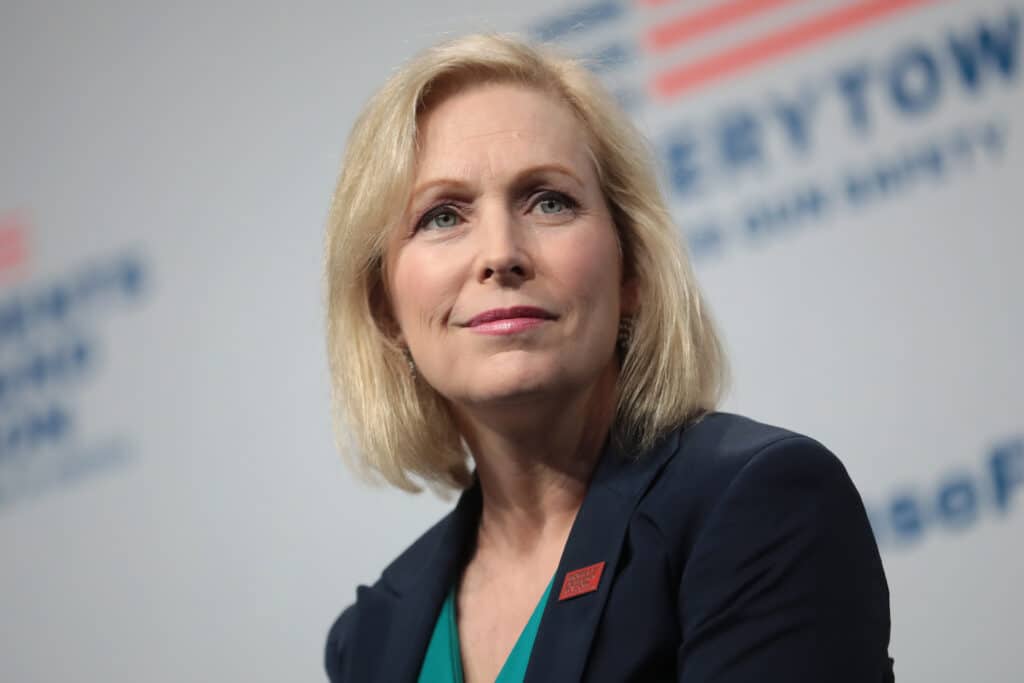
Senator Kirsten Gillibrand’s (D-NY) (pictured above) favorability rating is slightly underwater at 36%-38%, down from a healthier 44%-26% in October 2024. Pluralities of Democrats view her favorably, while pluralities of Republicans and Independents do not.
Overall, voters are pessimistic on their view of the state’s direction. 41% say that New York is on the right track while 45% say it’s on the wrong track. This is perhaps the largest improvement tracked in the August survey, as this statistic was at 37%-50% two months ago.
Voters are sour on congressional Democrats – 42%-49% – as well as congressional Republicans – 34%-58%.
This Siena College poll was conducted from August 4-7 among 813 registered New York State voters and has a margin of error of +/- 4.2%.