


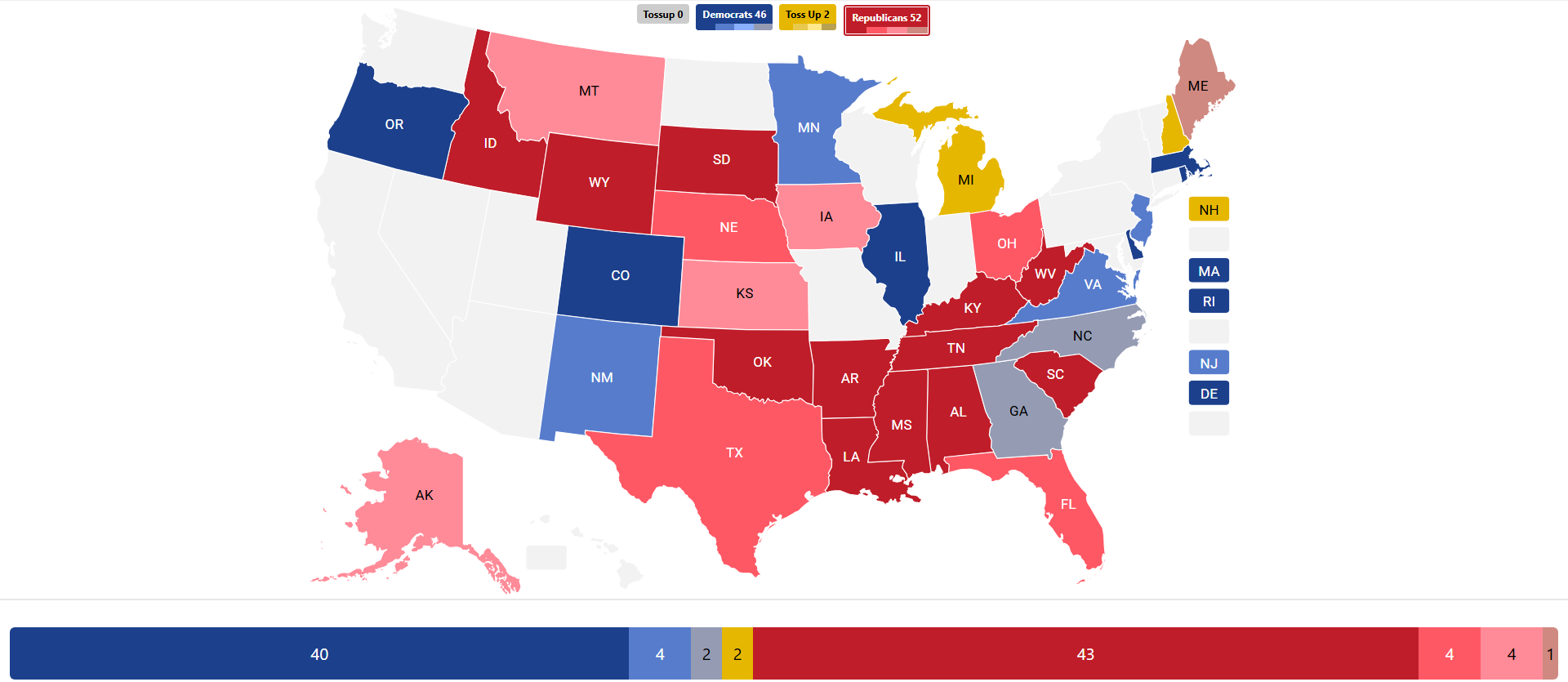
Balance of power is up for grabs in the U.S. Senate come November and Republicans are the odds-favorite to retain control. The question hasn’t been whether they’ll lose control, but rather what that majority will be.
Republicans have been bullish on a few targets, but the environment might preclude them from picking up any seats. On the other hand, Democrats have more targets to choose from, but the layout of the map poses a geography problem. The Democratic Party can only gain so much ground in one cycle, unless the midterms end up being a 2018-like blue wave.
The chamber is divided 53R-47D, which means Democrats must make a net gain of four seats in order to take control. Anything less than that means the GOP keeps control, as Vice President J.D. Vance (R-OH) can cast tie-breaking votes.
Of the thirty-five seats on the table this cycle, The Messenger identifies eighteen as competitive. Two of the total seats are special elections to fill remainders of Vice President Vance in Ohio and Secretary of State Marco Rubio (R-FL) in Florida.
Georgia – Tilts Democrat
Democrats managed to win both Georgia Senate seats in a double-barrel special election in 2021. Herschel Walker (R) failed to oust Senator Raphael Warnock (D-GA) in 2022, but now Senator Jon Ossoff (D-GA) – at 38, the Senate’s youngest incumbent – is up for re-election. Georgia’s tectonic leftward shift was seen as something of a fluke, until later election results have corroborated its newfound swing state status – courtesy primarily of the Atlanta metro area and its suburbs.
In fact, Atlanta is consistently ranked as one of the fastest growing metro areas in the U.S. The city is an economic engine of the South, as well as a hub for broader commerce. The economy is robust, and the suburbs continue to balloon in population. Moreover, Atlanta is home to the busiest airport in the world – Hartsfield-Jackson International Airport (ATL).
The counties that contain Atlanta proper have always been deep-blue: Fulton, DeKalb, and Clayton. While they have gotten slightly bluer between 2012 and 2024, the suburban counties of Atlanta reveal why Georgia is the swing state it is today.
In 2012, Mitt Romney (R-MA) won Cobb County 55%-43%. In 2024, Kamala Harris (D-CA) won Cobb County 56%-41% – almost a thirty-point shift in just four cycles. The results across the other suburban counties more or less follow this pattern. Gwinnett, and Henry counties have flipped from red to blue, while Rockdale and Douglas counties started as blue-leaning counties in 2012 and are now solidly-blue today. Only Fayette, Cherokee, and Forsyth counties remain red, albeit markedly less so than they were before the Trump Era.
The massive leftward shifts are only emblematic of the national urban-rural divide, as well as the suburbs of major metro areas becoming increasingly Democratic.
Ossoff remains a competitive candidate and as a younger, more progressive voice in the Senate, Atlanta’s younger, liberal voters will be hard swayed to back a Republican. Popular Governor Brian Kemp (R-GA) is term-limited but has said he will not run for the Senate seat. Conventional wisdom has stated that Kemp would be the best Republican candidate to take on Ossoff.
Republicans should be able to flip a seat like Georgia, even in a moderately blue environment. But this isn’t the Georgia of the last decade and even just a slightly blue national mood might make Ossoff’s advantage insurmountable. The massive leftward shifts of the Atlanta metro area only make the GOP’s climb steeper here, as Georgia might be transitioning to a blue-leaning battleground.
Michigan – Toss Up
The Wolverine State is gearing up for another competitive Senate race. The GOP hasn’t won a Senate race here since 1994, and the 2024 election was the closest in Michigan’s history. Elissa Slotkin (D) defeated Mike Rogers (R) by a margin of just 0.34% – 19,000 votes out of over 5 million cast.
Another open seat is up in Michigan this year, leaving Democrats vulnerable in a state they shouldn’t have problems in during a blue midterm. Mike Rogers is running a second time, while the Democratic field is growing between incumbent federal, state, and local officials.
While a Republican winning in Michigan is more common than it has been since the 1990s, it still takes a certain set of circumstances to pull it off. Environment is tantamount to this scenario, as well as a depressed Democratic voter turnout. With the conventional wisdom applied, Democrats shouldn’t have a problem retaining this seat, but polling indicates another nail-biter.
New Hampshire – Toss Up
The GOP once ruled the Granite State with an iron fist. While they have fallen from graces on the federal level, they’ve still managed to win gubernatorial races and have controlled the state legislature for several years.
New Hampshire was such a red beacon of New England that Democrats were shut out of Senate races from 1855 to 1919, and again from 1980 to 2008. In 2016, as Democrats flipped the Senate seat they did not have, they also took control of both U.S. House seats, marking the first time since 1854 that New Hampshire’s congressional delegation was entirely Democratic. It’s remained that way since then.
The GOP has also become their own worst enemy in this state, typically by picking the lesser-equipped Republican in the primaries who then can’t stack up to the incumbent. Also key is an environment good enough for the GOP to scale New Hampshire’s Democratic lean at the federal level as of late.
But candidate quality and name recognition go a long way in a small, compact state like New Hampshire, as does retail politics. The GOP scored a top recruit in former Senator John Sununu (R) – a scion of the Sununu political dynasty and brother of the wildly popular governor who ran the state from 2016 to 2024. That recency will be invariable to the intrinsically libertarian New Hampshire electorate. Sununu also has experience winning statewide under his belt, albeit in a different era entirely. He had served only one term, winning in 2002, but being defeated for re-election in 2008.
The only hurdle Sununu has is winning the primary, where former Senator Scott Brown (R) – who won the 2010 special election in Massachusetts in a massive upset – is eyeing a comeback. Brown had run for this seat in 2014 and narrowly lost to Shaheen in what was otherwise a red wave year.
Senator Jeanne Shaheen (D-NH) has chosen to retire instead of seeking a fourth term. Congressman Chris Pappas (D, NH-01) is the strongest candidate of the three Democrats presently declared. Pappas was elected in 2018 to NH-01, the redder of the state’s two congressional districts, and has been able to win in tough environments. Pappas, 45, is also on the younger side of things.
Both parties have good recruits, but if Sununu wins the primary – as we think he will – this seat could go down to the wire. Otherwise, Democrats should have no problem retaining this seat even in a mildly-blue year.
North Carolina – Tilts Democrat
Since Democrats need to net four seats to flip the Senate, we’ll look at their most conceivable path to that number. It all starts in North Carolina.
On paper, Democrats should have more federal statewide wins under their belt in the Tar Heel State. A premier battleground for over a decade, a diverse population, educated urban centers, and a penchant for ticket-splitting, one would think Democrats have had better luck in North Carolina Senate races.
In fact, Democrats have only won two such races here since the 1980s: John Edwards (D), who was John Kerry’s (D-MA) presidential running mate in 2004, won his first and only term in 1998, and Kay Hagan (D-NC), who won one term in 2008. Hagan’s victory is the last for a Democrat in a Senate race in this state, and is the last time North Carolina gave its electoral votes to a Democratic presidential nominee.
This year’s seat is being vacated by Thom Tillis (R), a twice-elected Senator who was the considerable underdog in both 2014 and 2020. Tillis was last seen sparring with GOP leadership over Medicaid cuts earlier this year and decided not to run for a third term. The seasoned overperformer would have been a crucial asset for the GOP’s defense of this seat this fall.
Former Governor Roy Cooper (D-NC) is the presumptive Democratic nominee for this seat. Elected in 2016 and re-elected in 2020, Cooper is seen as a generally more moderate Democrat, although not prohibitively so. Republican National Committee (RNC) Chairman Michael Whatley is aiming to earn the nod to run against him, but polling has Cooper ahead.
To put it succinctly, Democrats have no path to a Senate majority without North Carolina, and as of right now, they seem poised for a generational win in the Tar Heel State.
Maine – Tilts Republican
Like North Carolina, Maine is a state where Democrats, on paper, should have a lock on statewide races. However, Maine’s ancestral Republican lean has permeated into the Trump Era, and Senator Susan Collins (R-ME) is perhaps the Senate’s staunchest maverick.
Collins is eyeing a sixth term; she was first elected when Republicans still had significant political power in the Pine Tree State. Democrats were optimistic that they’d finally beaten her in 2020, but Collins ended up springing a shocker. She won by eight points, a staggering overperformance when polling aggregates showed her opponent leading by four to seven points. Collins won by that large margin on the same night that Joe Biden (D-DE) won the presidential race in Maine by nine points, generating a seventeen-point crossover gap – a once dime-a-dozen scenario that is now extremely rare in the modern era.
The real political calculus in this race comes down to who Democrats chose in a primary: two-term incumbent Governor Janet Mills (D) or harbormaster Graham Platner (D). Mills is the more mainstream choice, but Platner represents a younger, more “fed up” tone that could strike a chord. Polling suggests that Collins will have an easier time beating Mills than she would Platner. As incumbents and those with institutional political experience become less popular in the economic-populist era, Mainers might go with Platner.
If there’s one mistake to never make, it’s underestimating a moderate Republican in Maine. While Collins’ approval ratings are underwater, it’s entirely conceivable that she bridges the gap and earns a sixth term in November, so long as she retains her moderate record and if the wrong Democrat wins the primary.
Iowa – Leans Republican
The last decade has made Iowa a fantastic political case study. A swing state that the GOP had just gotten used to losing – between 1988 and 2012, they had won it just once in 2004 – is now a much redder beacon in the heart of the Great Plains. In 2022, Republicans solidified control of Iowa’s entire congressional delegation for the first time since the 1940s. While the state itself is much redder than it once was, the GOP shouldn’t revel as if it’s a ruby-red state like its neighbors.
Democrats still retain a relatively high floor in Iowa, meaning a ten-to-fifteen-point gap is closeable. The seat is also being vacated by two-term Senator Joni Ernst (R), who might have been more of a liability than an asset to her party this fall.
It’s a stretch, but in the right environment, especially one where Iowa farmers might not be enthused with Trump’s trade wars, Democrats could contest this seat. But their path to the majority runs squarely through Iowa.
But closing that gap might be easier said than done. On top of farmers, the blue-collar backbone of the classic Democratic coalition has all but evaporated in the Hawkeye State – a transition truly emblematic of the GOP’s strength in the Rust Belt in the Trump Era. Evangelical voters remain lock-step with the GOP, while Iowa has few college towns and dense urban areas to counterweight the rest of the state. Democrats thought they had flipped this seat in 2020, but the now-outgoing Ernst managed to win by a firm six-point margin. The eastern counties along the Mississippi River were once blue-leaning, but are now red-leaning battlegrounds at best.
Ohio – Likely Republican
Ohio is another excellent case study in American geopolitics. Ohio was once the quintessential swing state, but is now an obdurately Republican one. Bernie Moreno (R) ousted three-term moderate Senator Sherrod Brown (D) in 2024, giving Republicans control of both seats simultaneously since 2007. Brown is eyeing a comeback to this seat this year and poses Democrats’ best shot at flipping this seat back.
But appointed Senator Jon Husted (R) has more credentials on the Ohio ballot than Moreno did before defeating Brown. Husted is a twice-elected lieutenant governor, a twice-elected Ohio Secretary of State, and a former Speaker of the Ohio State House.
Ohio was once a state where both parties were able to win in reasonable environments, but Democrats had significantly more credibility among the working-class coalition. The northeastern counties of the state, particularly the Youngstown-Akron area, were the decades-long cornerstone of Democrats’ working-class coalition not just in Ohio, but nationally – arguably. Now, that area is at least red-leaning, as Donald Trump won Youngstown’s Mahoning County in 2020 – the first time a Republican had done so since 1972. The margins here have only grown for the GOP in the Trump Era and don’t seem keen on fading any time soon.
Even if the environment is on Democrats’ side, Ohio will be perhaps their largest hurdle in their quest for a majority.
Here’s the Count
While Democrats do have a conceivable path to fifty-one seats, it’s not a likely one. They would need to run the table in the Toss Ups, play solid defense elsewhere, and pick off all four of the key states: North Carolina, Maine, Iowa, and Ohio. If they lose just one, they remain in the minority for at least another two years. Strategists opine that the Democratic Party is using 2026 as a springboard to take back the majority in 2028, provided they can reduce the GOP’s caucus.
We’ll examine the other competitive races in ensuing columns.
Balance of power is up for grabs in the U.S. Senate come November and Republicans are the odds-favorite to retain control. The question hasn’t been whether they’ll lose control, but rather what that majority will be.
Republicans have been bullish on a few targets, but the environment might preclude them from picking up any seats. On the other hand, Democrats have more targets to choose from, but the layout of the map poses a geography problem. The Democratic Party can only gain so much ground in one cycle, unless the midterms end up being a 2018-like blue wave.
The chamber is divided 53R-47D, which means Democrats must make a net gain of four seats in order to take control. Anything less than that means the GOP keeps control, as Vice President J.D. Vance (R-OH) can cast tie-breaking votes.
Of the thirty-five seats on the table this cycle, The Messenger identifies eighteen as competitive. Two of the total seats are special elections to fill remainders of Vice President Vance in Ohio and Secretary of State Marco Rubio (R-FL) in Florida.
Georgia – Toss Up
Democrats managed to win both Georgia Senate seats in a double-barrel special election in 2021. Herschel Walker (R) failed to oust Senator Raphael Warnock (D-GA) in 2022, but now Senator Jon Ossoff (D-GA) – at 38, the Senate’s youngest incumbent – is up for re-election. Georgia’s tectonic leftward shift was seen as something of a fluke, until later election results have corroborated its newfound swing state status – courtesy primarily of the Atlanta metro area and its suburbs.
In fact, Atlanta is consistently ranked as one of the fastest growing metro areas in the U.S. The city is an economic engine of the South, as well as a hub for broader commerce. The economy is robust, and the suburbs continue to balloon in population. Moreover, Atlanta is home to the busiest airport in the world – Hartsfield-Jackson International Airport (ATL).
The counties that contain Atlanta proper have always been deep-blue: Fulton, DeKalb, and Clayton. While they have gotten slightly bluer between 2012 and 2024, the suburban counties of Atlanta reveal why Georgia is the swing state it is today.
In 2012, Mitt Romney (R-MA) won Cobb County 55%-43%. In 2024, Kamala Harris (D-CA) won Cobb County 56%-41% – almost a thirty-point shift in just four cycles. The results across the other suburban counties more or less follow this pattern. Gwinnett, and Henry counties have flipped from red to blue, while Rockdale and Douglas counties started as blue-leaning counties in 2012 and are now solidly-blue today. Only Fayette, Cherokee, and Forsyth counties remain red, albeit markedly less so than they were before the Trump Era.
The massive leftward shifts are only emblematic of the national urban-rural divide, as well the suburbs of major metro areas becoming increasingly Democratic.
Ossoff remains a competitive candidate and as a younger, more progressive voice in the Senate, Atlanta’s younger, liberal voters will be hard swayed to back a Republican. Popular Governor Brian Kemp (R-GA) is term-limited but has said he will not run for the Senate seat. Conventional wisdom has stated that Kemp would be the best Republican candidate to take on Ossoff.
Republicans should be able to flip a seat like Georgia, even in a moderately blue environment. But this isn’t the Georgia of last decade and even just a slightly-blue national mood might make Ossoff’s advantage insurmountable. The massive leftward shifts of the Atlanta metro area only make the GOP’s climb steeper here, as Georgia might be transitioning to a blue-leaning battleground.
Michigan – Toss Up
The Wolverine State is gearing up for another competitive Senate race. The GOP hasn’t won a Senate race here since 1994, and the 2024 election was the closest in Michigan’s history. Elissa Slotkin (D) defeated Mike Rogers (R) by a margin of just 0.34% – 19,000 votes out of over 5 million cast.
Another open seat is up in Michigan this year, leaving Democrats vulnerable in a state they shouldn’t have problems in during a blue midterm. Mike Rogers is running a second time, while the Democratic field is growing between incumbent federal, state, and local officials.
While a Republican winning in Michigan is more common than it has been since the 1990s, it still takes a certain set of circumstances to pull it off. Environment is tantamount to this scenario, as well as a depressed Democratic voter turnout. With the conventional wisdom applied, Democrats shouldn’t have a problem retaining this seat, but polling indicates another nail-biter.
North Carolina – Tilts Democrat
Since Democrats need to net four seats to flip the Senate, we’ll look at their most conceivable path to that number. It all starts in North Carolina.
On paper, Democrats should have more federal statewide wins under their belt in the Tar Heel State. A premier battleground for over a decade, a diverse population, educated urban centers, and a penchant for ticket-splitting, one would think Democrats have had better luck in North Carolina Senate races.
In fact, Democrats have only won two such races here since the 1980s: John Edwards (D), who was John Kerry’s (D-MA) presidential running mate in 2004, won his first and only term in 1998, and Kay Hagan (D-NC), who won one term in 2008. Hagan’s victory is the last for a Democrat in a Senate race in this state, and is the last time North Carolina gave its electoral votes to a Democratic presidential nominee.
This year’s seat is being vacated by Thom Tillis (R), a twice-elected Senator who was the considerable underdog in both 2014 and 2020. Tillis was last seen sparring with GOP leadership over Medicaid cuts earlier this year and decided not to run for a third term. The seasoned overperformer would have been a crucial asset for the GOP’s defense of this seat this fall.
Former Governor Roy Cooper (D-NC) is the presumptive Democratic nominee for this seat. Elected in 2016 and re-elected in 2020, Cooper is seen as a generally more moderate Democrat, although not prohibitively so. Republican National Committee (RNC) Chairman Michael Whatley is aiming to earn the nod to run against him, but polling has Cooper ahead.
To put it succinctly, Democrats have no path to a Senate majority without North Carolina, and as of right now, they seem poised for a generational win in the Tar Heel State.
Maine – Leans Republican
Like North Carolina, Maine is a state where Democrats, on paper, should have a lock on statewide races. However, Maine’s ancestral Republican lean has permeated into the Trump Era, and Senator Susan Collins (R-ME) is perhaps the Senate’s staunchest maverick.
Collins is eyeing a sixth term; she was first elected when Republicans still had significant political power in the Pine Tree State. Democrats were optimistic that they’d finally beaten her in 2020, but Collins ended up springing a shocker. She won by eight points, a staggering overperformance when polling aggregates showed her opponent leading by four to seven points. Collins won by that large margin on the same night that Joe Biden (D-DE) won the presidential race in Maine by nine points, generating a seventeen-point crossover gap – a once dime-a-dozen scenario that is now extremely rare in the modern era.
The real political calculus in this race comes down to who Democrats chose in a primary: two-term incumbent Governor Janet Mills (D) or harbormaster Graham Platner (D). Mills is the more mainstream choice, but Platner represents a younger, more “fed up” tone that could strike a chord. Polling suggests that Collins will have an easier time beating Mills than she would Platner. As incumbents and those with institutional political experience become less popular in the economic-populist era, Mainers might go with Platner.
If there’s one mistake to never make, it’s underestimating a moderate Republican in Maine. While Collins’ approval ratings are underwater, it’s entirely conceivable that she bridges the gap and earns a sixth term in November, so long as she retains her moderate record and if the wrong Democrat wins the primary.
Iowa – Leans Republican
The last decade has made Iowa a fantastic political case study. A swing state that the GOP had just gotten used to losing – between 1988 and 2012, they had won it just once in 2004 – is now a much redder beacon in the heart of the Great Plains. In 2022, Republicans solidified control of Iowa’s entire congressional delegation for the first time since the 1940s. While the state itself is much redder than it once was, the GOP shouldn’t revel as if it’s a ruby-red state like its neighbors.
Democrats still retain a relatively high floor in Iowa, meaning a ten-to-fifteen-point gap is closeable. The seat is also being vacated by two-term Senator Joni Ernst (R), who might have been more of a liability than an asset to her party this fall.
It’s a stretch, but in the right environment, especially one where Iowa farmers might not be enthused with Trump’s trade wars, Democrats could contest this seat. But their path to the majority runs squarely through Iowa.
But closing that gap might be easier said than done. On top of farmers, the blue-collar backbone of the classic Democratic coalition has all but evaporated in the Hawkeye State – a transition truly emblematic of the GOP’s strength in the Rust Belt in the Trump Era. Evangelical voters remain lock-step with the GOP, while Iowa has few college towns and dense urban areas to counterweight the rest of the state. Democrats thought they had flipped this seat in 2020, but the now-outgoing Ernst managed to win by a firm six-point margin. The eastern counties along the Mississippi River were once blue-leaning, but are now red-leaning battlegrounds at best.
Ohio – Likely Republican
Ohio is another excellent case study in American geopolitics. Ohio was once the quintessential swing state, but is now an obdurately Republican one. Bernie Moreno (R) ousted three-term moderate Senator Sherrod Brown (D) in 2024, giving Republicans control of both seats simultaneously since 2007. Brown is eyeing a comeback to this seat this year and poses Democrats’ best shot at flipping this seat back.
But appointed Senator Jon Husted (R) has more credentials on the Ohio ballot than Moreno did before defeating Brown. Husted is a twice-elected lieutenant governor, a twice-elected Ohio Secretary of State, and a former Speaker of the Ohio State House.
Ohio was once a state where both parties were able to win in reasonable environments, but Democrats had significantly more credibility among the working-class coalition. The northeastern counties of the state, particularly the Youngstown-Akron area, were the decades-long cornerstone of Democrats’ working-class coalition not just in Ohio, but nationally – arguably. Now, that area is at least red-leaning, as Donald Trump won Youngstown’s Mahoning County in 2020 – the first time a Republican had done so since 1972. The margins here have only grown for the GOP in the Trump Era and don’t seem keen on fading any time soon.
Even if the environment is on Democrats’ side, Ohio will be perhaps their largest hurdle in their quest for a majority.
Here’s the Count
While Democrats do have a conceivable path to fifty-one seats, it’s not a likely one. They would need to run the table in the Toss Ups, play solid defense elsewhere, and pick off all four of the key states: North Carolina, Maine, Iowa, and Ohio. If they lose just one, they remain in the minority for at least another two years. Strategists opine that the Democratic Party is using 2026 as a springboard to take back the majority in 2028, provided they can reduce the GOP’s caucus.
We’ll examine the other competitive races in ensuing columns.