

While we’ve touched on the Byrd Rule in this column, we’re taking a deeper dive into it this week.
What is the Byrd Rule?
The Byrd Rule is a Senate-specific rule under Section 313 of the Budget Act. Its purpose is to block “extraneous” provisions from budget reconciliation bills and to ensure that only budget-related matters are included in the process.
Reconciliation is a fast-track budgeting process that allows Congress to pass legislation affecting spending, revenues, and the debt limits with a simple majority (51 votes) as opposed to the higher hurdle of a 60-vote threshold. While making it easier to enact major fiscal policy, such as spending bills and tax cuts, with limited time for debate, it makes it more difficult for the Senate to place non-budgetary items in the reconciliation bills.
The reconciliation procedure was established by the Congressional Budget Act of 1974, with the long-term focus being reducing the deficit, generating revenue, and in some cases, increasing spending in certain areas. While reconciliation is an optional procedure, it has been used by Congress in most of its sessions. Twenty-three reconciliation bills have become law while just four have been vetoed.
History and Origin
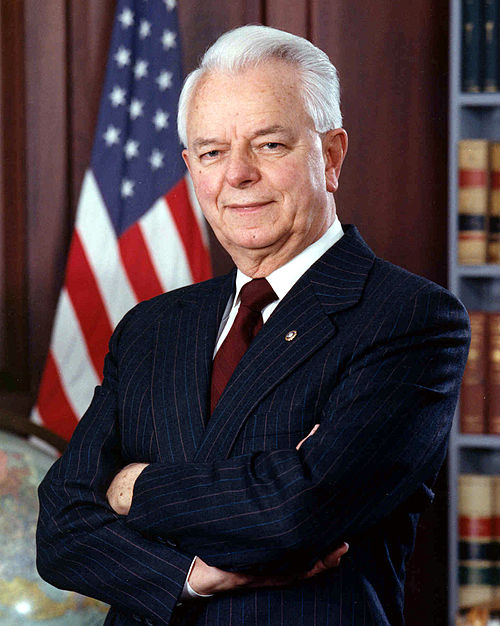
The rule is named for Senator Robert Byrd (D-WV), who represented West Virginia in the Senate from 1959 until his death in 2010. Byrd proposed the measure, which became law in 1985 and amended in 1990.
Its purpose was to curtail abuse of the budgeting process, specifically as committees were inserting unrelated policy changes, which typically warrant extensive legislative debate, into fiscal measures which are designed to be passed on a simple-majority basis. The loophole also worked around policy proposals that could possibly face a filibuster, a point of extensive and virtually limitless debate until cloture – the cessation of debate and to take up the measure as is – is invoked. The loophole also gave committees more power in passing measures that they favored, avoiding the scrutiny of the full Senate.
Points of Order
Points of order are formal objections raised by a Senator who finds that the Senate’s rules and procedures are violated. Points of order are required in the Senate as the presiding officer does not proactively enforce the rules, unlike the U.S. House.
The Senator in question can explain the perceived violation, after which the presiding officer – usually the vice president or president pro tempore – decides if the point is “well taken” (valid) or not, often in consultation with the Senate Parliamentarian.
The point of order is usually debated thereafter by the Senate and voted upon, while other Senators can challenge the presiding officer’s decision. Points of order require a three-fifths vote to be waived on budgetary matters.
A dissenting Senator can also disagree with the ruling of the presiding officer, asking for an appeal. The presiding officer then asks the Senate to vote on the fate of the point of order. A majority vote to not sustain the presiding officer’s decision overturns the ruling, while a vote to sustain the presiding officer’s ruling upholds it. A tie sustains the presiding officer’s ruling.
Points of order are crucial when debating budgetary matters, especially when it comes to the Byrd Rule.
The Six Cases
The Byrd Rule outlines six cases where a provision is defined as “extraneous” and is then considered ineligible for reconciliation. A provision must fit at least one case in order to be ineligible. Those cases are:
- If the provision does not produce a change in outlays (spending) or revenues.
The cost estimate of a measure provides the first indication of whether the measure in question will produce a change to the outlays or revenues. However, measures that are “terms or conditions” of a provision that does affect outlays and revenues are admissible in a reconciliation bill under the Byrd Rule. In other words, a stipulation, while not intrinsically budgetary itself, could affect a budgetary matter. An example of extraneous matter under this test would be an opinion, statement, or declaration by Congress. Called Sense of Congress language, these might be suggestions for action to the president without a mandate for action.
- If the provision produces an outlay increase or revenue increase when the specified committee is not compliant with its instructions.
Compliance in this case, as it relates to budgeting, means that a committee must find savings at least equal to the target instruction – called a “floor.” Instructions to increase a deficit is called a “ceiling.” A committee found to be in compliance with its instructions is one that recommends legislation that does not change spending or revenue to fall outside instructions by more than 20% of the sum of both the floor and ceiling and the total changes are not less than the total recommended.
The Economic Policy Innovation Center (EPIC) lists the following example. If a committee is instructed to reduce a deficit by $10 billion and pitches a measure to decrease spending by $1 billion and increase revenue by $9 billion, for a total deficit reduction of $10 billion, it is in compliance with case 2 of the Byrd Rule.
- If the provision is outside the jurisdiction of the committee that submitted the provision for inclusion in the reconciliation process.
The Presiding Officer determines jurisdiction in consultation with the Senate Parliamentarian. If a measure is not within the jurisdiction of the committee in question, it is stricken from consideration. In that vein, if a subsection of a measure is not within a committee’s scope, the subsection is stricken, not the rest of the section, as long as the remainder of the section is compliant with jurisdiction.
- If the provision creates a change in outlays or revenues that is “incidental” to nonbudgetary aspects of the provision;
This case has changed throughout the years and the precedents set by the Senate. While no formal test exists, the Parliamentarian generally weighs whether a provision is a policy change that “substantially” outweighs budgetary impact of that change. An example listed by EPIC is that of a 2021 point of order against a provision to increase the federal minimum wage. The Congressional Budget Office’s (CBO) cost estimate for that provision found that the policy would “indirectly affect the budget.”
However, measures whose budgetary effects that the CBO cannot estimate do not necessarily violate the “merely incidental” test.
- If the provision would increase the deficit for a fiscal year beyond the fiscal years covered by the reconciliation bill in question.
This deals with sunset provisions primarily. Sunset provisions are expirations for budgetary measures that are determined at their time of passage. Further measures to lengthen the sunset are required when the expiration date nears. These are commonly seen in tax cuts/benefits, such as the State and Local Tax (SALT) deductions recently secured under the Big Beautiful Bill (BBB).
This case says that measures are stricken under the Byrd Rule if the sunset provision of a reconciliation bill increases the deficit in the years beyond its window. Creative budgeting can avoid this chokepoint.
- If the provision aims to make changes to Social Security.
Old Age, Survivor, and Disability Insurance (OASDI), the formal name for Social Security, is off the table when it comes to reconciliation bills under Section 310(g) of the Congressional Budget Act. If a Senator raises a point of order against one offending provision, the rest of the bill could pass muster. However, if a Senator raises a point of order against the entire measure pursuant to Section 310(g), the entire bill will be sent back to committee and cannot be sent back to the floor without considerable changes.
Medicare and other non-OASDI programs established under the Social Security Act are not covered by this test under the Byrd Rule.
While the Byrd Rule does not automatically prevent the inclusion of extraneous provisions, it does require Senators to remove those provisions by raising procedural objections. Provisions believed to be extraneous are considered “Byrd-able”, which are then ruled upon by the Senate presiding officer and usually with the advice of the Senate Parliamentarian. Sixty votes are required to overturn the ruling.
As an interesting side note, while the Vice President can overrule the Parliamentarian, this has not been done on budgetary matters since 1975. The vice president has, however, overruled the Parliamentarian on judicial nominations as recently as 2013 and 2017.