


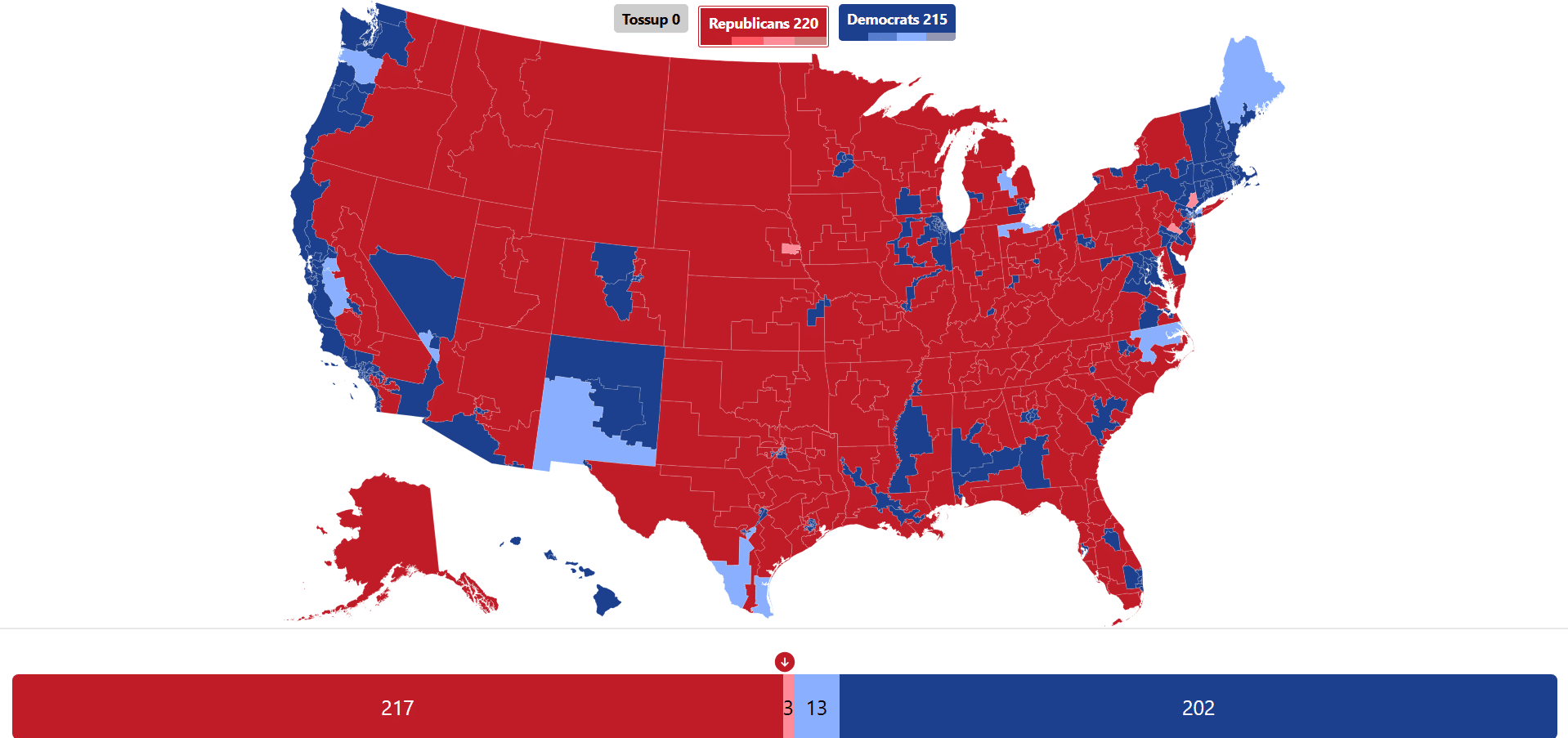
As the race for the 2026 midterms is already afoot, we’ll take this time to discuss a political phenomenon that is one of the jumping-off points for competition: crossover seats.
What is a Crossover Seat (or District)?
Crossover seats are those that backed one party for a higher office and a different party for its own office. In the context of the House elections, the crossover seat is one where voters elected a representative of one party but backed a presidential nominee of another party.
These seats are often seen as the jumping-off point for the campaigns, especially heading into a midterm, as they’re often the best gauge for where a party can pick up seats without foraging too deep behind enemy lines. For 2026, Democrats only need a net gain of three seats, assuming vacancies are won by the party who last held them. The crossover seats could make all the difference in 2026.
What are the Current Crossover Seats
Currently, Democrats represent sixteen districts that were won by Donald Trump (R-FL) in 2024. Before the mid-decade redraws in Missouri and Texas, that number sat at thirteen.
On the other hand, Republicans currently hold eight seats that were won by Kamala Harris (D-CA) last year. Before Proposition 50 passed in California and the court-ordered redraw in Utah, that number sat at just three.
Democrats will be keen to flip NE-02, NY-17, and PA-01, with the redrawn CA-48 posing a good pickup opportunity, although one where entrenched Congressman Darrell Issa (R) could thread the needle.
If the 2026 midterms were to be favorable to the GOP, Democrats would have much more turf to defend. However, since conventional wisdom says they’ll have the better year, they have a greater margin for error.
That said, since Democrats only need a net gain of three seats, and since the overall competitive landscape is smaller than it was in 2018, Democrats will want to run the table in these thirteen aforementioned seats. Notable districts include NC-01, a district that is 40% black and went to Trump by five points. The mid-decade redraw in North Carolina makes this an even steeper climb for two-term Congressman Don Davis (D, NC-01).
Mavericks Make All the Difference
This is a crucial component of gauging crossover districts, as some are crossover seats only because of their incumbents.
In NE-02, the Omaha-based Nebraska district that gave Joe Biden (D-DE) and Kamala Harris its sole electoral vote in 2020 and 2024, respectively, Congressman Don Bacon (R) has been able to withstand severe national headwinds. A narrow Trump district in 2016, Bacon survived an almost-assured defeat in the 2018 midterms. He managed to win the district in 2020, the same night Biden won it by a strong seven-point margin. Bacon held on in the 2022 midterms, and despite having his worst polling year yet, managed to clinch another term in 2024.
Now, Bacon is retiring, costing Republicans not only one of the House’s most notable mavericks, but also a seasoned overperformer. NE-02 starts at the forefront of a hypothetical Democratic House majority in 2027.
But prospects for Democrats are, on paper, lower in PA-01. This suburban Philadelphia seat contains almost all of Bucks County, one of the nation’s premier swing counties. Held by Brian Fitzpatrick (R) since 2018, this district narrowly backed Hillary Clinton (D-NY) in 2016, handily backed Biden in 2020, and narrowly went for Harris last year. PA-01 has also backed Democrats in U.S. Senate and gubernatorial races since 2018.
Fitzpatrick is regularly considered one of the most bipartisan members of the House and one of the most moderate Republicans. While Harris won this district by just 0.3 points last year, Fitzpatrick cruised to a 12.8-point win.
Democrats also have mavericks of their own who have been able to win in tough environments. Congresswoman Marie Gluesenkamp Perez (D, WA-03) flipped this red-leaning district in southwestern Washington State in 2022. She held it in 2024, despite Trump carrying it by three points. Perez has been one of the top mavericks of the Democratic caucus, voicing her support for the original stopgap that, had it been approved by the Senate, would have avoided the recent government shutdown. She also broke from her party in leading a vote to condemn a fellow Illinois Democrat for allegedly timing his retirement with the state’s registration deadlines so that his chief of staff could run unopposed in the primary for his seat.
Congressman Jared Golden (D, ME-02) is easily the most maverick-y Democrat in the House. Representing a conservative Maine district that backed Trump in all three of presidential runs, Golden was the sole House Democrat to vote for the September stopgap to avoid a government shutdown. Golden, also heralded for his bipartisanship and iconoclastic record, is not running for re-election next year, turning a seat Democrats have won since 2018 into a possible liability that could cut into their gains next year.
We’ve seen what happens when a notable maverick decides to hang it up. Look no further than John Katko (R), the former Congressman from the Syracuse area who held a Clinton-won district in 2016, was one of just three Republicans in Clinton-won districts to survive the 2018 midterms, and won his district concurrently with Biden in 2020. Katko retired ahead of 2022, allowing Brandon Johnson (R) to win the open seat. However, when Democrats redraw New York’s map ahead of 2024, the Katko shoes were too big to fill for someone who wasn’t as maverick-y as he was. Johnson lost to now-Congressman John Mannion (D, NY-22) last year.
Crossover Seats in Recent Elections
As ticket-splitting at-large has declined in the last decade or so, the number of crossover House seats has as well. In 1976, almost 30% of all House seats – 124 out of 435 – voted differently for president and House.
Fast-forward to 2018, where just thirty-five seats were in the same category. Before mid-decade redistricting kicked in, there were just seventeen crossover seats from 2024.
In 2018, twenty-five seats represented by House Republicans were won by Clinton in 2016. Of those, twenty-two flipped Democratic in 2018. The only survivors were the aforementioned John Katko, Brian Fitzpatrick, and Will Hurd (R-TX).
In 2018, thirteen Trump-won districts were represented by Democrats. All but two were flipped by Republicans; both were in Minnesota.
Suffolk County is also no stranger to crossover districts. NY-01, represented by Congressman Nick LaLota (R-Amityville) since 2023, was a narrow Trump district in 2020. But the reconfigured NY-01 used in 2022 had actually gone for Biden by a fraction of a point, putting LaLota in the rare part of the Venn Diagram where a crossover district is “created” by virtue of redistricting. LaLota went on to defeat then-Suffolk County Legislator Bridget Fleming (D-Noyack) by about ten points for the open seat in 2022.
Currently, Suffolk is home to just one crossover district, NY-03. Represented by Congressman Tom Suozzi (D-Glen Cove), NY-03 backed Trump by four points in 2024, despite going for Suozzi by about the same margin. While the district is predominantly northern Nassau County and parts of northern Queens, it does include the Huntington hamlets/villages of Cold Spring harbor, Halesite, Huntington Station, Huntington hamlet, West Hills, Huntington Bay, and Lloyd Harbor.
The Bigger Picture
Crossover districts can tell us a lot about the directions in which the country is headed but from a more local perspective. While House races are certainly nationalized contests, we’ve seen where a member accurately representing his/her constituents can make all the difference in overcoming those national headwinds. We can see the overall trends and some surprises that might promulgate statewide competition in future elections.
A great example of this is NJ-09. This New Jersey district contains parts of the Newark area all the way up through Clifton, Patterson, and Wyckoff, notably. While it was redrawn to be less Democratic-leaning that it had been prior, 2024 saw Trump not only come within six points of winning New Jersey, but win NJ-09 outright – albeit by a narrow margin. The district includes a Hispanic population of 41.6%, making this district emblematic of Trump’s gains in New Jersey and among Hispanic voting blocs nationwide. Similarly, Congresswoman Nellie Pou (D, NJ-09) won her seat the same night by just under five points – far below initial targeting for the district.
The overall decline in crossover districts also goes hand-in-hand with the decline of ticket-splitting nationally. As voters entrench themselves further with their parties, these numbers won’t pick up, at least not for now. The change in crossover districts over the years also demonstrates how parties once dominated the state and local scenes, while the state opted for another party on the presidential level. This was once a more common occurrence that was essentially baked into each state’s political wisdom.
Now, there’s almost no room for those idiosyncrasies to play out.