
Since last January, we’ve been handicapping the 2026 midterms and we’ve watched the cycle start as a jump ball for the voters as the parties were ostensibly shifting, to an all-out disaster for the GOP.
However, we’re taking a more modest approach to this forecast for several reasons.
Polling
The polling this cycle has been unlike any other in recent memory. Highly limited in most places, much of the polling we’re seeing are internal or partisan polls. They’re not necessarily wrong, but they need to be taken with a greater grain of salt than a typical poll.
It’s unclear if pollsters have perfected their weighting metric to account for the “hidden Trump” vote, which might be mostly absent this year, and to account for voting demographics who don’t typically show up to vote.
It’s what’s making this an incredibly difficult election to predict. On one hand, Democrats should sweep everything with just how bad Trump’s numbers are, but we found ourselves in the same scenario in 2022 with Biden’s poor ratings, only for the GOP to have a red ripple of a night instead of a red wave.
On the other hand, fundamental polling misses in states with notoriously bad polling are still on the table.
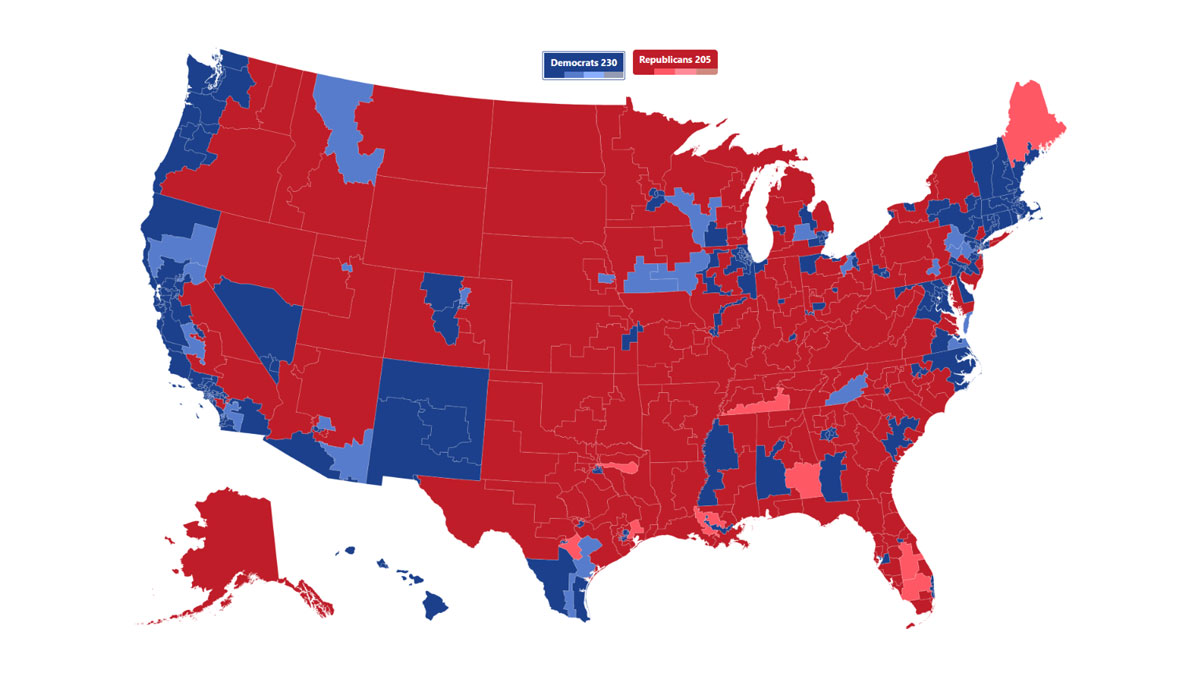
U.S. House – Democrats Win with 230 Seats
Initially, there was an expectation that Democrats would just barely take the House or Republicans could somehow defy history and retain the chamber. We now see Democrats as clear favorites to win, although we doubt some seats that the mainstream pundits are calling will end up flipping. We’re sorting the last of the Toss Ups and moving some red seats to the blue side.
We think Republicans will pick up 9 seats total, 8 of which come from their mid-decade redistricting ploy that seems relatively toothless now. They’ll flip three seats in Texas – although Democrats could hang onto TX-35 – and two seats in Florida – although Democrats could retain FL-22. The GOP will safely get LA-06 and TN-09, but there’s an outside chance Democrats retain AL-02.
The only seat we see flipping to the GOP outside of redistricting is ME-02, an open seat that’s been held by the most conservative House Democrat since 2019.
The Usual Suspects
These are swing seats, often in swing states, that typically flip with each midterm. There’s always a chance the GOP could retain one or two, but it’s hard to see how it makes up the difference at large. The Democrats, we think, will flip 5 seats in California – including the Central Valley-based CA-22. There, Congressman David Valadao, a notable maverick, is the last remaining Republican in the House who voted to impeach Trump in January 2021. He went down in 2018, despite being a staunch overperformer. We expect he will lose again, but narrowly, and could very well hold on. The other 4 California seats for Democrats come from their mid-decade gerrymander.
Usual Suspects Seats to Flip D: AZ-01, AZ-06, CO-08, IA-01, IA-03, MI-07, MI-10, NE-02, NJ-07, PA-07, PA-08, SC-01, TX-15, VA-01, WI-03.
Red-Leaning Seats to Flip D: MT-01, NC-11, OH-07, PA-10
Upset Alert
These are seats we think the GOP holds but could very well flip if Democrats have a tremendous night: AZ-02, CO-05, FL-13, IA-02, KY-06, MI-04, MN-01, MO-02, NY-17, VA-01.
These are seats we think the Democrats could lose if the GOP has a better night than expected, particularly in states they gerrymandered mid-decade: FL-14, FL-25, MI-10, MT-01, NY-03, NC-01, OH-09.
Overall, we’re fairly confident in our House forecast. We think if we end up being wrong, Democrats end up with a more sizable 230-245 majority, rather than a lower end. In that event, we don’t see their lower end going past 225 seats.
Again, individual polls in these districts are few and far between. Some seats haven’t been polled since the winter and spring, while much attention has been in Democratic-leaning pollsters that have been giving us mixed reads compared to the “usual suspects” seats that are producing margins more expected in a midterm scenario.
With 24 flips for the Democrats and 9 for the Republicans, we expect Democrats to walk away with a net gain of 15 seats, 12 more than they need to flip control of the House.
 U.S. Senate – A Tied Senate?
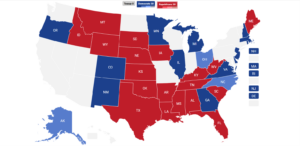
We’re asking this prediction, rather than simply giving it. Polling misses are frequent in Senate elections, especially with the states in question. The Toss Ups right now are Alaska, Iowa, Maine, Ohio, and Texas – all states known to have notoriously bad polling.
We see two scenarios for this Senate: one where Democrats only pick up one or two seats and ultimately come up short, and the other where they sweep everything. There’s plenty of evidence for both.
That said, both parties will need a lot to go right for them in order to take the chamber. The polling averages have Democrats ahead in Alaska, Texas, Ohio, and Maine, but all within standard margins for error. Our best inkling is that former Congresswoman Mary Peltola (D) will flip Alaska, as this is the first Senate race in the Last Frontier under their ranked-choice voting system that features a Democrat and a Republican.
Alaska’s leftward shift over the years doesn’t surprise us, and while it’s still relatively right-of-center, Democrats have a much improved floor as of late. That Senator Lisa Murkowski (R-AK), more of an Independent than a Republican, endorsed Peltola this late in the race gives us pause on two-term Senator Dan Sullivan’s candidacy.
Texas and Ohio are giving us the most agita. In Ohio, a state where the Democrats’ floor has dramatically sunk in the Trump Era, former Senator Sherrod Brown (D) seems poised for a comeback. While Senator Jon Husted (R), appointed to fill the remainder of J.D. Vance’s (R) term, is in line with the typical, pragmatic Republican that Ohioans like, we wonder if this is too much for him to overcome. Trump’s numbers in Ohio are abysmal, and the concurrent gubernatorial race being effectively thrown by Vivek Ramaswamy (R), we think might get Brown just over the finish line to return to the Senate.
In Texas, we’re increasingly skeptical of Ken Paxton’s (R) chances. Whether he wins or loses, he’ll easily go down as perhaps the worst Senate candidate either party has produced in recent memory. If James Talarico (D) wins, it will be the first time since 1988 that a Democrat has won a Senate race in the Lone Star State. That victory will likely be substantiated by massive turnout in the Texas Triangle – something early voting is signalling, but not guaranteeing – and a death-by-a-thousand-cuts scenario for Paxton in rural Texas.
If Paxton does win, it will be by the narrowest of margins. It’s difficult for us to see Texas flipping blue, even in this environment, but we can’t write it off. We’re going with Paxton only because it’s one of those “We’ll believe it when we see it” scenarios, but see it on Tuesday we just might.
In Maine, it’s always a rule of thumb to not bet against a moderate Republican – in this case, five-term Senator Susan Collins (R). Our talks with Mainers say they think she’s a lock for re-election. While she’s down in the polls, it’s only by a modest margin. She’s in a better place than she was in 2020 when Democrats thought they had her beat.
Some late-breaking races in Kansas and South Carolina are giving us some pause as well, and while they’ll be unseasonably close, we think the GOP has enough of a baseline to limp away with both of them.
We don’t see Republicans flipping Michigan, Minnesota, or New Hampshire, and we see Democrats as a solid bet to flip North Carolina and hold Georgia.
That would give Democrats a net gain of 3 seats, just 1 short of the necessary margin to take control of the Senate. Vice President Vance will retain tie-breaking votes to keep nominal control with the GOP.
We’ll be transparent in that we’re unconfident in this prediction, again owing to polling and some scrambled airwaves we haven’t seen in the modern political era. We think seeing a full sweep is not implausible given the climate, but we’ve seen sweep predictions go wrong before. The reality is, the last real Senate sweep for Republicans was in 2014, and 2008 for the Democrats.
Maybe we’re overdue for one, but then again, polarization lingers on. Both are equally reasonable and difficult to believe, and the information we’re getting from people on the ground is only making it more opaque.
 Governors
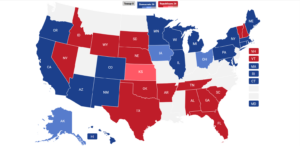
36 states will hold gubernatorial contests on Tuesday. At this point, we see Republicans flipping Kansas – which has long been in the cards – while we see Democrats poised to flip Iowa, Alaska, and Ohio.
Ohio is also giving us agita here. We initially thought the GOP would have an easier time winning here, but this has easily been the nastiest campaign of this cycle. Vivek Ramaswamy’s (R) latest ad appears to have backfired in favor of Amy Acton (D). It’s a “Hail Mary” we’ve seen done by campaigns before, and they can work, but Acton has held onto her modest polling leads since the ad dropped last week.
Ohio hasn’t elected a Democratic governor since 2006, and before that, 1986. We’d say Ohio is overdue for a Democratic governor, especially since Ramaswamy is not at all cut from the cloth of the moderate Republicans Ohioans typically send to Columbus.
The polls do, however, regularly underestimate Republicans, so we’d like to keep this in the Toss Up column and simply shrug our shoulders. But in the interest of putting all the cards on the table, our gut says the GOP will take some serious penalties this year.
In Georgia and Nevada, the former has regularly reliable polling, and the latter has a modestly-net positive incumbent. Both are difficult to contend with in any cycle, and while this cycle gives credence to both of those states flipping, we’re going with the GOP in both.
Democrats have some long-shot opportunities in Nebraska, Oklahoma, Florida, and even Vermont, but we think all remain on the table for the GOP. On the other hand, we’re not counting out Republicans in Wisconsin, Oregon, and New York, but we think the evidence we have says they’ll all win narrowly – Hochul in New York by a tepid margin.
A Final Note
We’ve always enjoyed putting out these forecasts, if anything, to educate the public on the state of the races from an angle not provided by other local outlets. It’s been one hell of a cycle, and we’re frankly glad to see it come to a close.
To reiterate our main points for this forecast: generic ballot midterm polling has been very accurate in 2018 and 2022. If Democrats are on track to win that vote by 8-9 points, we think a 230-seat majority is around where they would win. Individual district polls are almost entirely worthless this cycle, if anything for the sheer lack of them. State polls for Senate and governor have been numerous, yet with fundamental problems. Polling is tricky business and we don’t think the pollsters are up to any tricks, but it’s hard to believe everything they say when we’ve seen the same story throughout the years.
What’s unmistakable: Trump is massively unpopular, even more than he was at this point in 2018, but the Democrats don’t have an ostensible leader and many on the left don’t see them as properly countering Trump’s agenda. We think they take a penalty, but not one to seriously impact their chances of making credible gains.
Disclaimer: Since we print on Thursday, most pundits don’t make their final calls until Monday evening before the election. If any flash polls or last-minute October surprises come in, we can’t account for it. This is the best gauge we can give with the information we have.
And, as always, regardless of whether we’re spectacularly correct or preposterously wrong, we look forward to digging into the autopsy next week as results come in.