
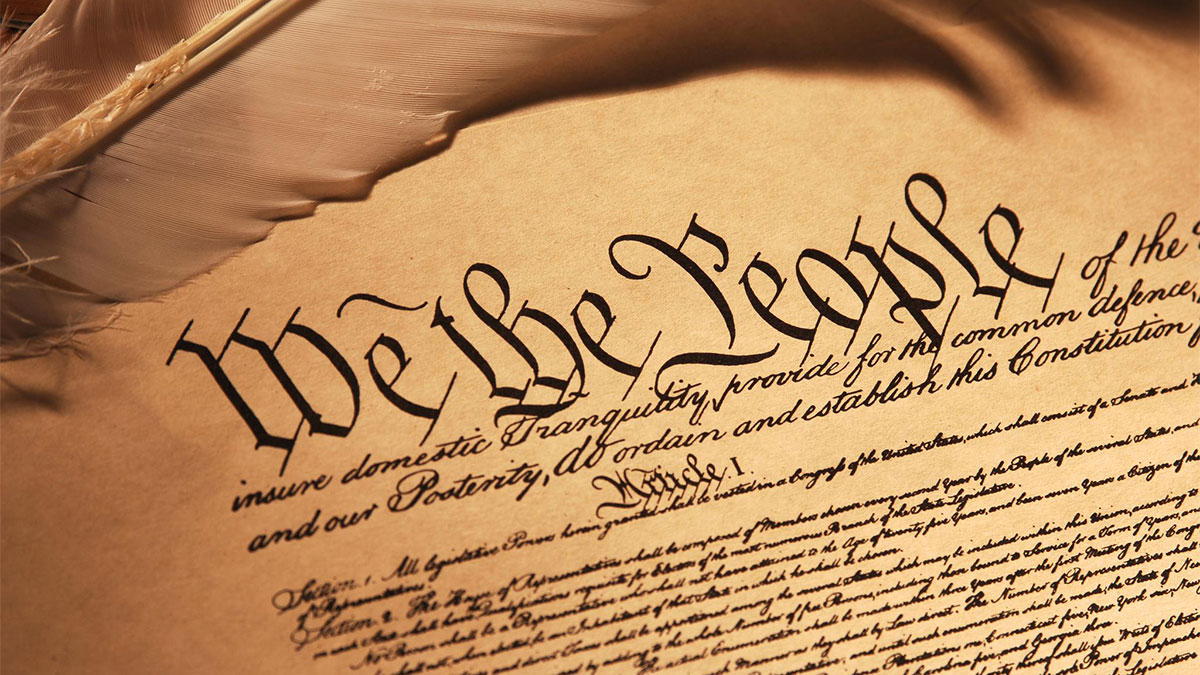
We continue with our deep-dive on the Constitution with Article III.
In a Nutshell
Article I establishes rules for the Legislative Branch, Article II sets up the Executive Branch, and Article III rounds out the “three branches” with rules for the Judicial Branch. Article III establishes the Supreme Court, due process for federal crimes, and a definition of treason.
Section 1
Section 1, Clause 1: Vests the judicial power of the United States in one Supreme Court. Inferior courts may be established by Congress. This also includes the “good behavior” phrase, during which federal judges may serve. This has been interpreted to instill a life tenure on the various courts, subject only removal for treason, bribery, or other high crimes and misdemeanors. This was borrowed from English Law and was meant to protect judges from arbitrary removal by the President or Congress. Article III also entitles federal judges to compensation that may not be decreased during their time in office.
Under Article III’s powers, Congress has authorized about 890 life-tenure judicial positions, 9 of which belong to the Supreme Court. The U.S. Court of Appeals has 179 judges, U.S. District Courts have 680, and the U.S. Court of International Trade has 9. These courts require presidential appointments followed by Senate confirmations.
Congress has also authorized non-Article III courts, which are usually specialized or territorial with set terms. The U.S. Court of Federal Claims accounts for 16 judges with 15-year terms and territorial courts for each of the five overseas U.S. territories with ten-year terms. The U.S. Court of Appeals appoints bankruptcy judges for 14-year terms, and district court judges appoint federal magistrate judges for eight-year terms.
Interesting Note: This exact clause would require an amendment to place term limits on the Supreme Court, a common consensus among right-wing and left-wing populists as of late, and one that is growing in sentiment. The Constitution, however, is silent on how many justices the Supreme Court has. The number has fluctuated throughout the years.
The original size set by Congress in 1789 was 6 justices. In 1807, a seventh justice was added, followed by a 9-justice court by 1837. The new justices were added as the country expanded westward. In 1863, the court reached its peak size at 10 justices, tied to the creation of the Pacific states. In 1866, the number was reduced to 7 justices by attrition, although the court never dropped below 8 justices. The Judiciary Act of 1869 was permanently fixed at 9 justices – one Chief Justice and eight Associate Justices.
Since the Constitution does not impose a set number of Supreme Court justices, and since Congress has the power to alter that number through a simple bill, there has always been a clearer path to Supreme Court reform through congressional action. Imposing term limits or other obligations would require a constitutional amendment ratified by most states. This is why there have been numerous pushes throughout history and renewed calls nowadays for Congress to take this approach. Moreover, such a bill would not require a supermajority of both chambers of Congress. A simple majority of both the House and Senate would be required before the President’s signature.
The only obstacle to that glidepath is the Senate filibuster, virtually a form of endless debate until deliberately ceased by 60 votes. Since the Senate has been closely divided for a number of years, that cloture-invoking vote has been elusive, making for a primary reason “packing the Court” has not occurred. However, that rule of the Senate has been circumvented before with the “nuclear option.”
Section 2, Clause 1: This clause outlines the scope of the federal judiciary’s power. It extends to all law and equity cases under the Constitution, the laws of the U.S., and all treaties made under the federal government’s authority. The federal judiciary’s prerogative is in hearing cases affecting ambassadors, public ministers, admiralty and maritime jurisdictions, controversies to which the U.S. is a party, controversies between two or more U.S., controversies between a state and citizens of other states, and controversies between citizens of different states. The federal courts also hear cases between citizens of the same state claiming lands under grants of different states and cases between a state or its citizens and foreign states or subjects.
This clause is also the basis for the “diversity jurisdiction,” which is the authority of federal courts to hear civil cases between parties when the cases involves state-law claims and no federal question. The Founding Fathers’ intention here was to levy the federal judiciary as a neutral arbiter in cases arising between states, citizens of different states, and foreign subjects, rather than leaving a chance one state favors its own citizen(s) over those of another. This has been ironed out in statute: no plaintiff may be a citizen of the same state as any defendant – otherwise it is purely an issue of the state’s prerogative – and the amount at stake must exceed $75,000, not accounting for interests and costs.
Congress can grant the inferior federal courts powers on these types of cases, but not to the full extent of what Article III allows. This all extends to civil cases, not criminal. Corporations are treated as citizens of both their state of incorporation and principal state of business.
Cases can move from the state level to the federal level if it is found to pass the “diversity jurisdiction” test. Congress can alter or abolish this provision at any time.
Section 2, Clause 2: Cases affecting ambassadors and foreign ministers and cases in which a state is a party belong under the Supreme Court’s jurisdiction. They bypass lower courts. The Supreme Court has appellate jurisdiction in all other cases, meaning it reviews decisions of lower federal or state courts.
This clause is also known as the Exception Clause. It gives Congress power to limit the Supreme Court’s appellate jurisdiction, although rather vaguely.” In other words, this clause acts as a traffic cop for directing litigation to the Supreme Court’s docket.
Section 2, Clause 3: All federal criminal cases, except those of impeachment, have a right to a jury trial. Clause 3 requires that the trial must take place in the state in which the crime was committed. When a crime is committed outside the boundaries of a state – such as in overseas territories, places under exclusive federal control, or in international waters, Congress must pass a bill designating a trial location.
For impeachment cases, Article I, Section 3 lays out those parameters. The Senate acts as the jury with the Supreme Court’s Chief Justice acting as the judge.
This clause was later bolstered by the Sixth Amendment, which included language for a right to a speedy and public trial, an impartial jury, and assistance of counsel when the defendant cannot afford one.
Interesting Note: Here is a well-documented theoretical loophole that tests constitutional law. Yellowstone National Park is under exclusive jurisdiction of the federal court. It is located almost entirely within Wyoming, but small parcels of the park extend into Idaho and Montana. None of those states can prosecute crimes committed inside the park. The U.S. District Court for Wyoming contains the entire park, making it the only federal judicial district that cross state lines.
Since Article III, Section 2, Clause 3 requires that crimes be prosecuted in the location of their commitment, and since the Sixth Amendment entitles the accused to an impartial district of the “state and district” in which the crime was committed, this requires those accused of committing a crime in the Idaho portion of Yellowstone a jury of people living in both the State of Idaho and the District of Wyoming.
However, no jury can technically be assembled since the Idaho strip of Yellowstone is uninhabited.
This has been called the “Zone of Death,” as cheeky researchers say that murder can effectively be committed here with no legal recourse.
However, the practical results have never been tested and no one has tried to escape prosecution here. This applies only to serious crimes, not petty offenses. Congress could easily close this loophole by reassigning the Idaho and Montana sections of Yellowstone to their respective state judicial districts, but has never done so.
Section 3, Clause 1: This clause defines treason as acts consisting of levying war against the United States and adhering to or giving comfort or aid to the enemies of the United States. No person can be convicted of treason unless at least two witnesses testify to the same act or if the accused confesses in an open court. These narrow definitions were adopted to intentionally make treason difficult to prove and to prevent political abuse.
Section 3, Clause 2: Congress has the power to declare the penalties for committing treason. The current penalties under U.S. law are death or imprisonment and fines. Clause 2, however, imparts two important restrictions to protect the family of the person convicted of treason. The phrase “no corruption of blood” means the traitor’s children or heirs cannot be punished or lose their inheritance rights because of the crime of a parent. It also prevents property of the convicted being forfeited only during the lifetime of the convicted. It cannot be permanently taken from the family line.
These failsafes were built to counter political accusations of treason and hereditary punishments that were common under English Law.