

We’re getting back into our mini-series on the federal executive departments. This week’s model is the Department of Labor.
History and Origin
The first signs of a Department of Labor were in 1884, when Congress established the Bureau of Labor Statistics – then a bureau of the Department of the Interior. Their purpose was to collect economic data, which they began in 1884, and published their first report in 1886. In 1888, the Bureau of Labor became an independent Department of Labor, but it was not given any executive rank in the Cabinet.
The Department of Labor (DOL) was formed on March 4, 1913, the final day of President William Howard Taft’s (R-OH) presidency, as he had been defeated for re-election in 1912. The department’s establishment arrived at an opportune time, as the Taft Administration is generally seen as more of the tail end of the Progressive Era, which had dominated American politics with the onset of the Industrial Revolution. Two significant prerogatives of the movement were to advocate for better working conditions and conservation of resources.
The organic act that established the Labor Department cited its main purpose, “to foster, promote, and develop the welfare of working people, to improve their working conditions, and to advance their opportunities for profitable employment.”
The Labor Department originally consisted of just four pre-existing bureaus of the Department of Commerce and Labor, with a total staff of about 2,000 and a budget of $2.33 million, according to the Labor Department’s official website.
The first Labor Secretary was William B. Wilson (D-PA), appointed by President Woodrow Wilson (D-NJ) – no relation. His father left his native Scotland during a mining strike to find work in the U.S. After he settled down in Pennsylvania’s coal country, he sent for his family. Secretary Wilson would, at the age of 9, quit school and help his father in the coal mines. He would become a labor organizer and later serve as secretary-treasurer of the United Mine Workers for American from 1900 to 1908 before serving a short stint in the U.S. House, where he would chair the House Committee on Labor.
Wilson’s tenure would be marked by wage-earner interests, the creation of the U.S. Conciliation Service – an agency within DOL that would bring settlements to labor disputes through mediation – and the organization of wartime employment during WWI, which included the eight-hour work week and collective bargaining.
Early bureaus included the Bureau of Labor Statistics (BLS), the Bureau of Immigration, the Bureau of Naturalization, and the Children’s Bureau.
The department would also mitigate a wake of strikes that threatened the post-war economy, and it would have oversight during the “Red Scare.” The Bureau of Immigration was ordered by the Department of Justice to deport all “dangerous” Communist aliens. Only 556 proven Communists were deported.
In 1933, President Franklin D. Roosevelt (D-NY) appointed Frances Perkins (D-NY) to head DOL, making her not only the first woman to preside over DOL, but the first woman ever to serve in a presidential cabinet. She was one of just two officials to remain in Roosevelt’s cabinet for his entire presidency, which ended with his death in 1945.
The DOL enforces over 180 federal laws that are concerned with worker safety, wages, benefits, and rights. Some key pieces of legislation include:
- 1. The Fair Labor Standards Act (FLSA) of 1938, which set federal standards for minimum wage, overtime pay, and child labor work thresholds.
- 2. The Occupational Safety and Health Act (OSHA) of 1970, which enforces safe working conditions.
- 3. The Employee Retirement Income Security Act (ERISA) of 1974, which offers protection for pension and welfare plans.
- 4. The Employee Polygraph Protection Act (EPPA) of 1988, which prohibits most private employers from utilizing lie detector tests.
- 5. The Family and Medical Leave Act (FMLA) of 1993, which allows employees to take unpaid leave for specific family and medical issues while the worker’s job is protected.
- 6. The Health Insurance Portability and Accountability Act (HIPAA) of 1996, which regulates health insurance coverage and patient privacy protection.
The Department of Labor Today
Today, the DOL workforce is just under 11,000 full-time employees and their requested budget for FY2026 was $53.3 billion – a $16.2 billion decrease from FY2025. A big chunk of that came from a $4.5 billion reduction in the department’s discretionary spending.
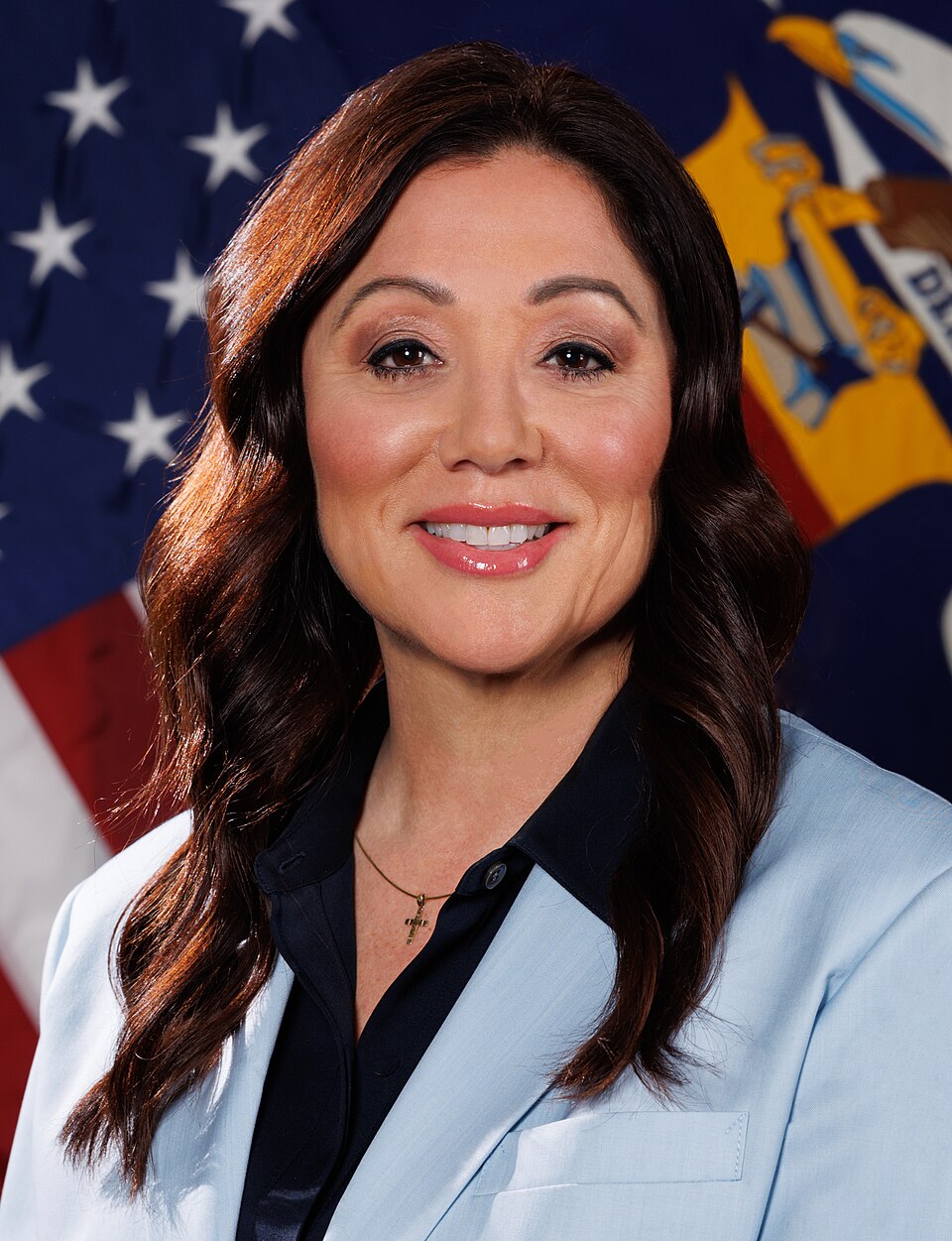
The thirtieth and current Secretary of Labor is Lori Chavez-DeRemer (R-OR). She served eight years as the Mayor of Happy Valley, Oregon, before flipping a swing seat blue in 2022. She defeated a progressive Democrat who had primaried a moderate, long-served incumbent in OR-05, a suburban swing district that runs from southern Portland to the tourist town of Bend. Chavez-DeRemer was narrowly defeated for re-election in 2024.
President Donald Trump (R-FL) unveiled the Oregon Republican as his pick to lead DOL. Chavez-DeRemer was seen as one of the less controversial Trump nominees and was confirmed by the full U.S. Senate in a 67-32 vote last March.
Chavez-DeRemer has prided herself on returning the aforementioned $4.5 billion in unused COVID-era funds and has urged states to not provide unemployment benefits to illegal immigrants. The DOL, under her leadership, has rescinded a 2022 directive that warned fiduciaries to “exercise extreme care” when handling cryptocurrency in 401(k) plans. That plan later made itself the basis of a Trump Executive Order.
Chavez-DeRemer, however, is under investigation for alleged misuse of office, including using official trips to see family and personal friends, drinking on the job, and an affair with a member of her security detail. Her husband, Shawn DeRemer, is also alleged to have inappropriately touched two women at DOL Headquarters in Washington. Two top aides to the secretary have resigned as of last week.
Agencies, Boards, and Bureaus
DOL has several offices and administrative divisions. For our purposes, we’ll discuss the various categories that represent the true teeth of DOL.
Administrative Review Board (ARB): A five-member board appointed by the Secretary of Labor who issues final agency decisions on appeals of worker protection laws. Established in 1996, the ARB hears cases including whistleblowers, environmental, immigration, child labor, and federal contracts.
Benefits Review Board (BRB): Created in 1972, this board reviews and issues decisions on appeals of workers’ compensation claims under the Longshore and Harbor Workers’ Compensation Act and the Black Lung Benefits Act. In other words, the BRB handles appeals related to injuries in maritime and coal mining environments, primarily.
Bureau of International Labor Affairs (ILAB): Manages DOL’s international affairs. As per their mission statement, they work to “ensure that workers around the world are treated fairly and are able to share in the benefits of the global economy.” Founded in 1947, ILAB represents the U.S. at trade negotiations and international bodies, such as the World Trade Organization (WTO). It also provides technical assistance to other countries to combat child labor and human trafficking.
Bureau of Labor Statistics (BLS): Founded in 1884, the BLS is the principal fact-finding federal agency on labor economics and statistics. It collects, analyzes, and distributes statistical data to the public, Washington, state and local governments to inform on economic and labor issues.
Employee Benefits Security Administration (EBSA): This bureau, created in 1970, administers, regulates, and enforces the provisions of Title I of ERISA.
Employees’ Compensation Appeal Boards (ECAB): This body hears appeals and awards in workers’ compensation cases under the Federal Employees’ Compensation Act. The board has final say in determining liability of the federal government regarding death or injury of employees within the scope of employment. Three members are appointed by the Secretary of Labor.
Employment and Training Administration (ETA): Provides training, employment, labor market information, and income maintenance services, according to DOL’s website. ETA handles federal job training, federal grants to states for public employment programs, and unemployment insurance benefits. Programs such as Job Corps, Trade Adjustment Assistance, and Workforce Innovation in Regional Economic Development (WIRED) are projects of the ETA.
Mine Safety and Health Administration (MSHA): Created in 1977, MSHA administers the provisions of the Federal Mine Safety and Health Act of 1977 with the goal of eliminating fatal accidents, reducing frequency and severity of injuries, promoting health conditions in the mines, and minimizing health hazards. MSHA’s Coal Mine Safety and Health Division is divided into twelve districts that contain coal mining across the country. The Metal-Nonmental Safety and Health Division has six districts.
Occupational Safety and Health Administration (OSHA): Founded in 1934 as the Bureau of Labor Standards, OSHA has federal visitorial powers to inspect workplaces under the OSH Act, signed into law in 1970. OSHA’s purpose is to set and enforce workplace safety standards and provide training and education.
Pension Benefit Guaranty Corporation (PBGC): The PBGC was created by ERISA to encourage the use of private defined benefit pension plans.