


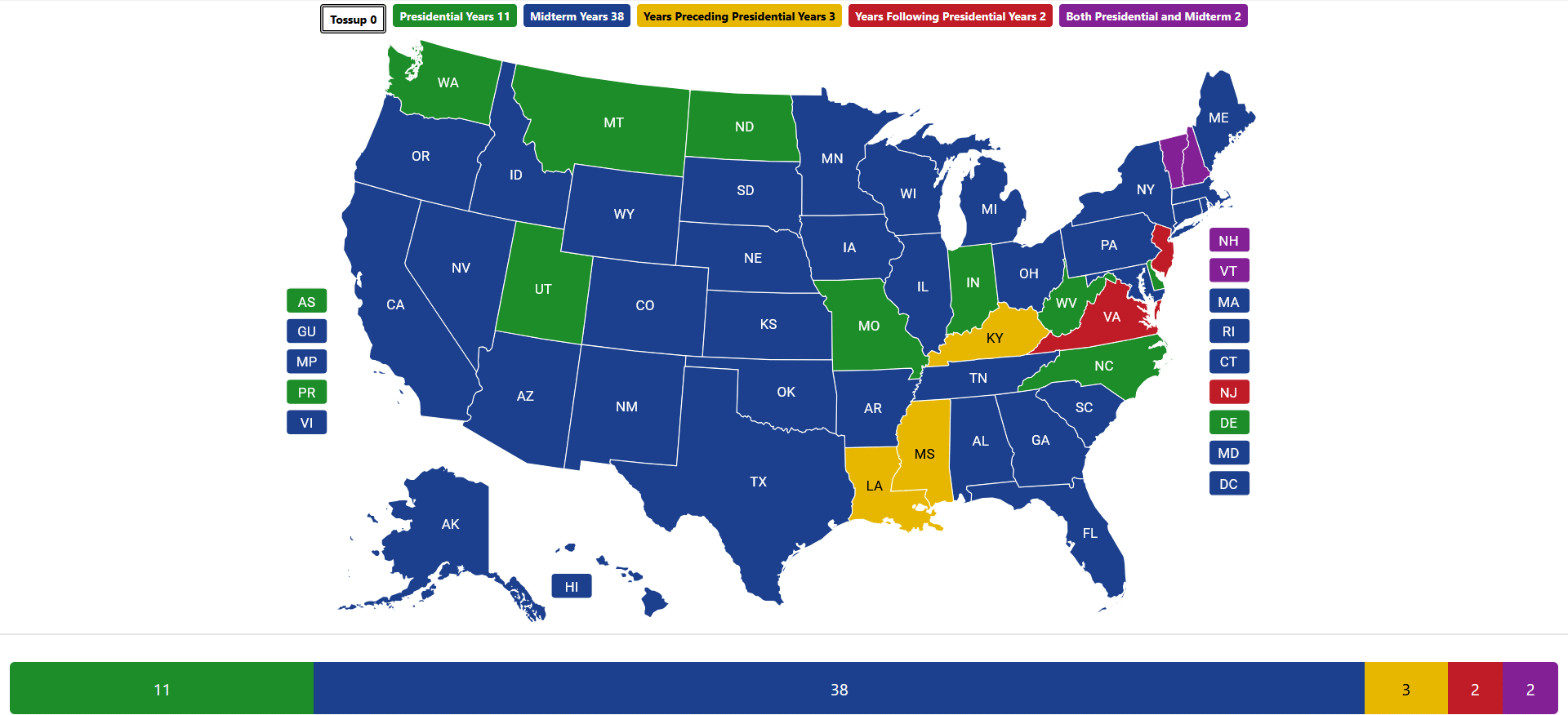
Since we’re intently watching the two gubernatorial elections held this November – Virginia and New Jersey – we’ll dig into why the state and territorial gubernatorial elections operate on the calendars they do.
As we’ve discussed in a previous iteration of this column, gubernatorial elections are cut from an entirely different political cloth than presidential, senatorial, and other statewide elections. We find three tenets that are key to governors’ elections: local issues, candidate quality, and retail politics. This makes for why both parties can find reasonable levels of success in all states. A quick example, Republicans currently govern the blue states of Vermont and Virginia – pre-2018, they had New Mexico, Illinois, Massachusetts, and Maryland – while Democrats currently hold Kansas, Kentucky, and North Carolina – pre-2018, they even had Montana, Louisiana, and West Virginia.
History and Purpose
The primary reason that many states have historically held their elections in off-years – those not aligned with presidential contests – is so that the states can operate within separate political vacuums, more or less removed from the nationalized politics that tend to dominate presidential elections, especially in the modern era.
Other states have more nuanced reasons. The two states up this year have interesting historical reasons for their gubernatorial and state legislative contests held in the years immediately following a presidential race.
New Jersey once had even- and odd-year elections. One-third of its Senate – whose members served unusual three-year terms – while its House was elected annually. The governor also served three-year terms, so the gubernatorial contest alternated between even- and odd-year elections. The 1947 State Constitution formalized the process, setting the Assembly terms to two years and Senate and gubernatorial terms to four years.
That constitutional change was largely due to then-Governor Alfred E. Driscoll (R) urged the convention that state elections should not coincide with presidential races, saying, “the problems confronting the state are frequently distinct from those confronting the nation.”
Virginia, on the other hand, has been holding odd-year elections since 1851. The rewritten constitution called for elections every two years. Since the first elections were held that year, the tradition has been carried on ever since.
In Louisiana, which holds state elections in years immediately preceding presidential elections, their revised state constitution in 1974 organized the elections for those years. A large reason was because of Louisiana’s then-solidly Democratic profile. Parties held their primaries in odd-year winters, with necessary runoffs held the following January. Since Republicans were such a political minority in Louisiana from Reconstruction until the 1980s, Democratic primaries were more or less coronations of a virtually guaranteed victor. The primary system was scrapped in 1975, with the general election system replacing it that year.
But Mississippi was the first state to organize an odd-year schedule, starting in 1817. The state constitution required annual elections for the entire House and a third of the Senate. By 1832, two-year terms for both chambers were then adopted.
It’s also worth mentioning that many states have shifted their gubernatorial term limits throughout the years. Many more states were once held in both gubernatorial and presidential years as their governors served two-year terms. In the modern, four-year terms is the status quo in all but two states. Rhode Island is the most recent state to shift from two-year terms to four-year terms, having made the change in 1994.
Presidential-Year Gubernatorial Contests
Currently, eleven states and two territories hold their contests in presidential years – consult the map above for which states elect governors in which years.
These states are arguably in the most nationalized environment, although ticket-splitting has been recent. The GOP has governed Vermont, Missouri, and New Hampshire since they flipped those seats in 2016. West Virginia and Montana elected Democratic governors in 2016, despite Donald Trump (R-NY) winning both states handily. That same year, Democrats flipped North Carolina, even as Trump won a state seen as crucial to his path to 270. Four remaining states – Washington, Utah, North Dakota, and Delaware – have been electing one party since the 1980s, while Indiana has stuck with Republican governors since 2004.
Midterm-Year Gubernatorial Contests
These are where the lion’s share of gubernatorial seats are. Thirty-six states and three territories are on the ballot in these years. These include crucial swing states, solidly red and blue states, and the territories of Guam, the Northern Mariana Islands, and the U.S. Virgin Islands. The District of Columbia also holds its mayoral election in midterm years.
The midterm-year contests can be susceptible to partisan wave elections, but it’s important to note that gubernatorial politics are incredibly idiosyncratic. Many states elect their governors on a two-term basis – that is, one party serves two terms, then the other party gets two terms. Many states operate on this like clockwork, including Michigan, Kansas, Wisconsin, and New Mexico.
2010 saw a big gain for the GOP in gubernatorial contests. They picked up twelve states, while Democrats picked up five. Interestingly, that year saw the GOP flip Wyoming, perhaps the reddest state in the union, and the Democrats flip Hawaii, one of the bluest – a testament to how removed from national overtones gubernatorial politics can be – and often is.
2018 was another wave election, this time for the Democrats. They picked up seven seats, while the GOP only flipped Independent-held Alaska. Many of these governors are term-limited or retiring for 2026: Michigan, Illinois, Maine, Kansas, New Mexico, and Wisconsin are the pickups Democrats made that year. The GOP still managed to score landslide wins in deep-blue Maryland, Massachusetts, and Vermont that year, while Florida kept its GOP gubernatorial voting streak alive with Ron DeSantis (R) – perhaps the earliest harbinger of Florida becoming a Republican stronghold nowadays.
But these two elections also saw a significant convergence: term-limitation of incumbents amidst wave elections. There’s evidence that many states in 2010 and 2018 would have flipped to the opposite party, regardless of the environment. National environments certainly do help, but it’s not the basis for many gubernatorial contests.
Here’s a good benchmark of comparison. In 2018, Democrats won the House popular vote 53.4%-44.8% – about nine points. That same year, Democrats won the Senate popular vote 58.2%-38.7% – a massive twenty-point gap owing to the twenty-four seats they had up that year, compared to the GOP’s nine.
But they won the gubernatorial popular vote 51.39%-48.28% – just about three points. The GOP had twenty-six seats up compared to the Democrats’ nine, but the contrast in popular vote compared to the national environment is markedly different. This is yet another reason that gubernatorial contests are of a different breed of politics altogether.
Contests Held in Years Preceding Presidential Elections
Three states hold contests in years before a presidential race: Kentucky, Louisiana, and Mississippi. All three have seen political whirlwinds. Republicans flipped Louisiana in 2023, after eight years of arguably one of the nation’s most moderate, pro-life Democrats, John Bel Edwards (D). Part of his election in 2015 was upon Bobby Jindal’s departure from office as one of the most unpopular governors in the country.
Democrats ousted another unpopular governor in Matt Bevin (R-KY) in 2019. Andy Beshear (D-KY) managed to oust him primarily on state education policy, and survived a close re-election bid in 2023. He’s now seen as a formidable presidential candidate in 2028 as one of the nation’s most prominent moderate Democrats, although he lacks name recognition compared to his counterparts. This is a great example of how off-year elections, held sans national moods, can elevate one to presidential ambitions.
Finally, Mississippi, which hasn’t elected a Democratic governor since 1999, saw a close election that saw incumbent Tate Reeves (R-MS) narrowly re-elected in 2023. Reeves won a close race in 2019, and faced Brandon Presley (D), the second-cousin of the late, great Elvis Presley, as an interesting sidenote.
Contests Held in Years Following Presidential Elections
You are here.
Virginia and New Jersey are the only two states holding gubernatorial elections this year.
New Jersey is one of those states that tends to elect two terms of one party, followed by two terms of another, more or less. This makes for a good harbinger for Jack Ciattarelli (R) to flip the state red, although it’s not ironclad. Given New Jersey’s long-held blue hue, this is usually seen as a good temperature check against the White House party’s electoral fortunes for the following midterm. Although, the GOP has picked some 200,000 new registered voters in the Garden State since 2021, and New Jersey’s presidential race last year was the closest it’s been in decades.
In Virginia, a built-in political institution dominates its gubernatorial politics. In every election since 1977, except for 2013, Virginians have elected a governor opposite the White House party. Its reliably contrarian streak was thought to be dead in 2021, owing to then-President Joe Biden’s (D-DE) historic ten-point win in the Old Dominion in 2020, and Virginia’s overall bluer profile.
But Glenn Youngkin (R-VA) proved that contrarian streak to be alive and well, which leads most prognosticators – including The Messenger – to assume that that streak will benefit former Congresswoman Abigail Spanberger (D).
Term Limits
Like their election years, states have varying regulations on term limits, with some having none at all, to others barring one from serving for life after two terms.
No Term Limits, Four-Year Terms: Eleven states, plus D.C. and Puerto Rico
No Term Limits, Two-Year Terms: Vermont and New Hampshire
One Term, Re-Eligible After Four Years: Virginia
Two Terms, Re-Eligible After Four Years: Twenty-three states, three territories
Two Terms, Re-Eligible After Eight Years: Four states.
Two Terms, Limited for Life: Nine states, one territory.