


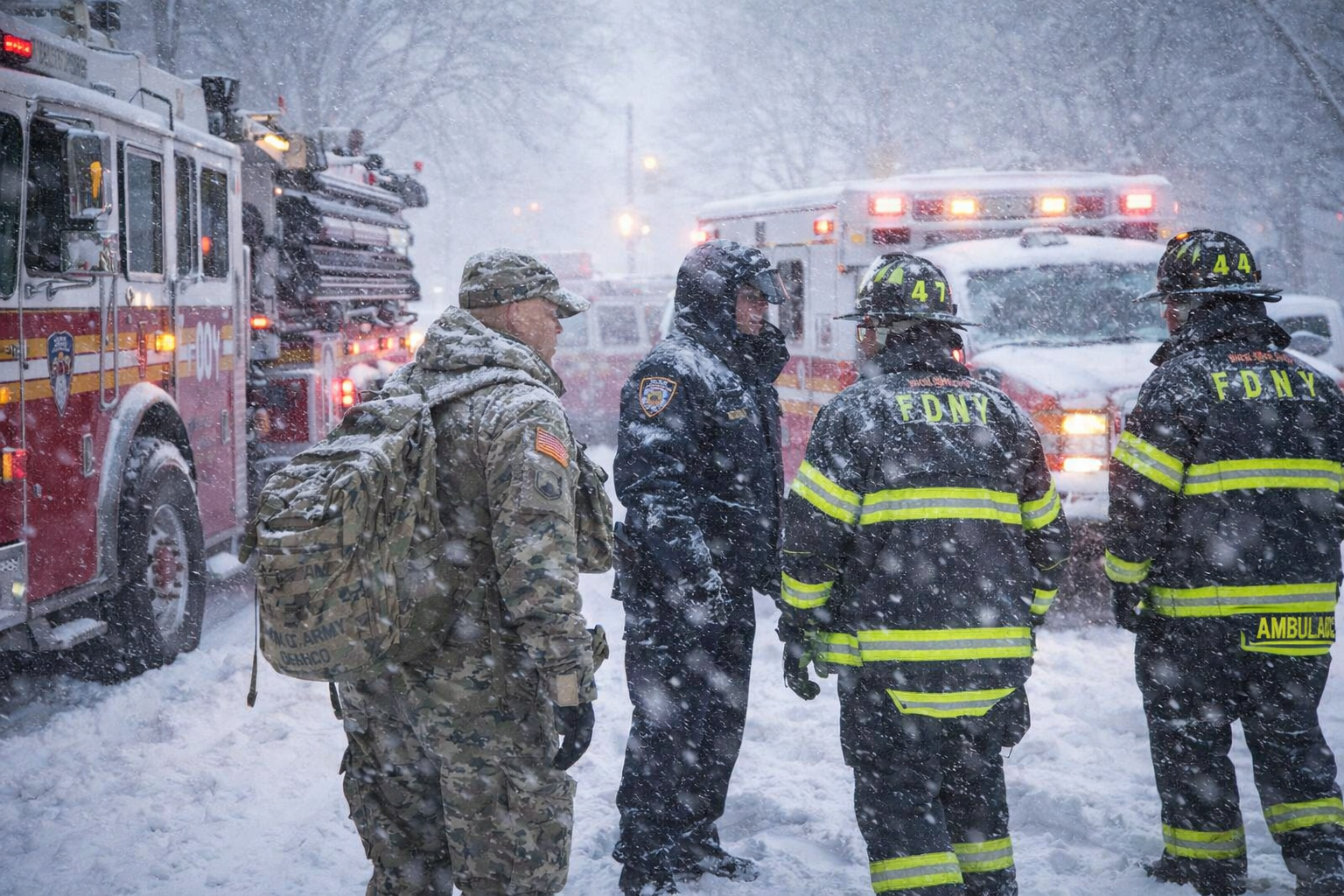
As New York endures what officials have described as one of the most significant winter storms in years, the focus should be singular: public safety. Roads are hazardous, power outages are a growing concern, and vulnerable populations face real risk as temperatures drop and conditions worsen.
It is in this context that Governor Hochul confirmed that federal assistance was offered to New York ahead of the storm. In a public statement, the Governor said that while assistance was offered, she conveyed that the “fastest way to help” would be for federal immigration enforcement to “back off,” so people would feel safe accessing warming centers, shelters, hospitals, and houses of worship.
Those remarks are notable—not because immigration policy is irrelevant, but because emergencies demand clarity of purpose. Disaster response exists to reduce risk to life and property. Federal assistance is not symbolic; it is logistical, operational, and often time-sensitive. It is designed to supplement state and local capacity precisely when conditions deteriorate beyond routine response.
In an active emergency, the question is not whether policy disagreements exist. The question is whether every available resource is being used to protect lives.
Nassau County Executive and Republican gubernatorial candidate Bruce Blakeman summarized that concern succinctly:
“As we brace for the largest winter storm in years, Kathy Hochul actually rejected federal assistance that was offered to help keep people safe. When lives are at risk, you don’t turn down help—you take every available resource. This isn’t about politics. It’s about public safety.”
That statement reflects a core principle of emergency management: crises narrow the margin for error. Introducing conditions—particularly those unrelated to weather response, infrastructure, or emergency logistics—adds complexity where simplicity is essential.
This does not negate broader debates over immigration enforcement or community trust. Those debates matter. But emergencies are not abstract policy discussions. They are moments when execution outweighs messaging and coordination outweighs positioning.
As the storm unfolds, New Yorkers will judge leadership not by intent, but by outcomes: whether warming centers are accessible, whether response times are swift, and whether preventable harm is avoided.
Public safety is not advanced through conditional cooperation. It is advanced through decisive action, clear priorities, and the full use of available resources—especially when the storm is no longer approaching, but already here.