


We’re continuing our mini-series on the federal executive departments, picking up this week where we left off with the Department of Transportation (DOT).
History and Origin
The DOT came into fruition during the administration of President Lyndon B. Johnson (D-TX). In 1965, the Federal Aviation Agency (FAA) urged Johnson to create a Cabinet-level department to merge the jobs of the FAA and the Undersecretary of Commerce for Transportation. This was due to the fact that the Federal Highway Administration and the Federal Transit Administration provided considerable funding for state and local projects, but they lacked the oversight of construction and operation. Article I, Section 8, Clause 3 of the Constitution, also known as the Commerce Clause, broadly defines “commerce” to include navigation and reinforces the federal oversight of railroads and aviation.
In October 1966, Congress authorized a new Department of Transportation at Johnson’s urging, and effective April 1, 1967, the DOT was able to use federal funds more effectively to support the nation’s transportation network.
The creation of the DOT allowed for over thirty agencies to be merged into the new Cabinet department. The Federal Highway Administration brought with it the Bureau of Public Roads, created in 1918, later transferred to the Department of Commerce in 1949; the Bureau of Motor Carrier Safety, created in 1913; and the National Highway Safety Bureau, an amalgamation of two separate entities within the Commerce Department.
The Urban Mass Transportation Administration landed at DOT after existing under the Department of Housing and Urban Development for a short time.
The Federal Railroad Administration was created with the DOT Act and brought in from Commerce the Alaska Railroad, originally from the Department of the Interior, the Bureau of Railroad Safety and Service of the Interstate Commerce Commissions, and the Office of High Speed Ground Transportation.
The National Highway Traffic Safety Administration was also created from two entities within Commerce. The U.S. Coast Guard also found a temporary home in DOT, coming over the Treasury Department.
Alan S. Boyd (D-FL) served as the first Secretary of Transportation under President Johnson. He had served as Under Secretary of Commerce for Transportation under Johnson and was part of the committee that lobbied the president to create the department. Boyd received early scrutiny from labor unions for advocating for tighter restrictions and his denouncement of featherbedding by railroad workers.
According to the University of Virginia’s Miller Center, Boyd prioritized “airport modernization, air traffic control requirements, and auto safety standards for driver education and alcoholism.” He also helped acquire funds for the Highway Beautification Program, an initiative of First Lady Lady Bird Johnson. The Miller Center also cites his “inability to revitalize passenger rail service” as one of his biggest failures.
When Richard Nixon (R-CA) took office in 1969, Boyd became the president of the Illinois Central Railroad, which led to conflict-of-interest allegations against Boyd when the DOT had given the railroad over $25 million in aid. Boyd was cleared of wrongdoing and would later serve as president of Amtrak until June 1982.
The DOT Today
The DOT’s FY2026 budget request topped out at $147.1 billion, an increase of $27 billion or 6% from FY2025. The budget brought total staffing up to about 55,000, of which the FAA has the lion’s share at over 45,000. In total, the DOT accounts for about 2.5% of the overall federal civilian workforce, according to USAFacts.org. It also called for a $22 billion hike to the FAA for air traffic controllers. The Federal Highway Administration is the most expensive agency of the department, with this year’s budget clocking in at $64.3 billion.
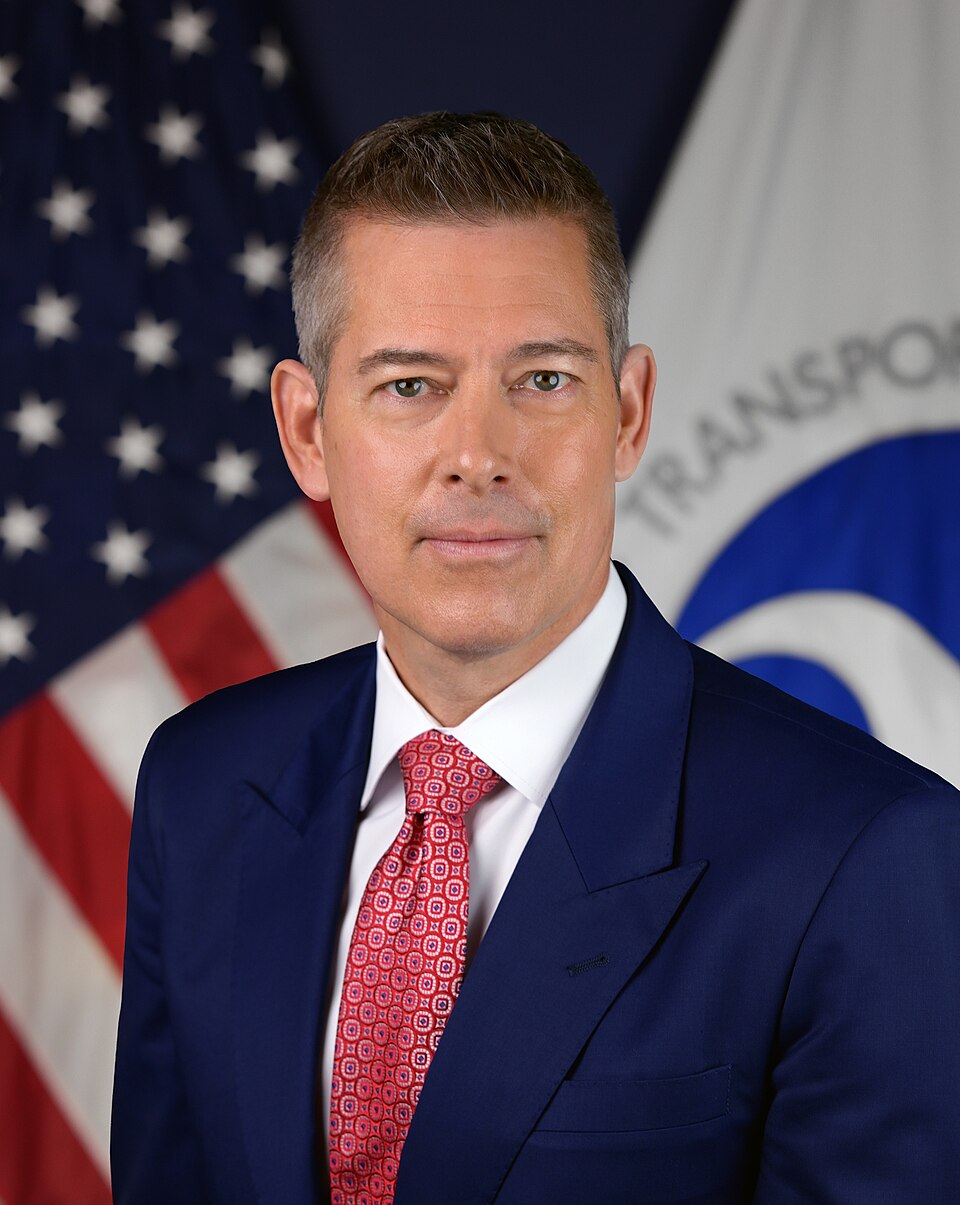
The twentieth and current Secretary of Transportation is Sean Duffy (R-WI), a lawyer who would gain national recognition as a professional lumberjack athlete, appearing on television in that capacity. He would begin his legal career in Ashland County, Wisconsin, and serve as district attorney upon his election to the U.S. House in 2010. He represented WI-07 until 2019 and would host “The Bottom Line” on FOX Business starting in 2023.
During his tenure as Secretary, Duffy has objected to New York City’s congestion pricing, even threatening to revoke the program’s federal approval. He also threatened to withhold federal funding from the MTA over subway crime and he did cut funding for the Texas Central Railway and the California High-Speed Rail. Under Duffy, the federal government has taken the reins on the $7 billion Penn Station reconstruction project. The initiative pushed the MTA out and instead has the Federal Railroad Administration and Amtrak, the latter being the owner of the station, running the public-private partnership.
He also pushed back on Elon Musk’s prerogative at the Department of Government Efficiency to fire air traffic controllers and moved to revert corporate average fuel economy (CAFE) standards set by the Biden Administration. Duffy is also intent on directing federal assistance to high-birthrate areas.
Duffy also briefly served as Acting Director of the National Aeronautics and Space Administration (NASA) from July to December 2025 until the appointment of Jared Isaacman (R-NJ).
Bureaus and Agencies
National Highway Traffic Safety Administration (NHTSA): According to the DOT’s website, they are “responsible for reducing deaths, injuries, and economic losses resulting from motor vehicle crashes.” The agency sets and enforces “safety performance standards for motor vehicles and equipment,” and “conduct[s] effective local highway safety programs.” They also advocate for fuel economy standards, safety belt usage, air bags, child safety, anti-theft regulations, and customer information. They investigate odometer fraud and safety defects in motor vehicles.
Federal Aviation Administration (FAA): This branch oversees civil aviation safety. They issue and enforce regulations and standards related to the “manufacture, operation, certification, and maintenance of aircraft.” The FAA rates and certifies the airmen and the airports that serve carriers. The FAA also operates a network of airport towers, air route traffic control centers, and flight service stations, all to develop air traffic rules, allocate airspace, and secures air traffic to meet national defense requirements. The FAA also regulates commercial space transportation and licenses those facilities and launches.
Federal Highway Administration (FHWA): This agency “coordinates highway transportation programs” in concert with states and partners to “enhance the country’s safety, economic vitality, quality of life, and the environment.” The Federal-Aid Highway Program provides federal funds to states to construct and improve the National Highway System, as well as urban and rural roads and bridges. The FHWA also provides access to and within national forests, national parks, Indian reservations, and other public lands.
Pipeline and Hazardous Materials Safety Administration (PHMSA): This agency oversees the “safety of more than 800,000 daily shipments of hazardous materials in the U.S.,” – accounting for 64% of the nation’s energy that is transported by pipelines. They work to eliminate “transportation-related deaths and injuries in hazardous materials and pipeline transportation” and actions that harm the natural environment.
Federal Motor Carrier Safety Administration: Created in 2000, this bureau serves to prevent commercial motor vehicle-related accidents and deaths. They enforce safety regulations, “targeting high-risk carriers and commercial motor vehicle drivers,” as well as improve technologies and operating standards.
Federal Railroad Administration (FRA): This bureau prompts “safe and environmentally sound rail transportation” by inspecting railroad compliance to federal standards, including track maintenance and operating practices. The FRA also researches and develops projects that support its safety mission to “enhance the railroad system as a national transportation resource.” They also run public education campaigns on highway-rail grade crossing safety and the dangers of trespassing on rail property.
Federal Transit Administration (FTA): This branch helps “plan, build, and operate” transit systems with “convenience, cost, and accessibility” at the forefront. They acknowledge buses and rail as the most common types of mass transit, but also look at ferries, trolleys, inclined railways, subways, and “people movers.” They also maintain leadership of “advanced local transit systems” and assist in the “development of local and regional traffic reduction.” The National Transit Library is run by the FTA, a document center for those “interested in transit and transit-related topics.”
Great Lakes St. Lawrence Seaway Development Corporation (GLS): Runs a “safe, reliable, and efficient waterway” for commercial and noncommercial vessels between the Great Lakes and the Atlantic Ocean. Jointly with Canada, it inspects vessels, controls traffic, and aids in navigation.
Maritime Administration (MARD): prompts the “development and maintenance of an adequate, well-balanced, United States merchant marine” to support, protect, and develop the U.S. maritime industry. Its prerogatives are ensuring that the nation “enjoys adequate shipbuilding and repair service, efficient ports, effective intermodal water and land transportation systems, and reserve capacity shipping in time of national emergency.”
The U.S. Merchant Marine Academy is one of Long Island’s gems. Located in Kings Point, the USMMA is set to receive about $200 million in federal funding this year.


