



National, State, and Local Temperature Checks
National
It was a tumultuous week in Washington.
The 2026 Iran War continues to unfurl across the Middle East. The U.S. and Israel have struck dozens of sites across Iran, mostly in the western part of the region, as well as parts of Iraq and Lebanon. Iran, Hezbollah, and the Popular Mobilization Forces (PMF), an Iranian-backed paramilitary group that operates within Iraq, have carried out strikes in Azerbaijan, Israel, Jordan, Cyprus, Turkey, Iraq, Saudi Arabia, Kuwait, Bahrain, Qatar, Oman, and the United Arab Emirates.
The cost of U.S. operations is estimated at around $1 billion per day.
The assassination of Ayatollah Ali Khamenei triggered an election for the new supreme leader, resulting in the election of the Ayatollah’s son, Mojtaba Khamenei, as the successor. President Donald Trump (R-FL) has called the younger Khamenei a “lightweight,” and that the new leader would not “last long” without his “approval,” highlighting American interests in regime change in Iran.
Moreover, the week brought the first high-profile departure from the second Trump Administration, that of Department of Homeland Security (DHS) Secretary Kristi Noem (R-SD). Noem had received intense backlash for the actions of Immigration and Customs Enforcement (ICE) and Customs and Border Patrol (CBP), which resulted in the deaths of two Americans in Minnesota, and for the $220 million taxpayer-funded ad campaign that featured herself prominently.
The reported last straw was Noem’s insistence that President Trump had cosigned the ad buy but has denied having any foreknowledge of it.
Trump’s nominee to lead DHS is Senator Markwayne Mullin (R-OK), who has represented Oklahoma in the U.S. Senate since 2023. Most of Mullin’s time on the Hill is spent on the Appropriations Committee. He sits on six subcommittees of Appropriations and chairs the Subcommittee on the Legislative Branch. Mullin also sits on the committees on Armed Services; Health, Education, Labor, and Pensions; and Indian Affairs.
In other news on the Hill, Congressman Kevin Kiley (I, CA-03) has broken from the Republican Party, registered as an Independent, and will run as such in CA-06 amidst a brutal gerrymander that took his sprawling, eastern California district into one that contains Sacramento and one of the most liberal parts of the state, Lake Tahoe.
Kiley was first elected to the open seat in 2022 in a close, yet still decisive, margin, followed by a more comfortable eleven-point win in 2024.
But California Democrats responded to Trump’s nationwide redistricting “arms race” with Proposition 50. Approved in November, Prop 50 suspends the Golden State’s independent redistricting commission (IRC) in favor of one of the most aggressive gerrymanders in the country. Democrats are favored to flip at least three seats, and possibly another, due to the redraw.
Kiley’s seat went from one that backed Trump by four points in 2024 to one that would have backed Kamala Harris (D-CA) by ten points. A Republican win is still possible on paper, but likely untenable given the modern environment.
Kiley, instead, is running CA-06, a suburban Sacramento seat that got moderately more competitive with the redraw but is still obdurately Democratic-leaning. He said the registration change reflects the “way” that he “approache[s]” his “role” in Washington, according to Politico.
Kiley is the first Independent House member since Michigan Congressman Justin Amash left the party in 2019. While Kiley said he’ll continue to caucus with the House Republican Conference, the change leaves Speaker Mike Johnson (R-LA) with 217 seats with vacancies in Georgia and California considered. 218 seats are needed for a majority, so while Kiley preserves that quorum by caucus, it shows that Johnson has perhaps the least margin for error yet.
Former Congresswoman Marjorie Taylor Greene’s (R, GA-14) resignation in January sent political shockwaves through the MAGA wing of the GOP and imposed broader implications of a no-confidence attitude towards the party’s prospects in the midterms. Her falling out with Trump made it all the more public, and the special election for her seat headed to a runoff on Tuesday night.
Retired Brigadier General Shawn Harris (D-GA) advanced to a runoff election with former assistant state attorney Clayton Fuller (R-GA). In Georgia, special elections have all parties run on the same ballot and if no candidate notches at least 50% of the total vote, the top two vote-receivers advance to a runoff featuring just those two candidates. All others are eliminated. Georgia uses the same format in partisan primaries and general elections.
Gen. Harris had lost to Greene in 2024, when he captured just 36% of the vote. Trump had won this seat with almost 70% of the vote. Thus, Republicans are heavily favored to retain this northwestern-Georgia seat, although a Democratic overperformance isn’t off the table.
Gen. Harris took 37.3% of the district-wide, all-party primary vote on Tuesday night. Fuller took 34.9%. The two emerged from a field of fifteen other candidates – two Democrats, eleven Republicans, a Libertarian, and an Independent. The runoff is scheduled for April 7.
The GOP got a last-minute shakeup on their U.S. Senate deck this week as two-term Senator Steve Daines (R-MT) announced just minutes before the filing deadline that he will not seek re-election. Filing his candidacy simultaneously was U.S. Attorney Kurt Alme (R-MT). He effectively locked up the Republican nomination before any other candidates had the opportunity to file. The move has been criticized by both parties.
Montana sits at the edge of the competitive table. Once friendlier to Democrats, its state-level politics have shifted right. Senator Jon Tester (D-MT) served three terms and was defeated in 2024. Daines won his second term in 2020 by ten points over two-term Governor Steve Bullock (D-MT). The 2026 race has a shakeup: former University of Montana president and Independent candidate Seth Bodnar. Montana’s libertarian, western electorate could play host to an interesting race in November.
Democrats are also fresh off a massive special election win, this time from the State of Arkansas.
Last Tuesday, Alex Holladay (D-AR) flipped the 70th State House District from red to blue. The district, which includes northern parts of Little Rock, had backed a Republican in 2024 by a narrow 51%-49% margin. Holladay cruised with almost 70% of the vote. The GOP still holds a supermajority in the Arkansas House.
State
Governor Kathy Hochul’s (D-Hamburg) lead in 2026 polling against Nassau County Executive Bruce Blakeman (R-Atlantic Beach) has dwindled, according to the Siena College, but she remains in the driver’s seat.

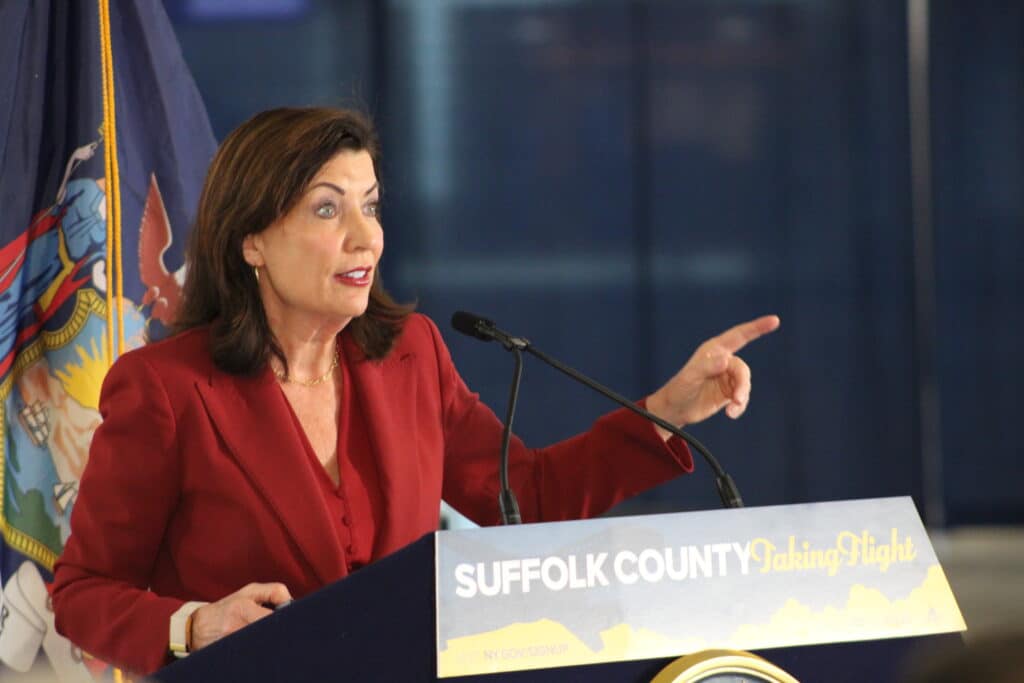
In their March poll, Siena College found Hochul (pictured left) leading Blakeman 51%-31% (+20) – a lead that’s down slightly from February’s 54%-28% (+26) matchup.
The six-point swing is accompanied by a 46%-42% (+4) favorability rating for the Governor, who is seeking a second full term, which is down from a 49%-40% (+9) last month. Her job approval rating sits at 53%-41% (+12), mostly unchanged from last month’s 54%-41% (+13).
“Democrats still outnumber Republicans more than two-to-one, so it’s not surprising to see Hochul continue to maintain a large double-digit lead over Blakeman, although it’s tightened a little bit in the last month,” said Siena pollster Steven Greenberg in a statement. “What was a 25-point lead in December and a 26-point lead in January is now a 20-point lead, largely due to Republicans coming home to Blakeman, and the race tightening among men – Hochul had led by 22 points and now leads by 4 – and in the downstate suburbs, where she led by 14 points and now leads by 2 points.
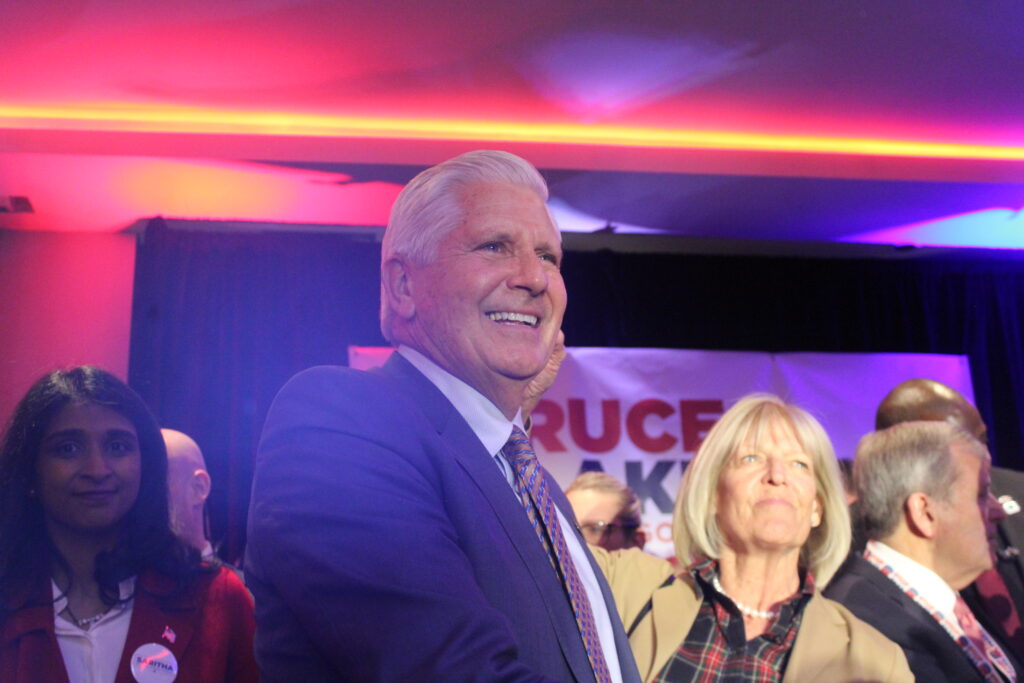
For Blakeman (pictured right), the bigger problem is name recognition. The College found that 61% of New Yorkers have either never heard of Blakeman, who was re-elected in a landslide in 2025, or have no opinion about him. His favorability rating, however, improved from last month. Underwater at 18%-20% (-2) last month, Blakeman is now at a 21%-18% (+3) rating.
President Trump’s numbers improved slightly, but he remains heavily underwater in sapphire-blue New York. His favorability rating – 35%-60% (-25) – has improved from his -30 rating last month, and his job approval numbers went from 34%-63% (-29) to 36%-61% (-25).
New York City Mayor Zohran Mamdani (D-Astoria) has a 47%-35% (+12) approval rating, down slightly from last month’s 48%-32% (+16).
The Siena College poll was conducted February 23-26, 2026, among 805 registered New York State voters. The margin of error is +/- 4.5%.
Local
Suffolk County Sheriff Errol Toulon (D) recently welcomed thirty-five new Correction Officer Recruits at their swearings-in on Monday at the Yaphank Correctional Facility.

The new recruits (pictured left) will begin a “rigorous fifteen-week training program that includes instruction in direct supervision, de-escalation techniques, report writing, defensive tactics, firearms, and much more,” according to the Sheriff’s Office. The new enlisters will graduate this summer to join an 840-strong Suffolk County Corrections Officers force.
Toulon reminded the new recruits that they “now hold a position of authority in Suffolk County, and with that authority comes great responsibility.”
The thirty-five recruits consist of twenty-nine males and six females. Six members have military or prior law enforcement backgrounds, including experience with the NYPD.


