In continuing our series on the federal departments, we arrive at the third executive department established, the Department of the Interior
History and Origin
As a fledgling nation, most domestic concerns were under the Department of State and a separate department for domestic affairs would be considered from the time of the First Congress in 1789 until about halfway through the 1800s.
The Mexican American War (1846-1848) would give significant way to a separate domestic department. Robert J. Walker (D-KS), President James K. Polk’s (D-TN) Secretary of the Treasury, would outline an 1849 report that several federal bureaus were miscellaneously placed under differing jurisdictions. The Indian Affairs Office was part of the Department of War, while the Patent Office belonged to the State Department. The bill authorizing the creation of the Department of the Interior would pass the Senate on March 3, 1849, the eve of President Zachary Taylor’s (W-LA) inauguration. Its final 31-25 Senate vote would showcase the Democrats’ delaying of another post for a Whig administration to fill.
Thomas Ewing, a Whig of Ohio, would serve as the first Secretary of the Interior. He was the father-in-law of the famed Civil War general William Tecumseh Sherman. Interestingly, Ewing would select Justin Butterfield, a Whig from New Hampshire, as his Commissioner of the General Land Office. For that post, Ewing passed over perhaps one of the most recognizable names in American history, Abraham Lincoln (R-IL).
Initially called the Home Department, the federal wing would become known for its library that distributed all government publications and handled the copyrighting of books, maps, and charts. The copyrighting responsibilities would, in 1871, be transferred to the Library of Congress, but the Interior Library would still be overburdened by the records of its bureaus. It wasn’t until 1907 that the Interior Library was abolished and the catalogue would be moved to the Library of Congress and the Washington, D.C., Public Library System.
More library shuffling continued until 1949, when the Interior Library was set to hold libraries pertaining to mining, fish and wildlife, reclamation, land management, Indian Affairs, territories and island possessions, and the National Park Service.
One of the biggest controversies coming out of the Interior Department was that of the Teapot Dome Scandal in 1921. The scandal is seen as perhaps the biggest stain on Warren G. Harding’s (R-OH) presidency. The political corruption scandal centered on Albert B. Fall (R-NM), then the Interior Secretary, for leasing petroleum reserves in Teapot Dome, Wyoming, that were originally designated for the U.S. Navy. Fall sold them to private oil companies at bargain prices without a bidding process. Fall was the only person in the scandal to be convicted, making him the first Cabinet member in history to go to prison.
And, as history would have it, the Interior Department would start to shed some of its oversight yet again, with some functions going to the Environmental Protection Agency (EPA) for instance.
The Interior Department Today
The Interior Department manages about 500 million acres of U.S. land – about 20% of the nation’s total land area.
The Department employs about 70,000 staff, about 11% of which are Native American/Native Alaskan, making up a workforce of scientists, rangers, and administrative staff across almost 2,500 locations nationwide.
For 2026, the Interior Department is set to have a $18.9 billion budget. Though it seems like a steep price tag, the Interior is actually one of the lesser-funded federal departments. It accounted for just 0.3% of the total FY2024 budget, according to usaspending.gov. For context, the Treasury Department’s allocation that year was $1.32 trillion – a whopping 19.5% of the $6.78 spending package.
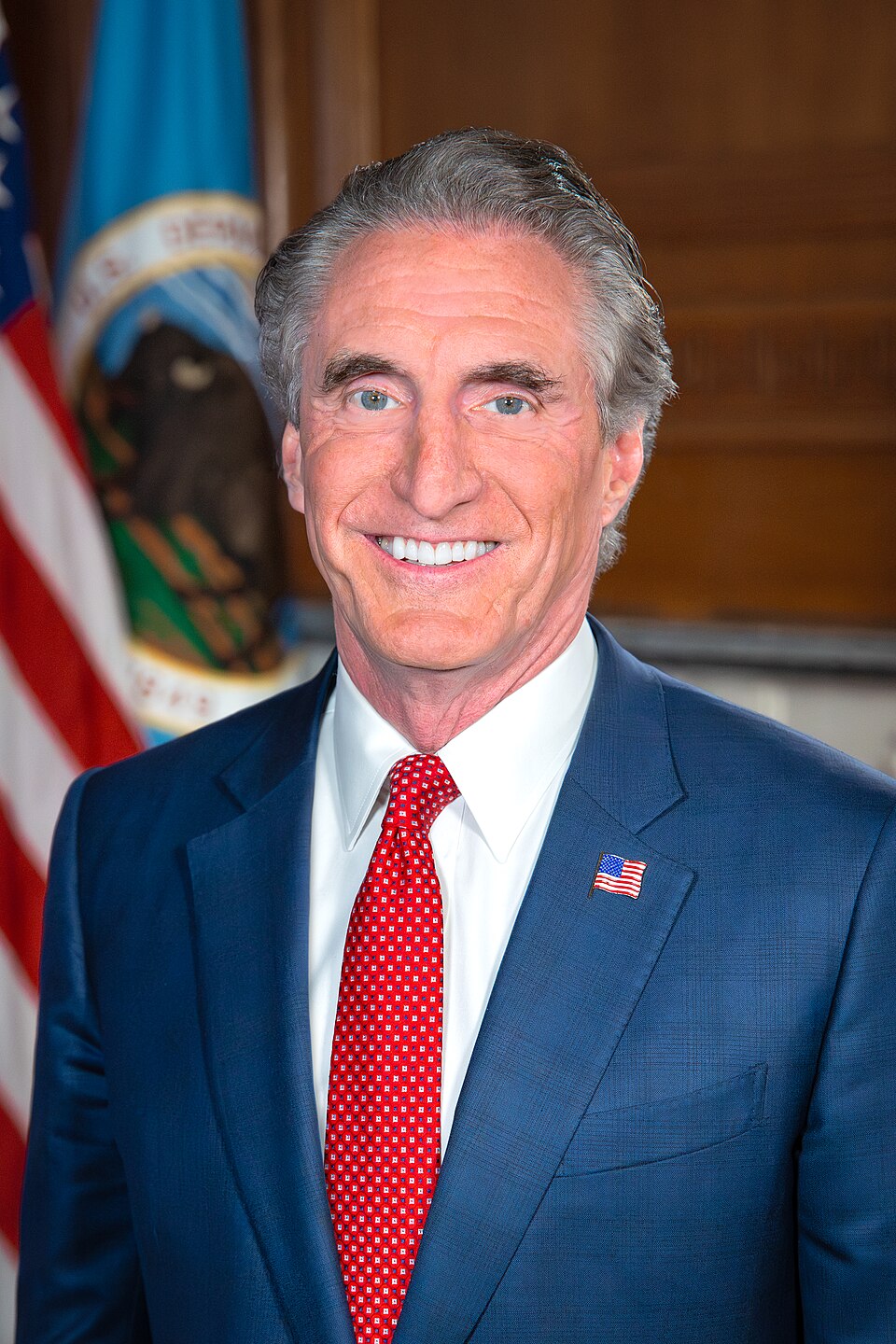
Doug Burgum (R-ND) serves as the fifty-fifth Secretary of the Interior under President Trump (R-FL). Fresh with an MBA, Burgum invested in Great Plains Software based in Fargo, North Dakota. He became its president in 1984 at the age of 28. After taking the company public in 1997, he sold to Microsoft for $1.1 billion in 2001. Business-seasoned, Burgum won the 2016 gubernatorial election in North Dakota in a landslide with 76.52% of the vote. 2016 represented a massive shift to the right for the Peace Garden State in the Trump Era, having mostly shed its Democratic dominance at the congressional level. Burgum would be reelected in 2020 with 65.84% of the vote.
Burgum would briefly run for president in 2024. After failing to qualify for the third and fourth debates, he suspended his campaign and endorsed Trump. He was confirmed to his current post by the Senate in a 79-18 vote.
Bureaus
The Interior Department has eleven bureaus, plus its administrative wing. While the Interior Department might be lesser known at face value, some of its bureaus are incredibly well-known.
Bureau of Indian Affairs: Maintains federal relationships with the Native American tribes and prompts self-sufficient and individual rights, according to the Interior Department’s website.
Bureau of Indian Education: Provides education opportunities from early childhood through life in accordance with a tribe’s needs and with respect to cultural aspects of tribal or village context.
Bureau of Land Management (BLM): Manages about 250 million surface acres and 700 million acres of subsurface mineral estates, primarily in the Western U.S. and Alaska. It handles the permitting of oil, gas, coal, and renewable energy projects on public lands, protects natural resources and wilderness areas, manages recreation, such as hiking, camping, hunting, and fishing on public lands, administers grazing permits for over 150 million acres of public land, maintains land records, and controls the wild horse and burro populations.
Bureau of Ocean Energy Management: Manages the development of the U.S. Outer Continental Shelf (OCS) energy and its mineral resources. It handles the offshore oil and gas leases, renewable energy developments, such as wind energy, and marine mineral use. Sand and gravel resources are also managed, particularly for coastal restoration and resilience projects, and maintains offshore boundaries for energy development.
Bureau of Reclamation: Manages, develops, and protects water and its resources in seventeen Western states. It is the nation’s largest wholesale water supplier and second-largest producer of hydropower and operates over 300 reservoirs and provides irrigation to 10 million acres, municipal water for 31 million people, and electricity for 3.5 million homes. It also maintains over 600 dams, including the Hoover Dam, 53 power plants, and water conservation efforts in drought-prone areas.
Bureau of Safety and Environmental Enforcement: Carries out inspections on offshore drilling rigs, reviews and approves permits for drilling, well operations, and productions, investigates oil spills or equipment failures, and evaluates new technologies to improve safety and environmental protection. Its Oil Spill Preparedness Division develops standards for offshore operations.
Bureau of Trust Funds Administration: Formerly known as the Office of the Special Trustee for American Indians, manages and invests the Interior’s $5 billion held in trusts for about 250 Native American tribes. It disburses over $1 billion annually from income generated from grazing, oil, gas, and timber on trust lands, and stores millions of historical documents at the American Indian Records Repository in Lenexa, Kansas.
National Park Service: Preserves and manages the nation’s 400-plus national parks and sites, such as Yellowstone National Park and the Statue of Liberty. It also manages recreation, like hiking, camping, fishing, and ranger talks at these sites, and conducts scientific research on the ecosystems. The NPS manages all 63 national parks across 30 states and two territories, 138 national monuments, 40 national recreation areas, over 2,500 national historic landmarks, and over 1,300 National Scenic Trails, Historic trails, and Recreation Trails.
Office of Surface Mining Reclamation and Enforcement: Regulates active coal mines and enforces cleanup of abandoned mines. It ensures coal mining operations are in compliance with the Surface Mining Control and Reclamation Act. It manages funds to restore land damaged by past mines, works with state and tribal authorities to meet federal standards, and collects fees from coal mining companies to fund the Abandoned Mine Land (AML) Reclamation Program.
U.S. Fish and Wildlife Service: Conserves, protects, and manages fish, wildlife, plants, and habitats. The Service oversees the National Wildlife Refuge System, protects endangered species, and restores significant fisheries. It operates over 500 National Wildlife Refuges, investigates wildlife crimes, enforces migratory bird regulations, protects wetlands, operates the National Fish Hatchery System to restore fish populations, and conducts research on species’ statuses.
U.S. Geological Survey: Provides data on natural hazards, ecosystems, and resources. It monitors earthquakes, landslides, wildfires, and volcanoes, manages water/mineral resources, and studies water quality and the health of those ecosystems. It also evaluates the nation’s energy and mineral resources, particularly quantities and qualities, and serves as the country’s top scientific agencies for these types of biological research.