


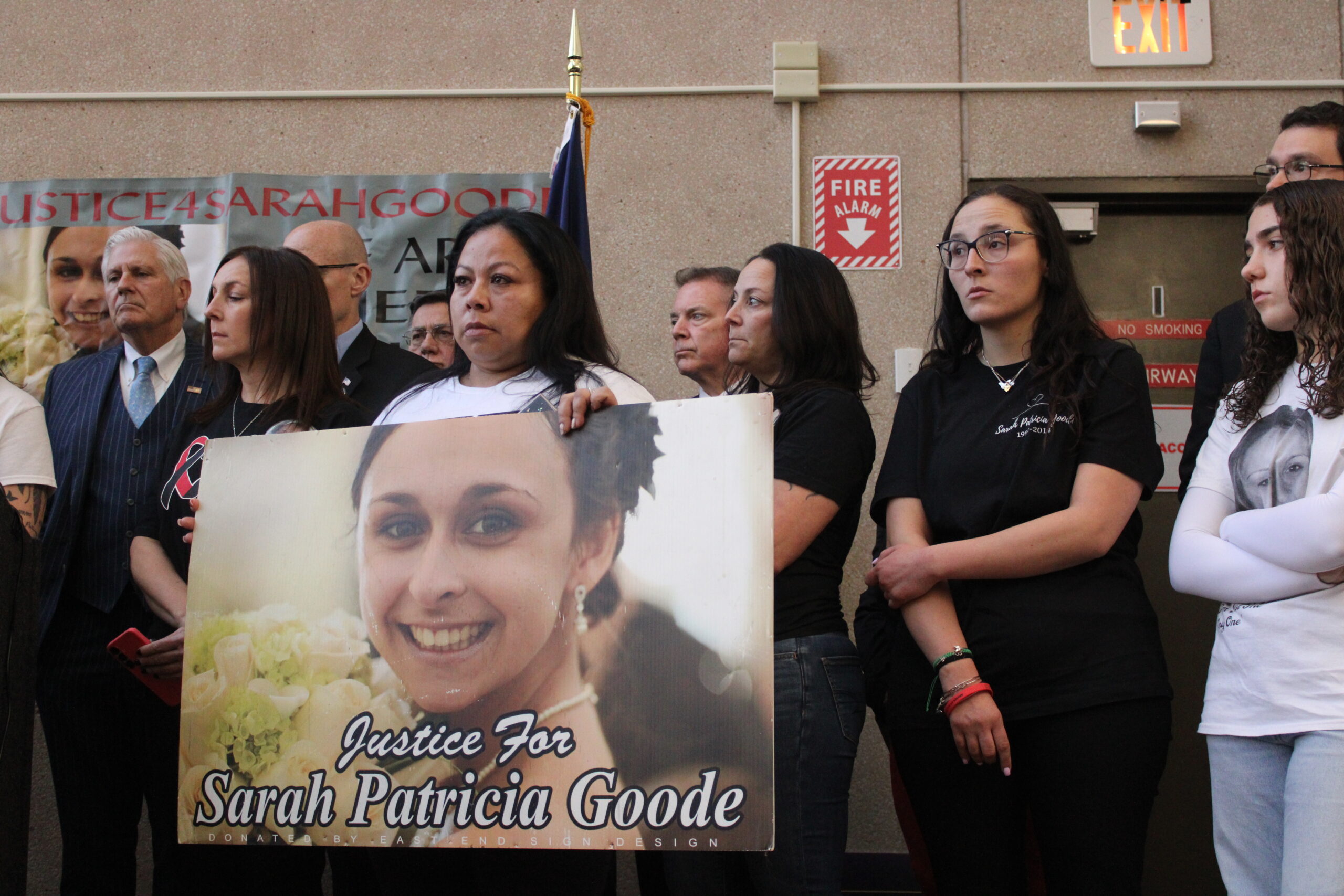
HAUPPAUGE – Crime victims and Senate and Assembly Republicans are rallying to pass “Sarah’s Law” this session of the State Legislature.
The bill, named for Sarah Goode, would close a loophole that expunges the criminal records of defendants who die while their conviction is on appeal. That loophole is called abatement ab initio.
Goode, of Medford, was raped and murdered by Dante Taylor, of Mastic, when she was just 21 years old. She vanished after a party at which the two had met in June 2014. She was stabbed forty-two times by Taylor, who had dumped her body in the woods. He was convicted and sentenced to life imprisonment without parole. While appealing his case, he committed suicide. Abatement ab initio, under New York State Law, required the dismissal of his conviction, leaving no defendant legally convicted of Goode’s horrific assault and murder.
The law is being carried by Senator Dean Murray (R-East Patchogue) and Assemblyman Joe DeStefano (R-Medford). Lawmakers and Goode’s family rallied at the Perry Duryea State Office Building in Hauppauge last Friday to make the proposal become law.
“New York State does a horrible, horrible job when it comes to crime victims. They are the most forgotten people in this state,” said Murray. “When these pro-criminal laws are being passed in Albany, there’s no thought given to the victims of what they went through or are going through, whether it’s the victims or the family members and loved ones of victims.”

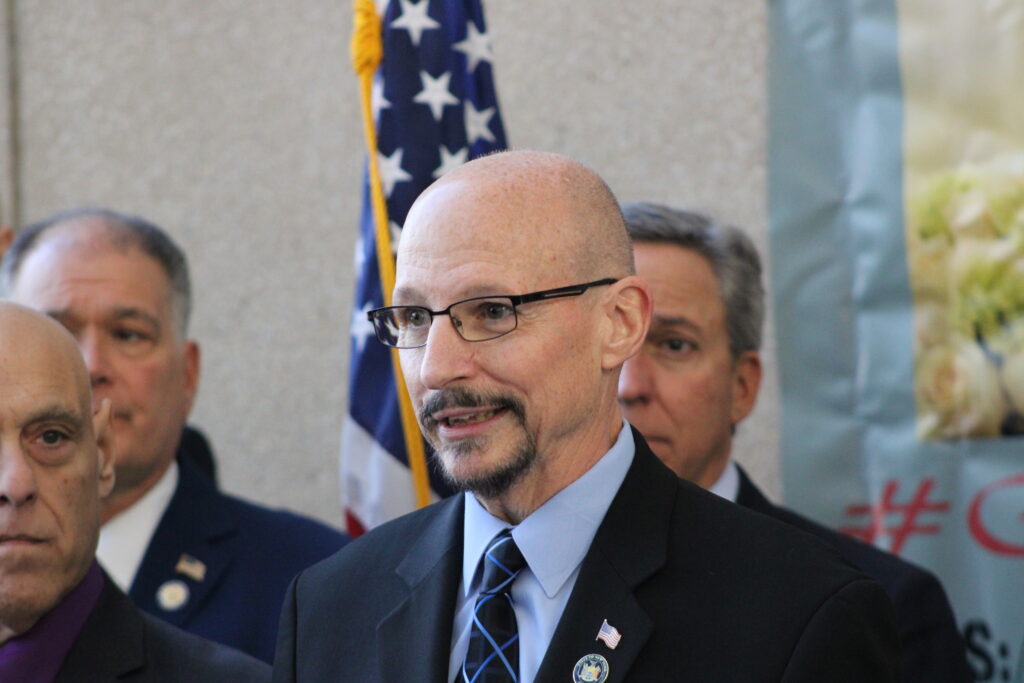
Murray (pictured left), a member of the Crime, Crime Victims, and Corrections Committee, said that even the most left-leaning states, such as Massachusetts, have realized that abatement ab initio goes “too far.”
“Dante Taylor was overwhelmingly found guilty; there is no question of his guilt,” said Murray. “If you look up the record [of Goode’s case] right now, you will not see his name there.”
Senators Mario Mattera (R-St. James), Patricia Canzoneri-Fitzpatrick (R-Malverne), Steve Rhoads (R-Bellmore), and Jack Martins (R-Great Neck) were present in Hauppauge and are co-sponsoring the bill.
“When a jury has weighed the evidence and delivered a guilty verdict, that decision should matter. Allowing that verdict to simply disappear undermines confidence in our judicial system and it sends a devastating message to victims and their families,” said DeStefano, adding that the loophole “opens wounds” of victims’ families. “Justice should not vanish because of a delay, timing, or procedural technicalities.”
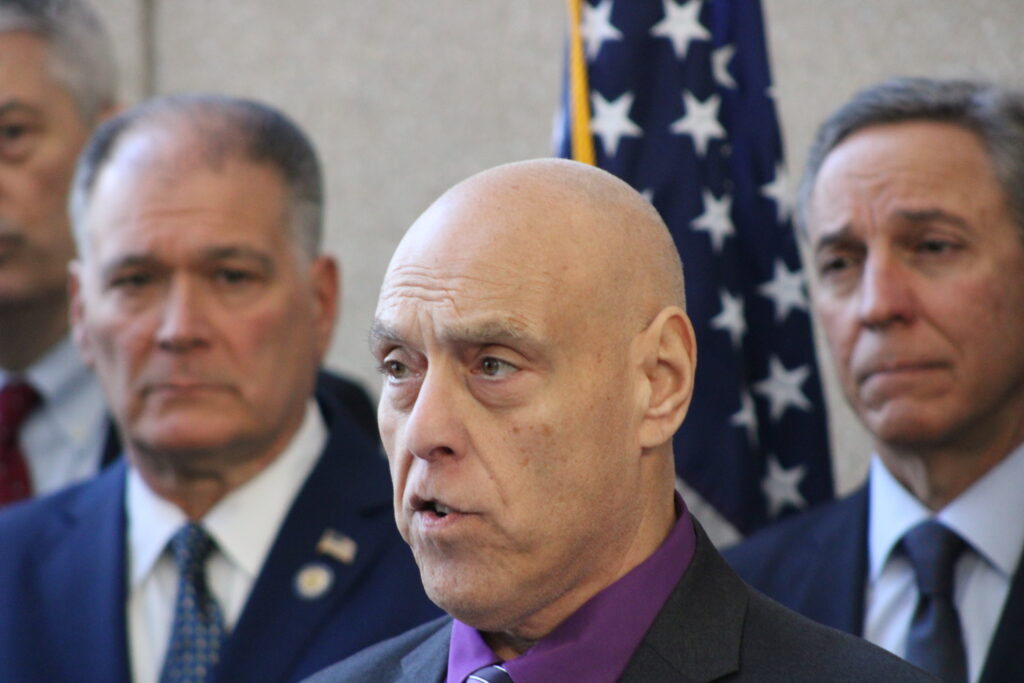
DeStefano (pictured right) was joined by fellow Assemblymen Mike Durso (R-Massapequa Park), Ed Ra (R-Garden City South), John Mikulin (R-Bethpage), and Ari Brown (R-Cedarhurst), who are co-sponsoring the bill.
Suffolk County Executive Ed Romaine (R-Center Moriches) said he is “100%” behind the bill, adding that Goode’s murderer “should be known” and that his “conviction should stand.”
Nassau County Executive Bruce Blakeman (R-Atlantic Beach), who is running for governor, said that Goode’s family, while in grief, had to endure the publicity and the process of the trial, only for it to be “stolen away” by “one of our ridiculous laws.”
“We have too many laws like that in the state of New York,” said Blakeman. “This was one of the most heinous crimes in the history of Long Island.”
Goode’s family made emotional pleas for the State to pass Sarah’s Law.
“The first time since Sarah was taken from us, our family had a small matter of peace, a conviction, a sentence, a permanent record that said this happened and this mattered. But instead of facing the consequences of what he did to Sarah, this coward chose to take his own life in prison,” said Jennifer Driver, one of Sarah’s sisters. “Because of an outdated and archaic legal doctrine, every charge was erased as if the trial never happened, as if the conviction never existed, as if Sarah’s life never mattered. Evidence did not disappear. Facts did not change. The jury’s verdict did not vanish.”
Driver added that the technicality did not “erase a conviction,” it “erased accountability.”
“New York ripped out our hearts, whatever shred was left of it, and buried Sarah deeper into the hole she’d been in since 2014, silencing victims yet again,” said Tabitha Miller, another one of Sarah’s sisters. “What New York is doing when they vacate convictions is telling the State to find a new murderer because this one that died in prison couldn’t have done it. Guess what, New York? No one’s going to find someone to accuse, because the one they found was already convicted.”
Elizabeth DeMuria, another sister of Goode, said that if “justice can be undone so easily,” then the “entire criminal justice system is compromised.”
“It also tells the victims’ families that the system will protect convicted murderers, rapists, pedophiles, and other horrendous criminals over the truth,” said DeMuria, adding that the loophole is akin to telling Sarah’s daughter, Jocelyn, who was a young child at the time of her mother’s death, that Sarah’s life was “not worth fighting for.”
“But it was okay to fight for a convicted murderer and wipe his charges out so that his family can benefit? Explain why a convicted killer deserved a clean slate, but Sarah did not deserve permanent justice,” said DeMuria. “Sarah’s voice will be heard even though she has been gone. This is her legacy.”
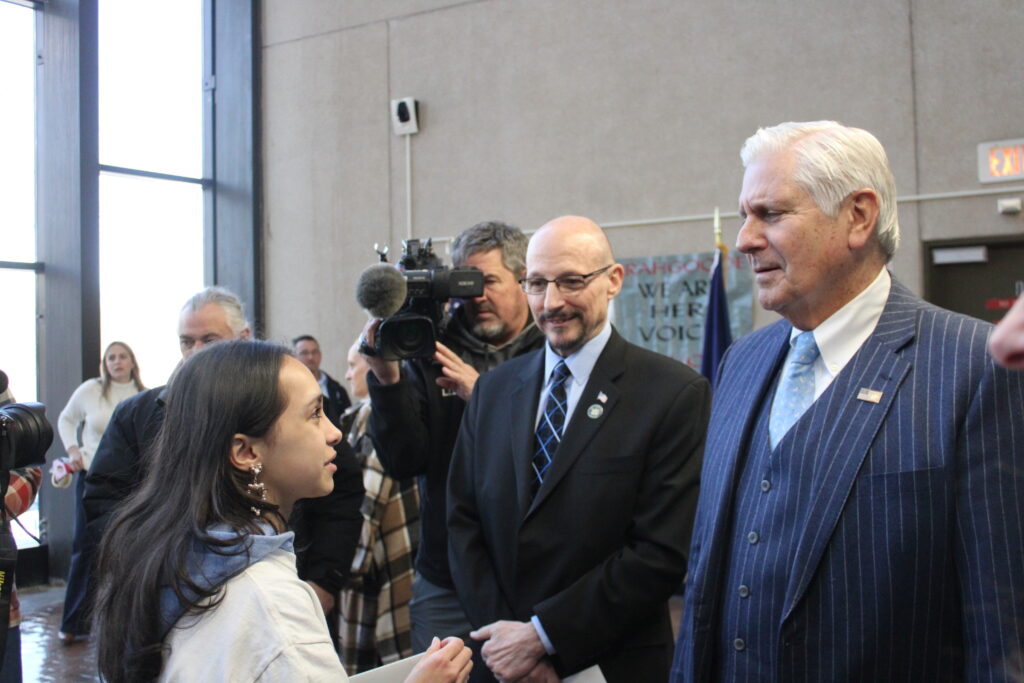
Sarah’s daughter, Jocelyn, is now 16, and eyeing a profession in fashion.
“In my opinion, even after death, my mother would like to help other crime victims,” said Jocelyn.
Senator Murray emphasized that passage of the bill transcends partisan credit.
“If you’re worried about a Republican getting credit, I’ll give you the damn bill. You can have it. Get it done.”
The legal doctrine was notably used to overturn the federal conviction of Enron CEO Kenneth Lay. Its existence stems from the benefit of the doubt that arises when a defendant is appealing a conviction. But Murray said that there is even less precedent for abatement ab initio to exist in light of the advanced scientific methods of conclusively solving a crime.
Senator Mattera said that Governor Kathy Hochul (D-Hamburg) could bypass the legislative process by adding this into her FY2026 Executive Budget.
“That’s how important it is for this bill to be bipartisan,” Mattera told The Messenger. “Let’s see what the Governor is going to do with that. We are asking her to put this in her budget this year.”
“We have a county executive [Blakeman] who is here and he is running for governor. He would make sure this gets done,” added Mattera.


