


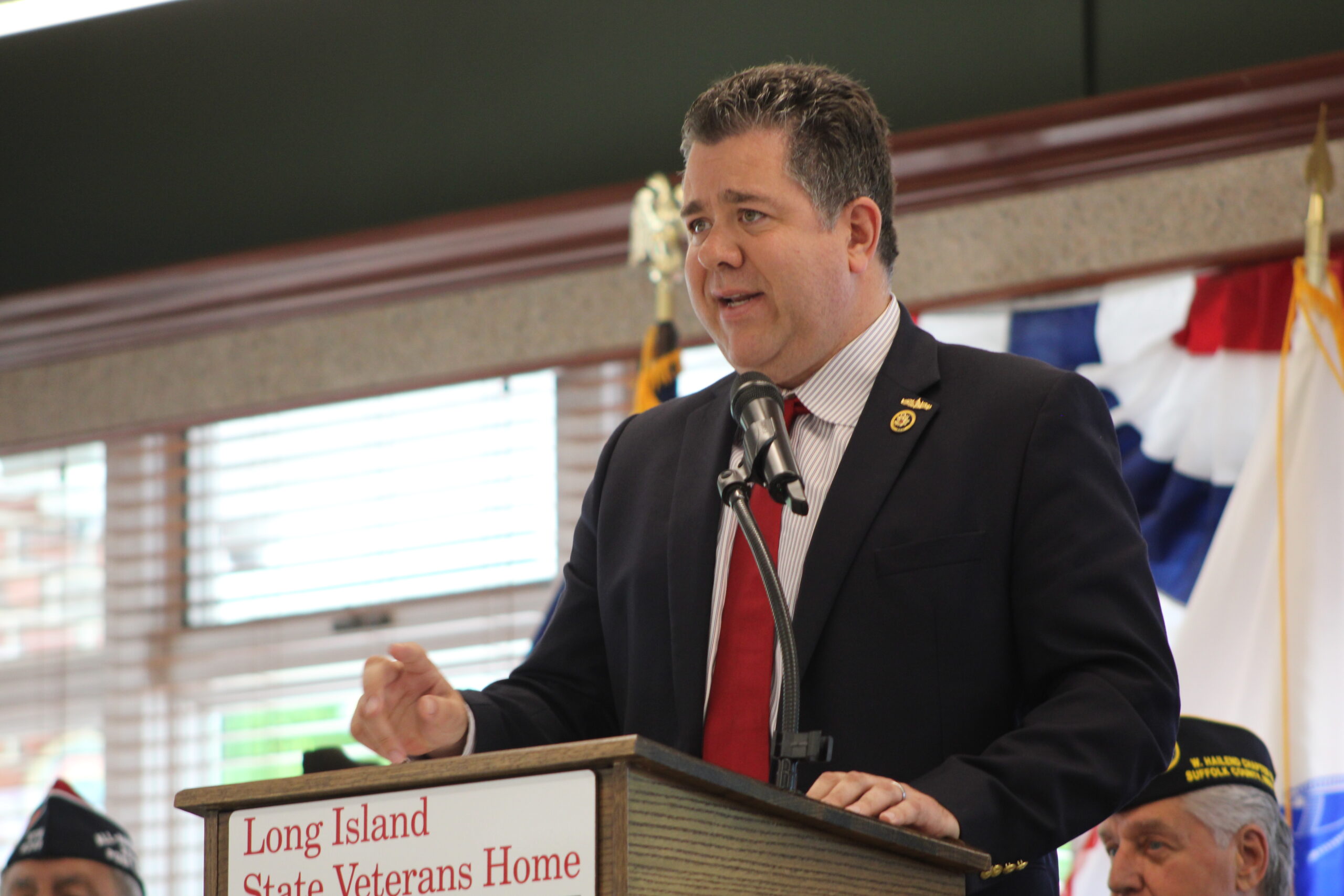
Congressman Nick LaLota (R-Amityville), the Northeast’s only Republican on the House Appropriations Committee, just this week announced a slew of funding to bolster Suffolk’s research capabilities, coastal protection, and public safety.
The $429 million spending package is part of the House’s three FY2026 appropriations bills: Interior and Environment, Energy and Water, and Commerce, Justice, and Science.
Brookhaven National Laboratory
The appropriations commit historic funding levels to the Island’s foremost research facility, and one of the most nationally and internationally renowned institutions of its kind. Brookhaven National Laboratory (BNL), located in Upton, is one of the U.S. Department of Energy’s ten national laboratories, paving the way in nuclear physics, energy technology, and high-energy sciences.
BNL is home to the only relativistic heavy ion collider in the country – also the world’s only polarized proton collider. The 2.4-mile ring smashes heavy ions and protons at practical light speed, reaching temperatures nearly 250,000 times hotter than the sun’s core. The collider is employed to study the fundamental properties of nuclear matter, and its results are set to support a future electron-ion collider (EIC).
The collider is currently in its twenty-fifth and final run. For this prestigious and one-of-a-kind device, LaLota secured $182 million for its preparation to transition to an EIC. Another $155 million was earmarked for the EIC’s construction, a $45 million increase from last year.
Of the appropriations is also $13.6 million for the NSLS-II Experimental Tools III project, a world-class light source made for studying materials at atomic levels. Quantum technology is also one of the gateways to the future, and $125 million has gone to BNL’s National Quantum Information Science Research Center – one of just five nationwide.
Finally for the Upton facility is $1 million for the Clinical Alpha Radionuclide Producer (CARP) project, which is intended to meet rising demand for alpha-emitting isotopes for certain cancer therapies.
Stony Brook University
For Stony Brook University (SBU), LaLota aided in restoring $938 million for STEM education that had been eliminated in the House bill and through the Administration’s request. The restoration of that funding will support the critical partnerships between SBU and BNL.
SBU’s own Quantum Research and Innovation Hub is also set to receive funds from the $8.8 billion subsidies to the National Institute of Standards and Technology – a nearly $900 million increase that expands the university’s research capacity.
Environment
The bacon brought home by LaLota doesn’t stop there, however, as $40.5 million has been earmarked for the Long Island Sound Geographic Program, a $500,000 increase, as well as $40 million for the National Estuary Program. The latter contains $2.5 million in competitive grants, some of which will benefit the Peconic Estuary and the Long Island Sound.
Long Island’s maritime economy is also bolstered by $6.2 billion for the National Oceanic and Atmospheric Administration (NOAA). The final sum was $1.7 billion above the Administration’s request, which will pave the way for better weather forecasting, coastal resilience, and marine research.
Public Safety
The Community Oriented Policing Services (COPS) program is set to receive $800 million, a $383 million increase that supports police hiring and retention for local law enforcement across Suffolk. Moreover, $3.25 billion is earmarked for the Drug Enforcement Administration (DEA), featuring an $80 million increase to combat the fentanyl scourge that has taken Long Island by storm in recent years. Those funds will also go to dismantling transnational criminal drug organizations.
$51 million is set for the Violence Against Women Act (VAWA) Transitional Housing Assistance, which represents a $7 million increase in providing support for domestic violence survivors in high-cost areas.


