By Ellyn Okvist, B.Sc.
Early days of skating was a form of exercise the entire family could enjoy. Women could engage in this sport publicly, when other sports were considered “for men only”. Early skates were carved from animal shin bones and developed as time progressed.
Were you one of us that had the opportunity to ice skate on Ronkonkoma Lake? Groups of us would walk down together, bump into yet another group, and make our way to the frozen sheet of ice.
Most of the time, we would walk past Newton Pond and spend a moment watching the three ice hockey games being played at once. The bright colors of the hats were a stand-out, and the whipping noise of the hockey sticks are recalled.
At this point, you would break the groups and follow your parents’ orders to “only skate” here or there, based on the safety lessons they had learned over the years. There are very specific places to skate, the same as for swimming, and if you were taught the places, you would be alright.
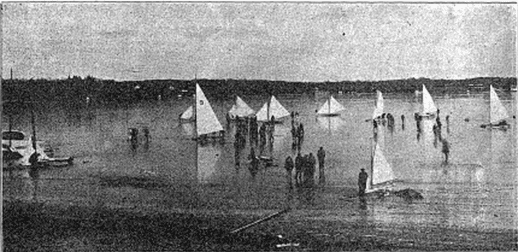
Ice skating was a popular pastime in our village long before the Lake Ronkonkoma Ice Boat and Yacht Club made us famous. In March 1924, the Lake became the ice boating and skating center of the East. Bunny Gubner, also known as The Commodore, gave all he had to make the sport popular and concentrated here, and possibly assist the merchants with commerce. At that time, the ice formed earlier and gave good ice up until St. Patrick’s Day.
An article from November 1930 boasted of Lake Ronkonkoma offering the lover of outdoor sports every facility for the joy of living and continuing through the winter. This is the place where the crisp, dry air adds zest and snap to the carefree life of Lake Ronkonkoma. Ice boating, skating, sleigh riding, tobogganing, and snow shoeing would put the tinge of color in your cheeks and whet your appetite.
A local man would place his wooden shed on the Lake, and keep it warm with a small, contained fire. The shed had wooden benches along the sides, and you could take a break from ice skating in the warmth and have a cup of hot chocolate as well. By 1936, Lake Ronkonkoma was considered a winter resort.
Skating safety was important in the village, and in December 1960, a warning was distributed: “A reader has called attention to the fact that ice skating days will soon be with us. Long Island’s largest lake – Ronkonkoma – will soon beckon to the energetic who like to cut fancy figures on the big pond’s frozen silvery surface. The Lake, however, presents two problems: because of its size it is slow to freeze and because of its depth it presents hazards especially to the unthinking who venture forth before a real solid freeze sets in. Town-owned Duffield’s beach, the reader notes, has a large pavilion and several depressed areas that could be flooded in freezing weather without too much difficulty. Such steps could be taken by volunteers with scant expense to the town. The result would be earlier skating and certainly safer skating. The suggestion, to be sure, merits the consideration of town officials.”
Partially due to the time length of the ice-skating season, the town planned to build an outdoor recreation area in the heart of Lake Ronkonkoma business district. The plans were announced August 10, 1961, by Frank Marino, local attorney and Jim Reese, Brookhaven Town Recreation director. It was to include a roller-skating rink which would be converted to an ice skate rink during the winter months. A basketball court was included, and lights would be installed for evening skating, dancing, and other activities. The location of the project would be behind the police booth on the west side of Hawkins Avenue. The land that would be used was donated with a five-year lease by the heirs of Frank and Henrietta Newton, pioneer residents of the Lake area. Frank Marino was attorney for the Newton Heirs, Frances Terry and Richard W. Newton. The exact location would have been in the Kohl’s area, as Newton owned the farming lot, and the Tavern had not been relocated at this date.
Perfection that adds to any memories should always include Lois Watt and her appropriate poem for the subject:
KIRBY KASTLE
Now once upon the Great Pond rim
There stood the Kirby Kastle
Of hexagonal tower form
And wooden upright tassel
In winter, folks would cross the Lake
On skates when it was frozen
To gaily dance in Kirby’s hall
With partner duly chosen!
The Kirby House once stood on the Islip side of the Lake and was quite unusual with a wooden tower in an octagonal shape. A large, sloped room was formed so it faced the Lake, and was used as a grand ballroom. Residents fondly remembered skating across the Lake to go dancing during the winter months. Aunt Charolotte Kirby also held dance lessons.
Carnival On Ice was planned at Lake Ronkonkoma for January 18, 1969, at the Islip Town Beach, Commissioner Roger Moran Town of Islip Department of Parks, Recreation, and Cultural Affairs. Children age 8 to 18 entered, with several contests to choose from. You could stop in with your registration application or use the U.S. Mail. An “unsuitable” ice conditions date would be January 25, 1969.
Three varied incidents on the Lake during winter: January 1957- Long Island Frogman Edward Haddock and Floyd Fanshew put themselves through a cut hole in the ice and test themselves for rescue attempts;
Jeffrey Clark drowns while walking on thin ice February 20, 1973. His friend is rescued;
January 1976 – two boys fall in through thin ice, no official help comes to their rescue, they are both saved by numerous skaters also on the Lake. This incident began the controversial Lake rescue coverage debate.
The approaching 1970’s put ice skating restrictions on the Lake, including closing time and weather conditions. There was also a stigma in newspapers that claimed Lake Ronkonkoma would not freeze enough and urged skaters to go to smaller bodies of water. We experienced a four-day freeze last January, which reacquainted the village with ice boats, ice hockey, and people seeing our ice boats for the first time. One can only hope for next year’s freeze so we can once again hit the ice.