The hamlet of Oakdale is situated in the south-central part of the Town of Islip. Bordering the Great South Bay and defined by the Connetquot River, Oakdale is located in one of the more environmentally precarious parts of western Suffolk.
Thus, sewers have been a conversation for several years for Oakdale. Suffolk County Legislator Anthony Piccirillo (R-Holtsville) has been a leading figure of the project, and hosted a public meeting and Q&A session with the developers on Monday evening at Islip Town Hall West.
The developer is P.W. Grosser Consulting, a Bohemia-based firm specializing in environmental engineering and hydrogeology that serves the Northeastern U.S. Three representatives delivered a presentation and entertained questions from the audience: Paul Boyce, President and CEO, Derek Ersbak, Vice President, and Edmond Kirby, Project Manager.
Piccirillo was joined by Assemblyman Jarett Gandolfo (R-Sayville) at the meeting, as well as a representative of Senator Alexis Weik (R-Sayville).
While the plan is moving along, its ultimate fate rests on the voters of the Phase 1A area. A December 8 election will determine whether this part of Oakdale is sewered or not.
Ersbak called the project a “historic community improvement” that carries “infrastructure” and “quality of life” upgrades. He said it would “increase property values, reduce impacts of the high water table, and improve the service water quality.”
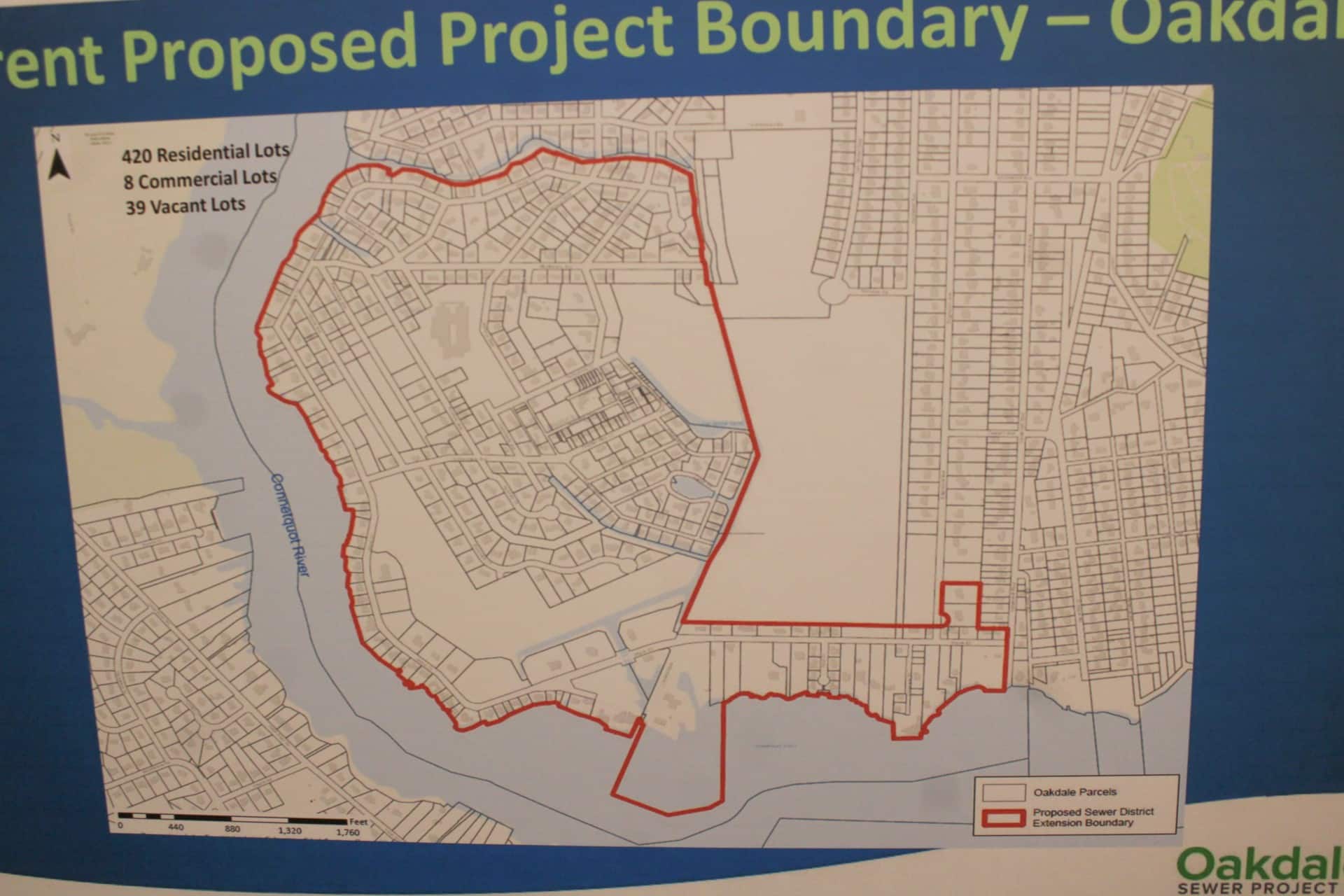
Oakdale was chosen as a high-priority site due to its proximity to three service bodies of water, as well as groundwater. The current plan is Phase 1A, which includes the peninsula carved out by the Grand Canal. The current phase district extends an eastward panhandle from Shore Drive and Central Boulevard to Shore Drive and Vanderbilt Boulevard. Remaining sections of Oakdale are slated to be sewered in ensuing phases.
The charted area contains 420 residential lots, 8 commercial lots, and 39 vacant lots. The vacant and commercial lots will receive “stubs”, so that future construction and/or expansions can connect to the sewer line.
The plan is funded by $43 million in grant funding at no cost to the taxpayers. $39.5 million comes from the FEMA Hazard Mitigation Grant Program (HMGP), while $3.3 million is sourced from the State Department of Environmental Conservation (DEC) Environmental Protection Fund. The County applied for the HMGP grant in 2022 and received it in June 2025.
“We estimate that about half-a-million pounds of nitrogen per year [are emitted] into the Great South Bay,” said Ersbak. “More than 73% of this nitrogen comes from
cesspools and septic systems. Nitrogen goes straight into the groundwater and out into our waterways. The Connetquot River is our highest-ranking priority.”
Ersbak added that the goal is to reduce 93% of the nitrogen released into the waterways, while also protecting water quality during storms. Since most of Oakdale is in the FEMA flood zone, coastal flooding often causes septic systems to back up and take the untreated water into the bay when the tide recedes.
P.W. Grosser, if the initiative is approved by voters, has committed to a case-by-case basis of installing the equipment, tailoring systems, pipes, and flow to each property while being mindful of landscaping, driveways, and existing infrastructure. The developers stressed that trenchless hookups can be used where applicable. Pre-existing landscaping will be restored to the best of the developers’ abilities. Residents will only be on the hook to water reimplemented vegetation, but replanting will be done by the developers in April, May, September, and October. Residents will have a control panel installed on the sides of their houses that will be hooked up to existing electrical meters and equipment. The control panel also has a hookup for electric generators in the case of a power outage. Residents can use their own generators or rely on the County for supplemental power to flush out the system during an outage.
The County Wastewater Management District (CWMD) will go into effect in January 2026, meaning all existing sewer districts will be consolidated into one district, sharing the tax burden across the county. As such, residents will see an initial annual fee of $661 – $490 for CWMD Operation and Maintenance (O&M) and $171 from the CWMD Capital Charge. Rates are expected to increase gradually year-over-year, but developers noted that the costs pale in comparison to a yearly pumping of a septic system or cesspool, which can easily eclipse $1,000. Repair and replacement costs are incurred by the County, so long as the systems are treated appropriately by the homeowners. Homeowners are not required to contact a third party for system clean-outs; the County will respond to those scenarios.
The one-eighth-cent sales tax passed by Suffolk voters last year will contribute to the overall costs that won’t come out of the ratepayers’ pockets to the tune of the aforementioned annual bills, which will be divided quarterly.
The first connections are anticipated to occur in late 2027 and early 2028. Residential properties will be billed quarterly, and electric fees to operate the pump will be incumbent upon the homeowner – roughly $25 per year.
Commercial properties will be required to hire a licensed contractor when hooking up to a stub and will be billed annually based on their own water consumption.
Each system holds 70 gallons of wastewater – roughly 35 flushes. In a power outage, most other home appliances aren’t typically used, meaning there’s a decent margin for error before the lights come back on or until a generator needs to be used to empty the
system. The developers have found that with over 2,000 of these systems installed in various areas, they’ve found no issues with odors.
Hours of construction will take place Monday through Friday from 7:00a.m. to 5:00p.m., with minimal work outside of those hours.
The developers also cautioned against flushing anything that typically can’t be flushed or poured down the drain, such as grease, rags, diapers, or even wipes that might be advertised as flushable.
The project is also not estimated to impact overall groundwater elevation, though the land might sink by negligible amounts, specifically along Idle Hour Road.
Phase 1B will be everything west of Vanderbilt Boulevard and south of the LIRR. A field investigation will begin on October 6.
Panelists said that the Health Department standards will be followed for the abandonment of current septic systems and they will be removed by the developers. Multi-family properties or those with accessory dwelling units (ADUs) will be consulted on a case-by-case basis, and separate pumps would be considered as needed.
Janice McGovern, Chief Engineer of Sanitation with Suffolk County Department of Public Works (DPW), said that the County has a fleet of fifteen trucks that are equipped with generators to go from house to house in the event of a power outage.
McGovern also said that if the plan is approved in December, residents will be notified of a responsibility to hookup to the sewers, although they will not be required to do so. However, she cautioned against delaying, as it can complicate the developers’ and engineers’ efforts in Oakdale and across the county, and could come with a hefty price tag. The average cost to the consumer of these systems is $35,000 per household.
Oakdale 1A will be connected to the Southwest Sewer District, where effluent will be treated and then discharged into the Atlantic Ocean. The developers are cognizant of saltwater intrusion and said that since Oakdale is one of the most shallow groundwater systems on Long Island, recharging the crucial sole-source aquifer isn’t optimal in most cases. However, that remains a priority in other areas they’re working where feasible.
For the December 8 election, Legislator Piccirillo is coordinating the effort with the Suffolk County Board of Elections. Piccirillo said that the election would be administered under normal procedures, where residents can request absentee ballots and if any residents are perennial absentee voters, they will have a ballot automatically sent. Idle Hour Elementary School is the proposed polling place for the referendum.
Some residents present at Monday’s meeting invoked the failed sewer referendum in neighboring Great River. The difference between Great River and Oakdale is that the former is nowhere near as included in the FEMA Flood Zone, nor is the elevation as low as that of the latter.
Residents also questioned whether property taxes would increase with the new infrastructure, which Piccirillo said would be subject to the Town of Islip’s tax next round of tax assessment.