While not a historical event dealing with the topic of civics at-large, we find this account timely. In the wake of the assassination of Charlie Kirk, this episode in American history has some eerily similar parallels to what we’re seeing today.
Our point in this week’s Civics 101 column: we as a country have been here before.
A Country Careening Towards Civil War
The Kansas-Nebraska Act is generally seen as one of the largest, if not the largest, catalyst for violence leading up to the Civil War. President Franklin Pierce (D-NH) signed the organic act for the territories in 1854, with one of the goals being to expand the Transcontinental Railroad. However, the act effectively repealed the Missouri Compromise of 1820, which delineated the Union abolitionist North from the slave-owning South. At the time, the North was almost completely controlled by the Whig Party, the precursor to the Republican Party, and the South was solidly controlled by the Democratic Party.
The Kansas-Nebraska Act repealed the Missouri Compromise by trying the idea of popular sovereignty, in which the two new territories would be able to vote on whether or not to allow slavery. What ensued was a period of armed conflicts known as “Bleeding Kansas”, in which many from across the country flocked to the heartland to tilt the scales of power.

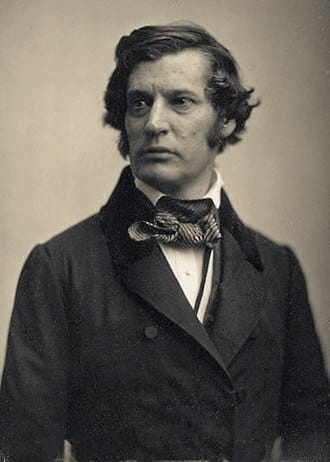
In 1856, Senator Charles Sumner (R-MA) (pictured above) denounced the act in his “Crime Against Kansas” speech delivered in May of that year.
“Not in any common lust for power did this uncommon tragedy have its origin. It is the rape of a virgin Territory, compelling it to the hateful embrace of slavery; and it may be clearly traced to a depraved desire for a new Slave State, hideous offspring of such a crime, in the hope of adding to the power of slavery in the National Government,” reads an excerpt from Sumner’s speech.
Sumner had been castigated by the Kansas-Nebraska Act’s authors, Senators Stephen Douglas (D-IL) and Senator Andrew Butler (D-SC). Butler is said to have race-baited Sumner by making crude sexual references to black women, as was customary among slave owners against abolitionist who promoted interracial marriage. On the other hand, abolitionists regularly stated that the ability to rape their slaves was a key component in their defense of slavery at large.
Stephen Douglas is quoted during Sumner’s speech as having said, “This damn fool is going to get himself killed by some other damn fool.”
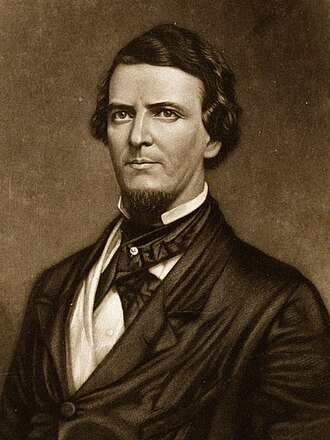
Congressman Preston Brooks (D-SC) (pictured below), Senator Butler’s first cousin once removed, later stated his intention to challenge Sumner to a duel. Brooks even consulted fellow Congressman Laurence M. Keitt (D-SC) on proper dueling etiquette, only for Keitt to say that Sumner was not a man of equal social footing and that Sumner was no better than a “drunkard.” Brooks surmised that since Sumner was not of equal stance, a public humiliation was warranted.

The Caning of Charles Sumner
Two days after Sumner’s speech, Brooks and Keitt entered the Senate chamber and waited for the galleys to clear.
“Mr. Sumner, I have read your speech twice over carefully. It is a libel on South Carolina, and Mr. Butler, who is a relative of mine”, Brooks said as he approached Sumner.
Sumner then began to stand up, only for Brooks to beat him over the head with a thick-wooded cane with a gold head.
“I no longer saw my assailant, nor any other person or object in the room. What I did afterwards was done almost unconsciously, acting under the instincts of self-defense,” Sumner recalled after the attack, stating that he lost his sight immediately.
Sumner became pinned under his Senate desk as Brooks continued to rain blows upon him, even to the point of snapping his cane, which did not cease the attacks. Even as Sumner collapsed and lost consciousness, Brooks continued to beat him with his cane. Brooks’ and Keitt’s allies blocked fellow congressional members from intervening. Keitt is said to have brandished his own cane and pistol against those attempting to help Sumner.
Senator Robert Toombs (D-GA) told Keitt not to attack others who were not party to the dispute, but later said he approved of Brooks’ caning of Sumner.
Parts of the cane were recovered from the Senate floor, which Southern lawmakers then took to make into rings as mementos. Some wore the rings around their necks as a show of solidarity with Brooks.
“The pieces of my cane are begged for as sacred relics,” Brooks boasted.
The Aftermath
Political polarization had reached the Senate floor. Newspapers across the country took positions on either side.
The Cincinnati Gazette is quoted as saying, “The South cannot tolerate free speech anywhere, and would stifle it in Washington with the bludgeon and the bowie-knife, as they are now trying to stifle it in Kansas by massacre, rapine, and murder.”
The New York Evening Post wrote, “Has it come to this, that we must speak with bated breath in the presence of our Southern masters? …Are we to be chastised as they chastise their slaves? Are we too, slaves, slaves for life, a target for their brutal blows, when we do not comport ourselves to please them?”
On the other hand, The Richmond Enquirer wrote in an editorial that Sumner should be caned “every morning”, calling the attack “good in conception, better in execution, and best of all in consequences.” The editorial continued by denouncing the “vulgar abolitionists in the Senate” who “have been suffered to run too long without collars. They must be lashed into submission.”
South Carolinians felt especially slighted by Sumner’s speech. The caning gave Brooks great praise in his home state, namely for defending South Carolina’s honor. The Yorkville Enquirer wrote, “South Carolina may well feel proud of her son.”
In support of Sumner and the abolition movement, thousands rallied to show their support in Albany, Boston, New York, Cleveland, Detroit, and Providence, among others, while Southerners sent Brooks hundreds of new canes. Southerners even mocked Sumner, going so far as to claim he was faking his injuries and that the cane used was not heavy enough to cause such damage.
Sumner suffered a traumatic brain injury and post-traumatic stress disorder that caused him debilitating pain until his death in 1874. He spent three years recuperating before returning to the Senate. The Massachusetts State Legislature could have appointed a replacement in the interim, but opted to leave his seat open as a reminder of the violence. He was re-elected in 1857.
Brooks was challenged to a duel by Congressman Anson Burlingame (R-MA) with the intention of setting up criteria to make Brooks back out, an alternate form of public humiliation that was successful. Brooks claimed he did not want to expose himself to possible violence by traveling to Niagara Falls for the duel.
Brooks stated he had no intent to kill Sumner, but was convicted in a District of Columbia court that penalized him with a $300 fine – equivalent to $10,500 today. He received no prison sentence. Brooks survived an expulsion vote from the House and was re-elected by Southerners who considered him a hero.
Keitt was censured by the House and resigned in protest. However, his constituents re-elected him to his seat within a month. In 1858, Keitt attempted to choke Congressman Galusha A. Grow (R-PA) for calling Keitt a “negro drive” during a debate on the House floor.
The caning of Charles Sumner has been regarded by many as a massive turning point not just for the country, but for the then-nascent Republican Party. Historian William Gienapp writes that Brooks’ assault was of “critical importance in transforming the struggling Republican Party into a major political force.” Although James Buchanan (D-PA) won the 1856 presidential election and Democrats increased their House majority – courtesy of the Three-Fifths Compromise – the GOP saw major gains in state legislatures across the country, allowing the state legislatures to send more Republicans to the U.S. Senate.
Along with Bleeding Kansas, the caning of Charles Sumner are seen as the two major catalysts that saw Abraham Lincoln (R-IL) win the election of 1860 over Stephen Douglas, one of the authors of the Kansas-Nebraska Act and the very Senator who foresaw Sumner’s assault.
Describing the incident, Ralph Waldo Emerson said, “I do not see how a barbarous community and a civilized community can constitute one state. I think we must get rid of slavery, or we must get rid of freedom.”
The Parallels to Today
While not an entirely congruent analogy, there are some historical parallels that stand out:
- The country was divided effectively on Democratic and Republican lines.
- Political violence and civil unrest fomented the assault on the Senate floor.
- Half of the nation sympathized with the victim and rallied in support, while the other half mocked and even celebrated the assault.
- Increasingly partisan and vitriolic language had been used leading up to the assault. Abolitionist Republicans pulled no punches in their characterizations of Southern Democrats – with some points showcasing the “ugly truth” while Democrats detested the language and insisted on its falsity.
- Language had also been used to intentionally subvert or understate the pressing issues of the day.
- Sumner, as a victim of political violence, became an avatar for the turning point of the nation in the late 1850s.
- Neither side saw conversation and cooperation as an alternative, as both were so bitterly divided.
- The prominent question asked, “has it come to this?”
- Republicans felt stifled to speak their opinions at risk of further violence.
- Both sides argued First Amendment rights to free speech and the consequences thereof.
We’re not endorsing any form of violence nor are we saying that we expect the current U.S. is headed for another civil war. Of the negative interpretations of these parallels, we can say that we’re just on the precipice of where our country was before the Civil War.
On the positive side, we have history as our reference. We have been in – more or less – the same spot before. Using history as a guide, do we change the trajectory?