With the fundamentals of the House map now changed considerably after the Texas GOP passed their gerrymander, the question now remains if Democrats will be able to draw their way back to a virtual stalemate in the battle for the lower chamber next year. While Texas’ map must now face judicial scrutiny, it is the active map for the 2026 midterms in the Lone Star State.
California is, as of now, the most potent potential counterweight to the Texas redraw. However, the fate of that map rests on a ballot measure to be approved or rejected by Golden State voters this November. Polls currently indicate an unclear picture of whether or not Californians will approve it, meaning the floor of support for both parties hangs in the balance of that crucial referendum.
For the sake of what we know now and what could come online soon, we’ll look at how these maps affect the political calculus of the 2026 midterms.
Where the Majority Currently Stands
With no vacancies considered, the GOP has 220 seats in the House to the Democrats’ 215. A quorum of 218 seats is required for a party to seal a majority, meaning the GOP can only afford to lose a net two seats to hang onto their majority – a razor-thin margin of error.
We’ll put on our prognostication hats for this column, although we note that this is a preliminary forecast more than a year out from the midterms.
We currently identify four seats that seem ripe for Democrats to flip, three with incumbents we would describe as slight underdogs and one open seat. Democrats, we believe, are currently poised to flip the Harrisburg-based PA-10, the Davenport-based IA-01, and the suburban Denver-based CO-08 – all seats with incumbent Republicans. Democrats also seem poised to flip the Omaha-based NE-02, currently represented by Congressman Don Bacon (R), who is not running for re-election. Bacon survived the blue wave of 2018 and the 2020 and 2024 elections in which Democratic presidential candidates won the district and its sole electoral vote.
That estimate gives Democrats a net gain of four seats. Before the Texas redraw, we didn’t see any seats in which Republicans were poised to flip. If the Texas map remained as it was and no other seats changed party hands, the Democrats would recapture the House with a slim 219-seat majority.
With the Texas redraw, however, we estimate that the GOP should be hard favorites to flip the Dallas-Fort Worth-based TX-32, the Houston-based TX-09, and the Austin-San Antonio-based TX-35. They’re also decently favored to flip the McAllen-based TX-34, currently held by a more conservative Democrat who could thread the needle and survive the midterms. The Laredo-based TX-28 becomes more competitive than ever but remains Democrats’ best hope at retaining a Texas seat after the aggressive gerrymander was approved.
For the sake of the argument, we’ll assume that the Democrats flip the four aforementioned seats, none of which – at the moment – have been affected by mid-decade redistricting and currently don’t seem that they will be. We’ll also assume that Republicans flip all five Texas seats redrawn to be more favorable to them.
That gives the GOP a net gain of one seat. If nothing else changes, the GOP would grow their majority by one seat, resulting in a 221R-214D House.
The presidential party has lost House seats in thirty-eight of the last forty-one midterm elections. Only two exceptions stand out: 1998, when Democrats gained House seats in the wake of Republicans’ impeachment efforts of President Bill Clinton (D-AR), and 2002, when President George W. Bush (R-TX) had historically high approval ratings in the wake of the September 11 Attacks.
In other words, Republicans defying the “midterm curse” would be nothing short of historic but owed demonstrably to the Texas redraw.


Map 1 (above) shows our aforementioned scenario in which the Democrats pick up four seats and the GOP picks up five from Texas, allowing the GOP to retain their majority. This is if no other seats change party hands and if the California redraw is not approved by voters.
Highlighted seats on the maps indicate flips for the respective parties.
What If the California Redraw Passes?
If California voters approve the redraw, it means that the raised floor the GOP has from Texas virtually disappears.
The California map is as aggressive as the Texas redraw, with three Republicans drawn into districts that would have backed former Vice President Kamala Harris (D-CA). Incumbent Democrats in swing districts also get a boost, virtually taking their districts off the table next autumn.
For the sake of the argument, we’ll estimate that the Democrats flip four seats in California if the map is approved: CA-01, CA-03, CA-41, and CA-48. CA-01 is based in northeastern California and would go from a Trump +25 district to a Harris +12 district, a massive shift that makes for a near-untenable re-election bid for incumbent Congressman Doug LaMalfa (R). CA-03 is currently based around Lake Tahoe and stretches down to San Bernardino County, with Congressman Kevin Kiley (R) having won two competitive races thus far. That district would become much more compact around the deep-blue Tahoe and Sacramento areas – going from Trump +13 to Harris +10.
The Riverside-based CA-41, which was already a competitive seat that could very well flip in its current iteration, would become a more urban Los Angeles-based seat, going from a Trump +6 district to a Harris +14 one. Finally, the San Diego-based CA-48, represented by entrenched incumbent Congressman Darrell Issa (R), would go from a Trump +15 district to a Harris +3 one.
It’s conceivable that Issa hangs on, as he is an institution in Southern California, just as it’s entirely conceivable that Democrats retain TX-28. The Central Valley-based CA-22 becomes slightly less of a Trump-won seat, but Congressman David Valadao (R) has won in much more unfavorable circumstances. We’ll give him the benefit of the doubt for our argument this week.

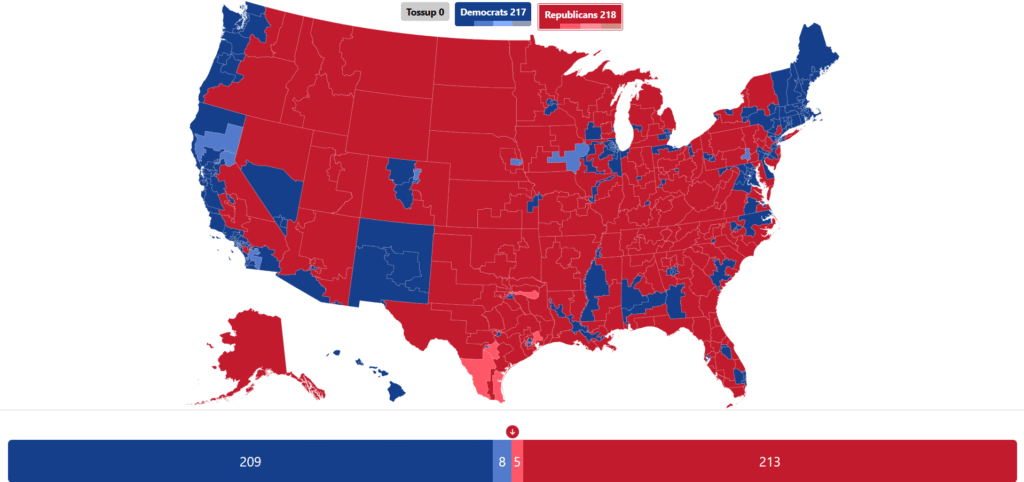
Map 2 (above) shows how our estimates play out. Democrats flip four seats across Colorado, Iowa, Nebraska, and Pennsylvania, while they net four from the California redraw. That is mirrored by a gain of five seats by the GOP in Texas. Again, this assumes both parties run the table in gerrymandered seats. The hypothetical end result is a net gain of three for the Democrats, giving Republicans the absolute bare-minimum majority of 218. In this case, Democrats would need to pick off one more seat in order to flip control of the chamber, and there are plenty of options available.
This shows that the California redraw is a pathway for Democrats to restore their floor ahead of the midterms, and if they can flip CA-22, they would find that fourth seat needed to flip the chamber to themselves.
What About Gerrymandering in Other States?
This is where Republicans have the upper hand. They’re already working on a redraw in Missouri, which would give them one more seat. Indiana and South Carolina are rumored to have redraws in the works; each of those states would net the GOP one seat. Ohio already had redistricting on the schedule, wherein Republicans could draw an aggressive gerrymander to knock out two or even three Democratic seats, while Utah’s map must be redrawn on a court order. The conventional wisdom, as of now, is that Salt Lake City might be contained in a heavily blue district, effectively giving the Democrats another seat without much leg work.
Republicans have more options to pad their runtime if California gerrymanders. But where do Democrats go?
There are talks of Maryland axing the red MD-01, the sole Republican-held seat in the Old Line State, as well as rumors of Washington state carving up the Spokane-based WA-05, but the party has contended both seats would be uphill battles in the eyes of the courts. Maryland Democrats tried to make MD-01 much bluer in 2021, but the map was overturned.
Other than that, it’s difficult to see where Democrats could further gerrymander their way into a majority.

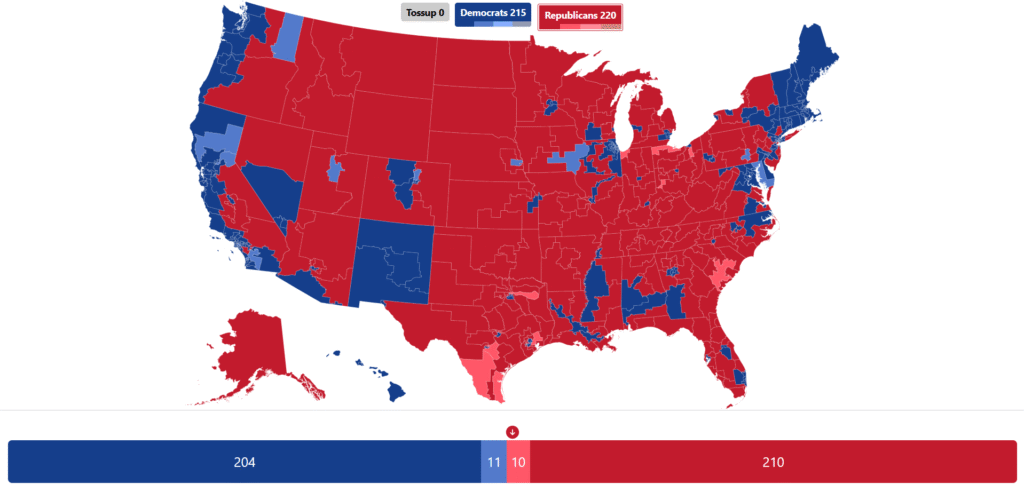
Map 3 (above) puts all of these moving parts into play, with the GOP netting the Gary-based IN-01, the Kansas City-based MO-05, the Columbia-based SC-06, the Cincinnati-based OH-01, the Toledo-based OH-09, and the Akron-based OH-13. It also shows Democrats netting a hypothetical SLC-based UT-04, as well WA-05 and MD-01 if those state legislatures were able to cook up more seats.
The end result is a 220R-215D House – exactly where the current quorum lies with vacancies not considered.
Disclaimer
This is a preliminary forecast and the national environment likely isn’t near what it will be next summer. There are plenty more seats that both parties could flip, but this shows what the current environment is more or less indicating.